
Many English learners get confused when they hear sentences like “The meeting is brought forward” or “The meeting is pushed back.”
At first, both sound like they might mean the same thing. Even native speakers sometimes pause for a second to think about the direction of time in these phrases.
The confusion happens because we mix physical movement with time. In real life, “forward” usually means ahead, and “back” means behind.
But when we talk about time and schedules, English behaves in a different way. That is where learners get stuck.
These phrases are very common in offices, schools, online meetings, and daily planning.
If you don’t understand them properly, you may come late to a meeting or miss an important event. That is why learning the correct meaning is very useful for real communication.
After reading this article, you will clearly understand what each phrase means, how they are different, and how to use them correctly in real-life situations.
You will also learn simple grammar rules, common mistakes, and an easy trick to remember everything without stress.
By the end, these expressions will feel natural and easy for you.
What Does “Brought Forward” Mean?
“Brought forward” is a phrase used when an event or meeting is moved to an earlier time or earlier date. It means something happens sooner than planned.
Simple Definition:
To “bring forward” means to move something to an earlier time.
When to Use It:
We use it when a meeting, appointment, exam, or event is scheduled before its original time.
Grammar Rule:
- It is usually used in passive form: is/was brought forward
- It shows change in schedule
Example Sentences:
- The meeting is brought forward to Monday.
- The exam was brought forward by two days.
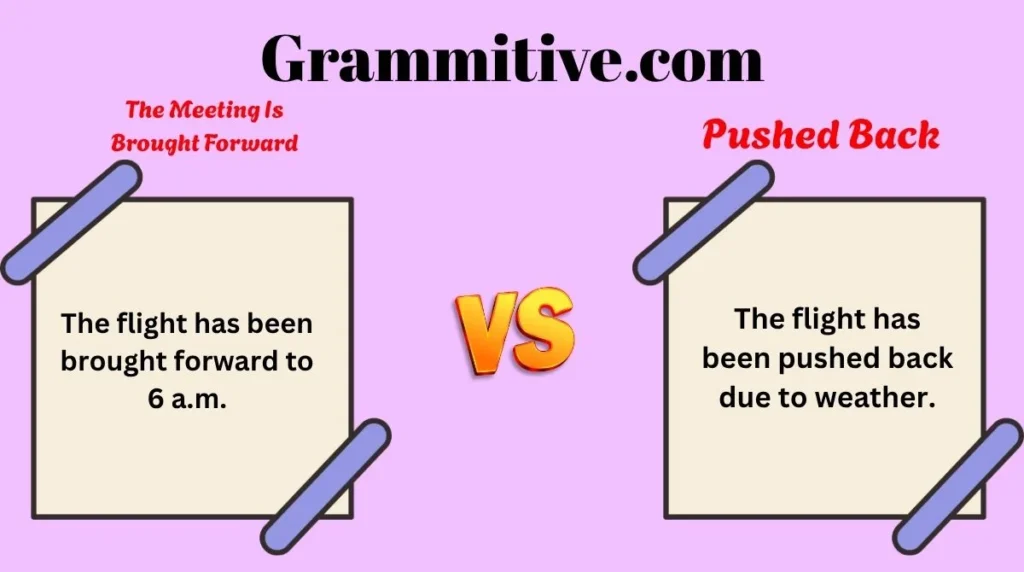
- The flight has been brought forward to 6 a.m.
- The class is brought forward because of the holiday.
- The interview was brought forward to this week.
- The deadline is brought forward due to urgent work.
- The conference was brought forward after planning changes.
- The appointment is brought forward to tomorrow.
Common Learner Confusion:
Many learners think “forward” means later because in daily life we think forward is “future.” But in scheduling, “forward” means earlier in time. This is the key idea to remember.
What Does “Pushed Back” Mean?
“Pushed back” means moving an event or meeting to a later time or later date. It shows delay.
Simple Definition:
To “push back” means to move something to a later time.
When to Use It:
We use it when something is delayed, postponed, or rescheduled for later than planned.
Grammar Rule:
- It is also used in passive form: is/was pushed back
- It shows delay or postponement
Example Sentences:
- The meeting is pushed back to Friday.
- The exam was pushed back by one week.
- The flight has been pushed back due to weather.
- The event is pushed back to next month.
- The class was pushed back because of rain.
- The deadline is pushed back to allow more time.
- The interview was pushed back to next Monday.
- The concert is pushed back because of technical issues.
Common Learner Confusion:
Learners sometimes think “back” means physically going backward in space, not time. But here it clearly means moving to a later date.
Difference Between “Brought Forward” and “Pushed Back” (Detailed)
These two phrases look similar but they have opposite meanings in time.
Comparison Table:
| Feature | Brought Forward | Pushed Back |
|---|---|---|
| Meaning | Earlier time | Later time |
| Direction in time | Moves forward in schedule (sooner) | Moves backward in schedule (later) |
| Result | Less waiting time | More waiting time |
| Usage | Event happens earlier | Event happens later |
| Tone | Sometimes positive (happens sooner) | Sometimes negative (delay) |
Usage Difference:
- “Brought forward” is used when something is planned earlier than expected.
- “Pushed back” is used when something is delayed.
Grammar Logic:
Both phrases use passive structure:
- is/was + brought forward
- is/was + pushed back
Sentence Structure Difference:
There is no major structural difference. The only change is the verb phrase that changes meaning completely.
Meaning Comparison:
- Brought forward = earlier
- Pushed back = later
Simple as that. But the tricky part is remembering direction in time, not physical space.
Grammar Rules You Must Remember
Rule #1: Always Use Passive Form
We do not usually say “We bring forward the meeting” in daily spoken English. Instead:
- The meeting is brought forward.
- The meeting is pushed back.
Rule #2: Time Always Changes, Not Object
We are not physically moving things. We are changing schedules.
- Wrong: I pushed the meeting back physically.
- Correct: The meeting was pushed back.
Rule #3: Add Time Reference for Clarity
Always mention new time or date.
- The meeting is brought forward to 3 p.m.
- The meeting is pushed back to next week.
Rule #4: Both Work for Any Event
You can use these phrases for:
- Meetings
- Exams
- Flights
- Deadlines
- Events
- Appointments
Example:
- The exam was brought forward.
- The exam was pushed back.
Common Mistakes Students Make
Many students mix these phrases because of translation from their native language.
Mistake #1: Confusing Forward with Future
❌ Wrong: The meeting is brought forward means later
✔ Correct: It means earlier
Mistake #2: Forgetting Passive Form
❌ Wrong: They bring forward the meeting
✔ Correct: The meeting is brought forward
Mistake #3: Mixing Up Directions
❌ Wrong: The meeting is pushed forward (incorrect in this meaning)
✔ Correct: The meeting is pushed back
Mistake #4: Not Mentioning New Time
❌ Wrong: The meeting is brought forward
✔ Correct: The meeting is brought forward to 2 p.m.
Why These Mistakes Happen:
- Direct translation from native language
- Confusion between space and time direction
- Lack of real-life practice
Easy Correction Tip:
Always ask yourself:
- “Is it earlier or later?”
That will guide your choice.
Easy Trick to Remember the Difference
Here is a very simple trick students love:
👉 Think of a calendar on a table.
- If you move it toward today → it is brought forward (earlier)
- If you move it away from today → it is pushed back (later)
Another trick:
- Forward = faster, sooner
- Back = delay, wait
Imagine:
- You are excited → bring it forward
- You are busy → push it back
This emotional connection helps memory stay strong.
Daily Life Examples (Very Important)
Here are real spoken English examples you may hear every day:
- The meeting is brought forward to 10 a.m., so be ready early.
- Our class is pushed back because the teacher is not available.
- The interview has been brought forward to today afternoon.
- The movie show is pushed back due to technical issues.
- The deadline is brought forward, so submit your work early.
- The trip is pushed back because of bad weather.
- The school meeting is brought forward to tomorrow morning.
- The event is pushed back to next weekend.
- My appointment was brought forward by one hour.
- The seminar is pushed back until further notice.
These are natural sentences used in offices, schools, and daily conversations.
Practice Section
Choose the correct option:
- The meeting is ____ to 3 p.m.
a) brought forward
b) pushed back - The exam was ____ by two days.
a) brought forward
b) pushed back - The event is ____ to next week.
a) brought forward
b) pushed back - The deadline has been ____.
a) brought forward
b) pushed back - The class is ____ due to holiday.
a) brought forward
b) pushed back
Answers:
- a) brought forward
- b) pushed back
- b) pushed back
- a) brought forward
- a) brought forward
FAQs
1. What is the difference between “brought forward” and “pushed back”?
“Brought forward” means earlier time, while “pushed back” means later time. They are opposite in meaning.
2. Can we use these phrases in spoken English?
Yes, both are very common in spoken English, especially in offices, schools, and meetings.
3. Is “brought forward” formal or informal?
It is slightly formal but used in both spoken and written English.
4. Is “pushed back” formal or informal?
It is neutral. You can use it in formal and informal situations.
5. Can we say “move forward” instead of “brought forward”?
Sometimes yes, but “brought forward” is more natural in scheduling.
6. Why do people confuse these phrases?
Because learners mix physical direction (forward/back) with time direction, which is opposite in meaning.
Final Conclusion
Understanding the difference between “brought forward” and “pushed back” is very important for clear communication in English.
Both phrases are common in daily life, especially when talking about plans, meetings, exams, or events.
The key idea is simple: one means earlier, and the other means later. Once you remember this basic rule, you will never feel confused again.
Try to practice with real-life examples and notice how people use these expressions in conversations, emails, and announcements.
Don’t rush. Take your time to repeat the examples and use them in your own sentences.
With a little practice, these phrases will become natural in your speaking and writing. English becomes easy when you understand logic, not just memorization.

I am Lucas Bennett, a digital content creator passionate about social media trends and online growth strategies.
I share practical insights and guides to help users better understand and navigate the digital world.