
Many English learners get confused when they hear phrases like “on lunch” and “at lunch.”
They look similar, but native speakers do not always use them in the same way.
Sometimes both sound okay in conversation, but in grammar, only one is fully correct in most situations.
This confusion happens because English prepositions like on, at, in do not always follow simple logic.
In some languages, one word can express everything, but in English, small changes can change the meaning completely. That is why learners often mix them up.
This topic is very important for daily English communication. You may hear people talking about lunch at school, office, or work.
You might also need to ask questions like when someone is free or what they are doing during their break.
If you use the wrong preposition, your sentence may sound unnatural or unclear.
After reading this guide, you will clearly understand:
- When to use “at lunch”
- When (and if) “on lunch” is correct
- The grammar behind both phrases
- Real-life examples from daily English
- Simple tricks to never confuse them again
By the end, you will feel more confident using lunch-related expressions in speaking and writing.
4️⃣ What Does “At Lunch” Mean?
Simple Definition
“At lunch” means someone is eating lunch or taking their lunch break. It refers to the time when a person is having lunch.
When to Use It
Use “at lunch” when you want to describe:
- The act of eating lunch
- Being in the lunch break time
- Someone’s activity during lunch
Grammar Rule
We use “at” to talk about a specific time or period of the day. Lunch is considered a meal-time period, so we use “at lunch.”
Example Sentences
- I was at lunch when you called me.
- She is at lunch right now.
- We talked about the project at lunch.
- My teacher is at lunch, please wait.
- He met his friend at lunch yesterday.
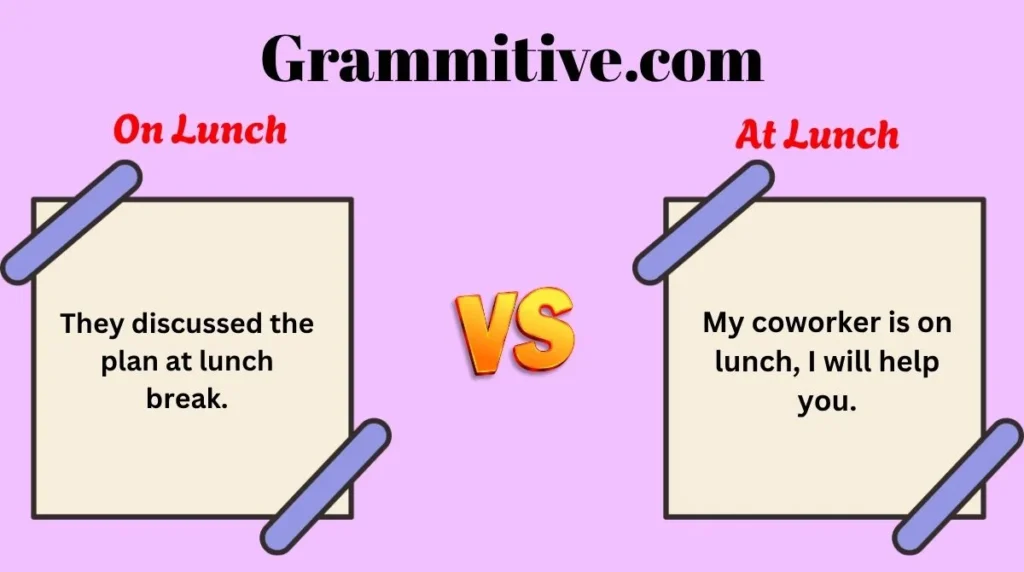
- They discussed the plan at lunch break.
- I cannot answer because I am at lunch.
- The manager is busy at lunch.
Common Learner Confusion
Many students think “at lunch” means a place, but it is not a place. It is a time/activity. That is why we do not say “I am on lunch” in formal grammar. Instead, “at lunch” is the correct and natural form.
5️⃣ What Does “On Lunch” Mean?
Simple Definition
“On lunch” is not standard grammar in formal English. However, it is sometimes used in informal American English as a short form of “on my lunch break.”
When to Use It
You may hear “on lunch” in:
- Casual workplace conversations (mainly US English)
- Quick spoken English
- Informal texting or chatting
Example meaning:
👉 “I am on lunch” = I am on my lunch break
Grammar Rule
Normally, we use:
- on a break
- on vacation
- on leave
So, in informal speech, people sometimes shorten “on my lunch break” to “on lunch.”
Example Sentences
- I am on lunch right now, call me later.
- She went on lunch 10 minutes ago.
- He is on lunch break, not available.
- We are on lunch, please wait outside.
- My coworker is on lunch, I will help you.
- Sorry, I’m on lunch, I’ll reply soon.
- They are all on lunch at the moment.
Common Learner Confusion
Students often think “on lunch” is correct in all English. But in formal writing, exams, or professional communication, it is better to avoid it. Instead, use “at lunch” or “on my lunch break.”
6️⃣ Difference Between “At Lunch” and “On Lunch” (Detailed)
Comparison Table
| Feature | At Lunch | On Lunch |
|---|---|---|
| Grammar Type | Standard English | Informal English |
| Meaning | Eating lunch / lunch time | On lunch break |
| Usage | Formal & informal | Mostly informal |
| Correctness | Always correct | Not always correct |
| Spoken Use | Very common | Casual workplace speech |
| Written Use | Yes | Avoid in formal writing |
Usage Difference
- At lunch = describes the moment of eating or lunch time activity
- On lunch = short informal way of saying “on lunch break”
Grammar Logic
English prepositions follow patterns:
- at + time (at 5 PM, at lunch)
- on + days/events (on Monday, on holiday)
So, “at lunch” fits the natural rule of time expressions. “On lunch” does not follow standard grammar rules.
Sentence Structure Difference
✔ Correct:
- I am at lunch.
- She was at lunch when I arrived.
⚠ Informal:
- I am on lunch.
- He is on lunch break.
Meaning Comparison
Even though both can point to the same situation, the tone is different:
- “At lunch” = natural, correct, neutral
- “On lunch” = short, casual, workplace slang
7️⃣ Grammar Rules You Must Remember
Rule #1: Use “at lunch” for meal time
- I was at lunch when you called.
Rule #2: “At” is used for time expressions
- at noon, at night, at lunch
Rule #3: Use “on lunch break” in formal clarity
- He is on his lunch break, not available.
Rule #4: Avoid “on lunch” in formal writing
- ❌ I am on lunch. (formal writing)
- ✔ I am at lunch / I am on my lunch break.
8️⃣ Common Mistakes Students Make
Mistake #1: Using “on lunch” in exams
Students often write:
❌ I am on lunch now.
Correct:
✔ I am at lunch now.
Mistake #2: Thinking “on lunch” is always correct
Many learners hear native speakers say it and copy it without understanding context.
Mistake #3: Confusing “at lunch” with location
❌ I am at lunch table (wrong meaning confusion)
✔ I am at lunch. (correct meaning = eating lunch)
Why these mistakes happen
- Influence of spoken English
- Lack of preposition rules
- Mixing informal and formal usage
Easy Fix Tips
- Remember: at lunch = correct grammar
- Think: at = time
- Use full phrase: on lunch break if unsure
9️⃣ Easy Trick to Remember the Difference
Think like this:
👉 “AT = Activity time”
👉 “ON = Full phrase needed”
So:
- You are at lunch (simple and correct)
- You are on your lunch break (complete idea)
If you only say “on lunch,” it feels incomplete in grammar.
🔟 Daily Life Examples (Very Important)
- I will talk to you after I am at lunch.
- She is not in the office; she is at lunch.
- We usually discuss work at lunch.
- My boss is at lunch, please wait.
- I saw him at lunch yesterday.
- Are you at lunch right now?
- He cannot answer because he is on his lunch break.
- They always meet friends at lunch.
- I met my colleague at lunch time.
- Sorry, I am at lunch, I will call back later.
1️⃣1️⃣ Practice Section
Choose the correct option:
- I am ___ right now.
a) on lunch
b) at lunch - She is ___ break.
a) on lunch
b) at lunch - We met ___ yesterday.
a) at lunch
b) on lunch - He is ___ and cannot answer.
a) at lunch
b) on lunch - They were talking ___ time.
a) at lunch
b) on lunch
Answers:
- b) at lunch
- a) on lunch (on lunch break is implied)
- a) at lunch
- a) at lunch
- a) at lunch
1️⃣2️⃣ FAQs
1. What is the difference between at lunch and on lunch?
“At lunch” is correct grammar for eating lunch. “On lunch” is informal and short for “on lunch break.”
2. Is on lunch correct English?
It is not correct in formal English. It is only used in casual workplace speech, mostly in American English.
3. Can we use at lunch in exams?
Yes, “at lunch” is the correct and safe form for exams, writing, and formal communication.
4. Is on lunch formal or informal?
“On lunch” is informal. It is used in spoken English or quick messaging only.
5. What is the correct full form of on lunch?
The full correct form is “on my lunch break.”
6. Why do people say on lunch?
People shorten sentences in casual speech to save time. That is why “on lunch break” becomes “on lunch.”
1️⃣3️⃣ Final Conclusion
Understanding the difference between “at lunch” and “on lunch” helps you speak English more naturally and confidently.
Even though both expressions are used in daily life, they are not equal in grammar.
“At lunch” is the correct and standard expression. It clearly shows that someone is eating or taking a lunch break. It works in both formal and informal situations.
On the other hand, “on lunch” is mostly informal and comes from shortening “on lunch break.”
It is common in workplace conversations but should be avoided in writing and exams.
The key idea is simple: use “at lunch” when you are unsure. It will always be correct. If you hear “on lunch,” just remember it is casual speech, not strict grammar.
With practice and real-life examples, you will naturally start using these phrases correctly. Keep noticing how native speakers use them, and soon it will become easy for you too.

I am Lucas Bennett, a digital content creator passionate about social media trends and online growth strategies.
I share practical insights and guides to help users better understand and navigate the digital world.