
Many English learners get confused when they have to choose between “ate” and “eaten.”
These two words look similar, but they are used in very different situations. Because both come from the verb “eat,” students often mix them in speaking and writing.
In daily English, we use “eat” in three forms: eat, ate, and eaten.
The problem starts when learners do not understand when to use the past simple form and when to use the past participle form.
As a result, sentences like “I have ate breakfast” or “I eaten rice” become common mistakes.
This topic is very important because “eat” is one of the most common verbs in English. We use it every day while talking about food, meals, habits, and experiences.
If you learn the correct difference between “ate” and “eaten,” your English will instantly sound more natural and correct.
After reading this guide, you will clearly understand:
- When to use “ate”
- When to use “eaten”
- How both forms work in real English sentences
- Easy tricks to never mix them again
Let’s make this confusion simple forever.
4️⃣ What Does “Ate” Mean?
“Ate” is the past simple form of the verb “eat.”
✔ Simple Meaning:
We use “ate” when something happened in the past and is already finished.
✔ When to Use:
Use “ate” when:
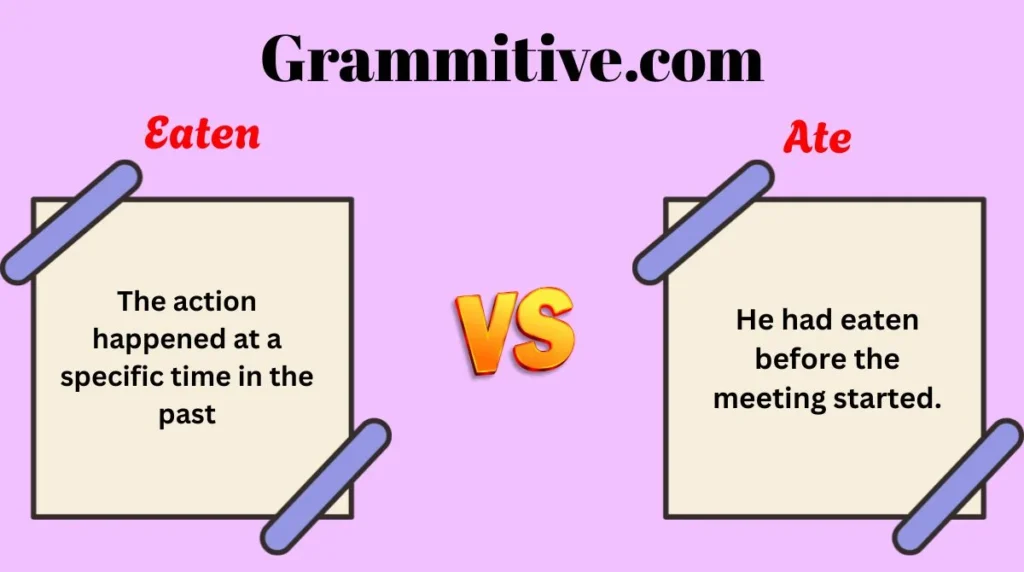
- The action happened at a specific time in the past
- There is no helping verb like “have/has”
- You are telling a simple past story
✔ Grammar Rule:
Subject + ate + object
✔ Example Sentences:
- I ate an apple yesterday.
- She ate pizza last night.
- They ate lunch at 2 PM.
- We ate at a new restaurant.
- He ate too much food at the party.
- My brother ate rice for dinner.
- The baby ate slowly.
- I ate breakfast early today.
✔ Common Learner Confusion:
Many students try to use “ate” with helping verbs like:
- ❌ I have ate breakfast.
- ✔ I have eaten breakfast.
Remember: “ate” never goes with has/have/had.
5️⃣ What Does “Eaten” Mean?
“Eaten” is the past participle form of “eat.”
✔ Simple Meaning:
We use “eaten” when talking about completed actions with helping verbs like have, has, or had.
✔ When to Use:
Use “eaten” in:
- Present perfect tense (have/has + eaten)
- Past perfect tense (had + eaten)
- Passive voice (rare for this verb in daily use)
✔ Grammar Rule:
- has/have + eaten
- had + eaten
✔ Example Sentences:
- I have eaten breakfast.
- She has eaten lunch already.
- They have eaten all the food.
- We have eaten here before.
- He had eaten before the meeting started.
- I have never eaten sushi.
- The cake has been eaten.
- She had already eaten when I arrived.
✔ Common Learner Confusion:
Students often say:
- ❌ I have ate dinner.
- ✔ I have eaten dinner.
Rule is simple: After have/has/had, always use “eaten.”
6️⃣ Difference Between “Ate” and “Eaten” (Detailed)
Understanding the difference becomes easy when you see them side by side.
✔ Comparison Table
| Feature | Ate | Eaten |
|---|---|---|
| Verb form | Past simple | Past participle |
| Helping verb | No | Yes (have/has/had) |
| Time reference | Specific past time | General past or experience |
| Usage | Simple sentences | Perfect tenses |
| Example | I ate food | I have eaten food |
✔ Usage Difference
- Ate → Used alone for finished past actions
- Eaten → Used with helping verbs for completed or connected actions
✔ Grammar Logic
English verbs change form depending on time and structure:
- Present: I eat rice.
- Past: I ate rice.
- Perfect: I have eaten rice.
So:
- “Ate” = direct past action
- “Eaten” = action linked to present or past result
✔ Sentence Structure Difference
- Ate → Subject + ate + object
- Eaten → Subject + have/has/had + eaten + object
✔ Meaning Comparison
Both words talk about eating, but:
- “Ate” tells when it happened
- “Eaten” tells completion or experience
7️⃣ Grammar Rules You Must Remember
✔ Rule #1:
Use “ate” for simple past actions.
- I ate noodles yesterday.
✔ Rule #2:
Use “eaten” after has/have/had.
- She has eaten breakfast.
✔ Rule #3:
Never mix both forms together.
- ❌ I have ate food.
- ✔ I have eaten food.
✔ Rule #4:
Use “ate” when time is mentioned clearly.
- I ate lunch at 1 PM.
8️⃣ Common Mistakes Students Make
Many learners mix these forms because they translate directly from their native language.
✔ Mistake 1:
- ❌ I have ate dinner.
- ✔ I have eaten dinner.
👉 Reason: Forgetting past participle rule.
✔ Mistake 2:
- ❌ She eaten rice yesterday.
- ✔ She ate rice yesterday.
👉 Reason: Missing helping verb.
✔ Mistake 3:
- ❌ They have ate already.
- ✔ They have eaten already.
✔ Easy Fix Tip:
Always ask:
- Is there a helping verb? → Use “eaten”
- No helping verb? → Use “ate”
9️⃣ Easy Trick to Remember the Difference
Here is a very simple trick:
👉 Think like this:
- Ate = Alone Action (past is finished)
- Eaten = Helper Verb Needed (have/has/had)
Or even easier:
👉 If you can say “yesterday,” use ate
👉 If you say “have/has,” use eaten
Example:
- Yesterday I ate rice ✔
- I have eaten rice ✔
🔟 Daily Life Examples (Very Important)
Here are natural spoken English examples:
- I ate breakfast at 8 AM.
- Have you eaten lunch yet?
- She ate too fast today.
- We have eaten at that cafe before.
- He ate all the biscuits.
- I have already eaten dinner.
- They ate together after work.
- I have never eaten spicy food.
- My friend ate my sandwich.
- We had eaten before the movie started.
1️⃣1️⃣ Practice Section
Choose the correct option:
- I have (ate / eaten) breakfast.
- She (ate / eaten) pizza yesterday.
- They have (ate / eaten) all food.
- He (ate / eaten) lunch at 2 PM.
- We have (ate / eaten) here before.
✔ Answers:
- eaten
- ate
- eaten
- ate
- eaten
1️⃣2️⃣ FAQs
✔ 1. What is the difference between ate and eaten?
“Ate” is past simple, while “eaten” is past participle used with has/have/had. Both come from the verb “eat,” but their usage is different in grammar.
✔ 2. Can we use eaten in past simple tense?
No, “eaten” is not used alone in past simple. You must use “ate” for simple past sentences.
✔ 3. Is ate formal or informal?
“Ate” is neutral and used in both formal and informal English when talking about past actions.
✔ 4. Can we use eaten in questions?
Yes, but with helping verbs:
- Have you eaten lunch?
- Has she eaten yet?
✔ 5. Why do students confuse ate and eaten?
Because both come from the same verb “eat,” and learners forget that English changes verbs based on tense and structure.
✔ 6. Which is more common in daily English?
Both are common. “Ate” is used for storytelling, while “eaten” is very common in conversation with “have/has.”
1️⃣3️⃣ Final Conclusion
The difference between “ate” and “eaten” becomes simple when you understand their roles in English grammar.
“Ate” is used for completed past actions without helping verbs, while “eaten” is used with has, have, or had to show completed actions or experiences.
Many learners make mistakes because they try to use both forms in the same way, but English grammar always depends on sentence structure.
Once you remember the simple rule—“ate for past, eaten for perfect tenses”—your sentences will become much more natural.
Keep practicing with real-life examples like food, meals, and daily routines. The more you use these words, the easier they become.
With time, you will automatically choose the correct form without thinking.
English improves step by step, and mastering small grammar points like this builds strong confidence in speaking and writing.

I am Lucas Bennett, a digital content creator passionate about social media trends and online growth strategies.
I share practical insights and guides to help users better understand and navigate the digital world.