

But in real English, these two phrases are not always interchangeable. The small change of one word can slightly change the meaning of the sentence.
That is why learners feel confused.
This topic is very important because we use these phrases in daily life all the time. We talk about school, work, relationships, projects, hobbies, and even problems using “involved with” or “involved in.”
If you use them incorrectly, your sentence may sound unnatural to native speakers.
After reading this guide, you will clearly understand:
- When to use “involved in”
- When to use “involved with”
- How their meanings are different
- Easy rules to never forget the difference
- Real-life examples that sound natural
Everything is explained in very simple English so that beginners and non-native speakers can easily understand. No complex grammar terms.
Just clear, practical learning that you can use in real conversations right away.
4️⃣ What Does “Involved with” Mean?
Simple Definition
The phrase “involved with” is used when you are connected to a person, group, or relationship. It often shows a personal or emotional connection.
When to Use It
Use “involved with” when talking about:
- Relationships (romantic or personal)
- People or groups
- Emotional or social connections
- Sometimes informal activities
Grammar Rule
involved with + person / group / organization
Example Sentences
- He is involved with a new friend group.
- She is involved with a kind man from her office.
- I don’t want to be involved with bad people.
- They are involved with a charity organization.
- Are you still involved with her?
- He became involved with a local community group.
- She is deeply involved with her church activities.
- I got involved with the wrong crowd.
Common Learner Confusion
Many students think “involved with” is just like “involved in.” But “with” focuses more on people and relationships, not actions or tasks. So if you are talking about a project or work activity, “with” is usually not correct.
5️⃣ What Does “Involved in” Mean?
Simple Definition
The phrase “involved in” is used when someone is part of an activity, task, situation, or event.
When to Use It
Use “involved in” when talking about:
- Work or projects
- Activities or studies
- Situations or problems
- Events or actions
Grammar Rule
involved in + activity / situation / process
Example Sentences
- She is involved in a school project.
- He is involved in business work.
- I am not involved in this problem.
- They are involved in a new research study.
- We are involved in planning the event.
- The police are involved in the investigation.
- She became involved in sports at a young age.
- He is involved in many online courses.
Common Learner Confusion
Students often say “involved with a project,” but that is incorrect in most cases. A project is an activity, so the correct phrase is “involved in a project.”
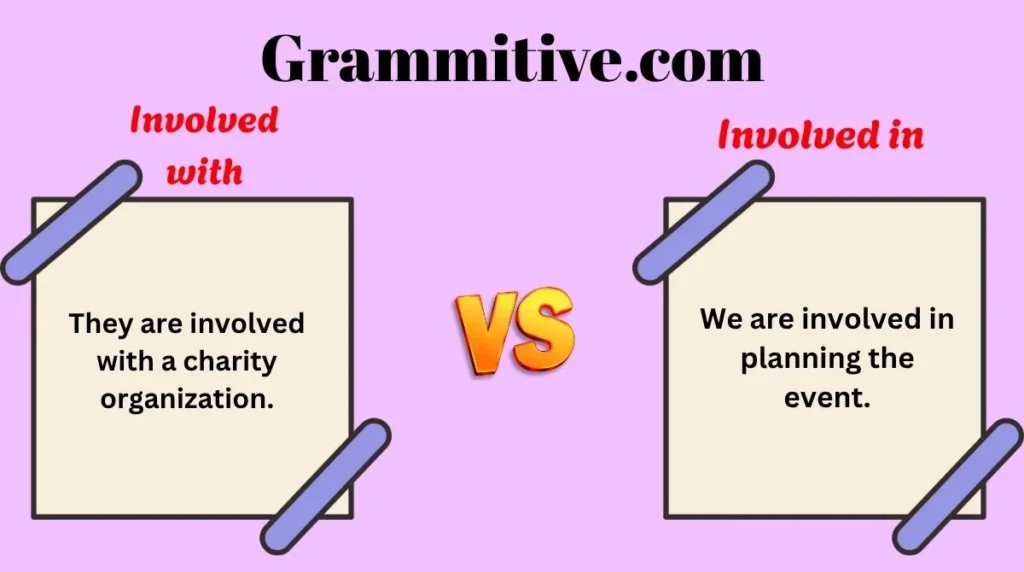
6️⃣ Difference Between “Involved with” and “Involved in” (Detailed)
The difference is actually simple once you understand the idea behind each phrase.
- “Involved with” = people or relationships
- “Involved in” = actions, work, or situations
Comparison Table
| Feature | Involved with | Involved in |
|---|---|---|
| Meaning | Connection with people | Participation in activities |
| Focus | Relationship | Action or task |
| Usage | Social or personal | Work or events |
| Example | involved with a friend group | involved in a project |
| Tone | More personal | More formal or neutral |
Usage Difference
If you are talking about a person or group, use “with.”
If you are talking about something you do, use “in.”
Grammar Logic
Think of it like this:
- “With” = who you are connected to
- “In” = what you are part of
Sentence Structure Difference
- He is involved with Maria. (person)
- He is involved in marketing work. (activity)
Meaning Comparison
Even if both phrases use “involved,” the meaning changes depending on the preposition. That small word (with/in) decides the direction of meaning.
7️⃣ Grammar Rules You Must Remember
Rule #1: Use “involved in” for activities
- She is involved in teaching English.
Rule #2: Use “involved with” for people
- He is involved with his classmates.
Rule #3: Do not mix both randomly
- ❌ She is involved with a project.
- ✔ She is involved in a project.
Rule #4: Context decides meaning
- He is involved with a company (relationship/connection)
- He is involved in company work (activity/job role)
8️⃣ Common Mistakes Students Make
Mistake 1: Using “with” for everything
Many learners say:
- ❌ I am involved with homework.
Correct:
- ✔ I am involved in homework.
Mistake 2: Confusing people vs work
- ❌ She is involved in her friend.
- ✔ She is involved with her friend.
Mistake 3: Overthinking the phrase
Students try to translate from their native language. This causes errors.
Why These Mistakes Happen
- Lack of exposure to real English
- Mixing prepositions
- Learning rules without context
Easy Fix Tips
- Always ask: “Is it a person or an activity?”
- Practice with real-life sentences
- Read simple English conversations
9️⃣ Easy Trick to Remember the Difference
Here is a very simple trick:
👉 “WITH = WHO”
👉 “IN = ACTION”
Think:
- “With” connects you to people
- “In” puts you inside a task or activity
Real-Life Logic
If you are sitting with friends, it is social.
If you are sitting in a meeting, it is an activity.
This simple idea helps you choose the correct phrase instantly.

🔟 Daily Life Examples (Very Important)
Here are natural spoken English examples:
- I am involved with my school friends.
- She is involved in cooking classes.
- He is involved with his business partner.
- They are involved in a big project.
- I don’t want to be involved in drama.
- She is involved with a kind family.
- He is involved in football practice.
- We are involved in organizing the trip.
- I got involved with a study group.
- They are involved in solving the issue.
1️⃣1️⃣ Practice Section
Choose the correct option:
- She is involved ___ a school project.
- He is involved ___ his new friends.
- They are involved ___ business work.
- I am involved ___ a charity group.
- She is involved ___ sports training.
Answers:
- in
- with
- in
- with
- in
1️⃣2️⃣ FAQs
1. What is the difference between involved with and involved in?
“Involved with” is used for people or relationships. “Involved in” is used for activities, work, or situations.
2. Can we use “involved with” in formal English?
Yes, but it is more common in informal or social contexts. Formal writing usually prefers “involved in.”
3. Is “involved in” correct for work?
Yes, it is correct. Example: She is involved in office work.
4. Can both be used in one sentence?
Yes, but with different meanings. Example: He is involved with a team and involved in a project.
5. What is the most common mistake?
Using “with” for activities like projects or studies is the most common mistake.
6. How can I practice this grammar?
Use daily life sentences, write small notes, and practice speaking simple English conversations.
1️⃣3️⃣ Final Conclusion
Understanding the difference between “involved with” and “involved in” becomes easy once you focus on meaning instead of memorizing rules.
The key idea is simple: one connects you to people, and the other connects you to actions or activities.
Many learners get confused because both phrases look similar. But English depends heavily on small words like prepositions.
A single word can change the whole meaning of a sentence.
The best way to master this topic is practice. Try using real-life examples in your daily speech.
Think about your friends, your studies, your work, and your activities. Then decide which phrase fits the situation.
With regular practice, you will stop making mistakes naturally. Soon, choosing between “involved with” and “involved in” will become automatic.
Keep sentences simple, stay consistent, and learn through real usage. That is how natural English is built.

I am Lucas Bennett, a digital content creator passionate about social media trends and online growth strategies.
I share practical insights and guides to help users better understand and navigate the digital world.