
Many English learners get confused between coma and comma. At first, they look almost the same. Only one extra “m” changes everything.
Because of this small difference, students often mix them up in writing and speaking.
This confusion is very common, especially for beginners and non-native speakers.
You might write comma when you actually mean coma, or the other way around.
The problem is that these two words are completely different in meaning, use, and grammar. One is a medical condition, and the other is a punctuation mark.
Understanding the difference is important for everyday English. If you use the wrong word, your sentence may sound strange or even funny.
Imagine telling someone, “He is in a comma.” That would not make sense!
After reading this guide, you will clearly understand what each word means, how to use them correctly, and how to avoid common mistakes.
You will also learn simple tricks to remember the difference forever. By the end, you will feel more confident when writing and speaking English.
What Does “Coma” Mean?
Coma is a noun. It is a medical term.
A coma is a deep state of unconsciousness. A person in a coma is alive, but they cannot wake up, speak, or respond to things around them.
When to Use It
You use coma when talking about health, accidents, or serious medical conditions.
Grammar Rule
- “Coma” is a countable noun.
- You can say: a coma, the coma, in a coma.
Example Sentences
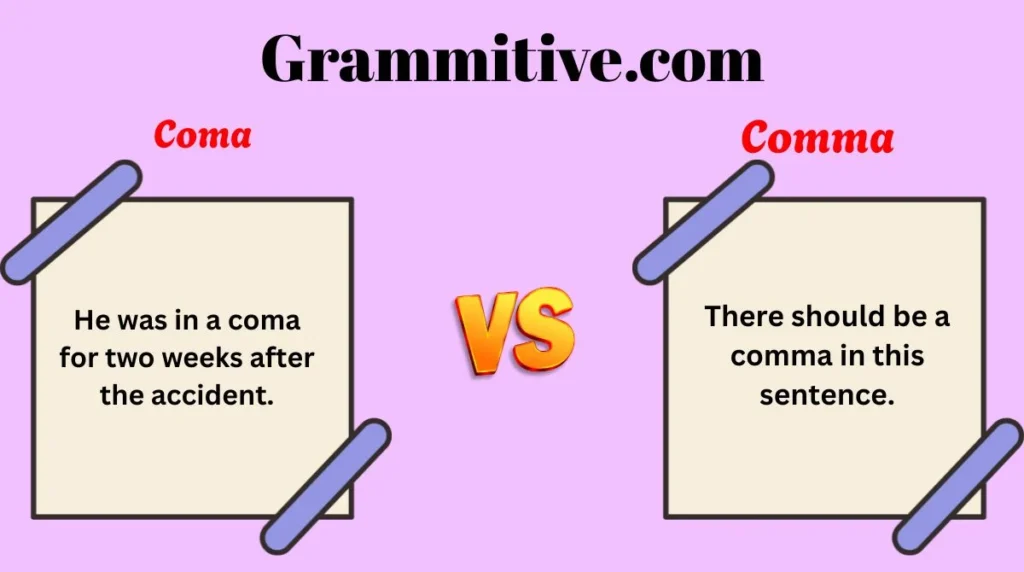
- He was in a coma for two weeks after the accident.
- The patient is still in a coma.
- She went into a coma after the surgery.
- Doctors are trying to wake him from the coma.
- He fell into a coma suddenly.
- The movie shows a man who wakes up from a coma.
- She remained in a coma for several days.
- His family stayed with him while he was in a coma.
Common Learner Confusion
Many students think coma is related to punctuation because it sounds like comma. But this is not true.
👉 Remember:
Coma = medical condition (related to the body and health)
What Does “Comma” Mean?
Comma is also a noun, but it is used in grammar and writing.
A comma is a punctuation mark (,) used to separate parts of a sentence. It helps make sentences clear and easy to read.
When to Use It
You use comma when writing sentences in English.
Grammar Rule
- “Comma” is a countable noun.
- You can say: a comma, two commas, use a comma.
Example Sentences
- Use a comma after the first word.
- There should be a comma in this sentence.
- Add a comma before “and”.
- This sentence needs two commas.
- Don’t forget the comma after the name.
- Put a comma between the items in the list.
- She forgot to use a comma.
- A comma can change the meaning of a sentence.
Common Learner Confusion
Students often misspell comma as coma because they forget the double “m”.
👉 Remember:
Comma = punctuation mark (used in writing)
Difference Between Coma and Comma (Detailed)
Understanding the difference becomes easy when you compare them side by side.
Comparison Table
| Feature | Coma | Comma |
|---|---|---|
| Meaning | Medical condition | Punctuation mark |
| Field | Health / Medicine | Grammar / Writing |
| Spelling | One “m” | Two “m”s |
| Usage | Talking about unconsciousness | Writing sentences |
| Example | He is in a coma | Use a comma here |
Usage Difference
- Coma is used in serious health situations.
- Comma is used in everyday writing.
👉 Example:
- Correct: He is in a coma.
- Correct: Add a comma after the word.
Grammar Logic
- Coma belongs to vocabulary related to health.
- Comma belongs to punctuation rules in grammar.
Sentence Structure Difference
- Coma: usually used with verbs like is, went into, fell into
- Comma: usually used with verbs like use, add, put
👉 Examples:
- She went into a coma.
- Please add a comma here.
Meaning Comparison
- Coma affects a person’s body and life
- Comma affects a sentence’s clarity and meaning
Grammar Rules You Must Remember
Rule #1: Always Check the Context
If the sentence is about health → use coma
If the sentence is about writing → use comma
✅ Example:
He is in a coma.
Use a comma in this sentence.
Rule #2: Spelling Matters
One small letter changes the meaning completely.
- coma → 1 “m”
- comma → 2 “m”
✅ Example:
Wrong: Use a coma here.
Correct: Use a comma here.
Rule #3: Use “Comma” in Lists
A comma helps separate items.
✅ Example:
I bought apples, bananas, and oranges.
Rule #4: “Coma” Is Not Used in Grammar
Never use coma when talking about punctuation.
✅ Example:
Wrong: Add a coma after this word.
Correct: Add a comma after this word.
Common Mistakes Students Make
Why Mistakes Happen
- Similar spelling
- Similar pronunciation
- Lack of attention while writing
Mistake #1: Using “coma” Instead of “comma”
❌ Wrong: Put a coma here.
✅ Correct: Put a comma here.
👉 Tip: If you are writing, it is always comma.
Mistake #2: Spelling “comma” Incorrectly
❌ Wrong: coma
✅ Correct: comma
👉 Tip: Double “m” = punctuation
Mistake #3: Using “comma” in Medical Context
❌ Wrong: He is in a comma.
✅ Correct: He is in a coma.
👉 Tip: Medical = one “m”
Easy Correction Tip
Ask yourself:
👉 “Am I talking about health or writing?”
This simple question can fix most mistakes.
Easy Trick to Remember the Difference
Here is a simple trick that works very well:
👉 Comma has two “m” letters, just like many sentences have many parts.
👉 Coma has one “m”, like one person lying still.
Another easy idea:
- Comma = writing tool
- Coma = hospital word
You can also remember:
👉 If you see a pen ✍️ → think comma
👉 If you see a hospital 🏥 → think coma
This small trick can help you remember forever.
Daily Life Examples (Very Important)
These are simple sentences you might hear in real life:
- Please add a comma in this sentence.
- I forgot to use a comma in my essay.
- My teacher told me to check my commas.
- He is still in a coma after the accident.
- The doctor said she might come out of the coma soon.
- Can you put a comma after my name?
- This sentence looks strange without a comma.
- He was in a coma for three days.
- Use a comma to make the sentence clear.
- She woke up from a coma last week.
These examples show how different the two words are in real conversations.
Practice Section
Choose the correct word: coma or comma
- He is in a ______ after the accident.
- Add a ______ after the first word.
- She woke up from a ______.
- Use a ______ to separate items.
- The patient is still in a ______.
Answers
- coma
- comma
- coma
- comma
- coma
FAQs
1. What is the difference between coma and comma?
A coma is a medical condition where a person is unconscious. A comma is a punctuation mark used in writing. They have completely different meanings.
2. Can we use comma in questions?
Yes, you can use a comma in questions. It helps separate ideas or clauses in a sentence.
3. Is “coma” used in grammar?
No, coma is not used in grammar. It is only used in medical situations.
4. Why do students confuse coma and comma?
Students confuse them because the words look and sound similar. The spelling difference is very small.
5. Is comma formal or informal?
A comma is used in both formal and informal writing. It is an important part of English grammar.
6. How can I remember the difference easily?
Remember:
- One “m” = medical (coma)
- Two “m” = punctuation (comma)
Final Conclusion
The difference between coma and comma is simple once you understand it clearly.
Even though the words look almost the same, their meanings are completely different.
One belongs to the world of medicine, and the other belongs to grammar and writing.
Small mistakes like this are normal when learning English. What matters is noticing the difference and practicing it regularly.
When you read and write more, these words will become easy to recognize.
Try to use both words in your own sentences. Check your spelling carefully, especially the number of “m” letters. Over time, you will stop making this mistake completely.
Keep practicing, stay curious, and don’t worry about small errors. Every mistake is a step toward better English.

I am Lucas Bennett, a digital content creator passionate about social media trends and online growth strategies.
I share practical insights and guides to help users better understand and navigate the digital world.