
Many English learners get confused when they see phrases like “thoughts on” and “thoughts about.”
Both look very similar, and in daily conversation, native speakers often use them without thinking much.
But for learners, this small difference can feel tricky and sometimes even stressful.
You may hear someone say, “What are your thoughts on this movie?” and also, “What are your thoughts about this movie?”
So which one is correct? Are they the same? Or is there a hidden rule that changes the meaning?
This confusion happens because English does not always follow strict one-to-one rules.
Some expressions are flexible, and prepositions like “on” and “about” can overlap in meaning.
But at the same time, there are small usage patterns that help you sound more natural and confident when speaking or writing.
After reading this guide, you will clearly understand when to use “thoughts on” and when to use “thoughts about.”
You will also learn how native speakers naturally choose between them in real life.
Simple examples, easy explanations, and practical rules will help you remember everything without stress.
By the end, you will be able to use both expressions correctly in conversations, exams, and writing.
4️⃣ What Does “Thoughts on” Mean?
“Thoughts on” is used when you want someone’s opinion or view about a specific topic. It is slightly more focused and often sounds a bit more formal or direct.
Simple Definition:
“Thoughts on” means asking or giving an opinion about something.
When to Use It:
Use “thoughts on” when:
- You want opinions about a clear topic
- You are asking feedback
- You are in a formal or semi-formal situation
Grammar Rule:
Thoughts + on + topic/idea
Example Sentences:
- What are your thoughts on this idea?
- She shared her thoughts on the new policy.
- Do you have any thoughts on my project?
- I need your thoughts on this plan.
- His thoughts on the movie were very positive.
- Students gave their thoughts on the lesson.
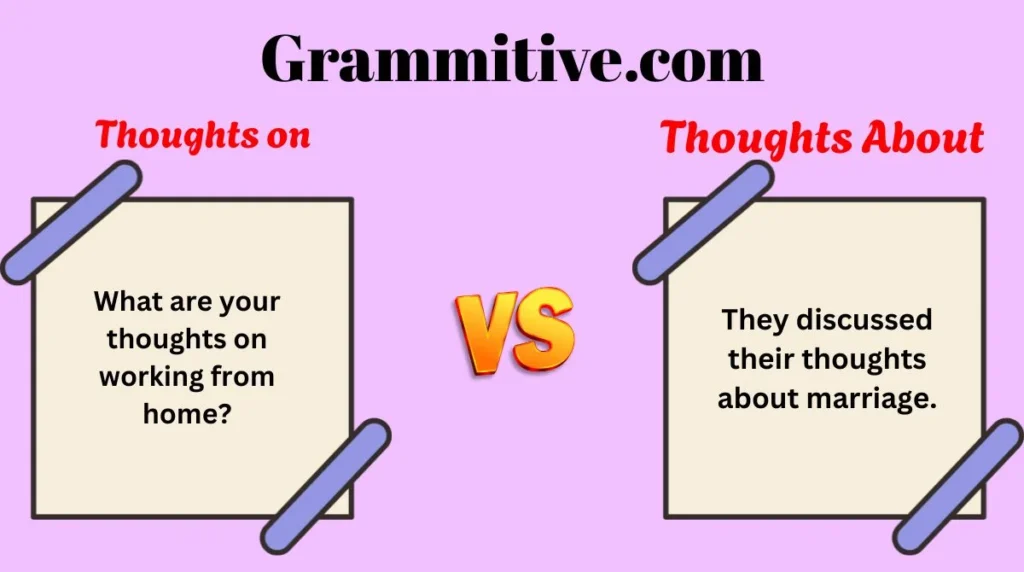
- What are your thoughts on working from home?
- The teacher asked for our thoughts on the story.
Common Learner Confusion:
Many learners think “on” means physical position only. But in English, “on” is often used for topics, like “discussion on,” “comment on,” or “thoughts on.” So here, “on” connects your opinion directly to the subject.
5️⃣ What Does “Thoughts about” Mean?
“Thoughts about” is also used to express opinions, feelings, or ideas about something. It is more general and often sounds softer or more conversational.
Simple Definition:
“Thoughts about” means what you think or feel regarding a topic.
When to Use It:
Use “thoughts about” when:
- You are speaking casually
- You are talking about general feelings or ideas
- You want a softer tone
Grammar Rule:
Thoughts + about + topic/idea
Example Sentences:
- What are your thoughts about this movie?
- I have mixed thoughts about this decision.
- She shared her thoughts about the trip.
- We talked about our thoughts about school life.
- He has strong thoughts about politics.
- My thoughts about the event are positive.
- They discussed their thoughts about marriage.
- What are your thoughts about this situation?
Common Learner Confusion:
Many students think “about” is only used for “about a topic,” like “talk about.” But it also works with “thoughts,” “feelings,” and “ideas.” It gives a more natural spoken English feel.
6️⃣ Difference Between “Thoughts on” and “Thoughts about” (Detailed)
Even though both phrases are often interchangeable, there are small differences in tone and usage.
Comparison Table:
| Feature | Thoughts on | Thoughts about |
|---|---|---|
| Tone | Slightly formal | More casual |
| Focus | Direct opinion | General feeling |
| Usage | Feedback, discussion | Conversation, reflection |
| Style | Structured | Flexible |
| Common in | Writing, meetings | Speaking, chats |
Usage Difference:
- “Thoughts on” is often used when someone wants clear feedback or structured opinion.
- “Thoughts about” is used when someone is expressing general feelings or thinking out loud.
Grammar Logic:
Both follow the same structure:
- Thoughts + on/about + noun
So the difference is not grammar error—it is mainly tone and style.
Sentence Structure Difference:
- Thoughts on: “What are your thoughts on + topic?”
- Thoughts about: “What are your thoughts about + topic?”
Both are correct, but “on” sounds slightly more professional.
Meaning Comparison:
In most cases, both mean the same thing. Native speakers use them interchangeably in daily life. The difference is very small and usually depends on personal speaking style.
7️⃣ Grammar Rules You Must Remember
Rule #1:
Use both phrases with nouns or ideas.
- Correct: Thoughts on education
- Correct: Thoughts about education
Rule #2:
Both can be used in questions.
- What are your thoughts on this?
- What are your thoughts about this?
Rule #3:
“On” feels more formal in writing.
- The report includes thoughts on climate change.
Rule #4:
“About” feels more natural in conversation.
- Let’s talk about your thoughts about the trip.
8️⃣ Common Mistakes Students Make
Mistake #1: Thinking one is wrong
Many students believe only one form is correct. But both are correct.
Wrong:
- Your thoughts on this movie are wrong (not natural belief)
Correct:
- What are your thoughts on this movie?
Mistake #2: Overthinking prepositions
Students try to memorize strict rules, but English is flexible.
Mistake #3: Using only one form always
Some learners stick only to “on” or only to “about.”
Easy Fix Tips:
- Listen to native speakers
- Read English articles
- Practice both forms in sentences
9️⃣ Easy Trick to Remember the Difference
Here is a simple trick:
- “On” = Opinion focused (like pointing a spotlight)
- “About” = General talk (like a casual chat)
If you want to sound slightly formal or clear, use “on.”
If you want to sound relaxed or natural, use “about.”
Think like this:
- “On” = serious discussion table
- “About” = friendly conversation
🔟 Daily Life Examples (Very Important)
- What are your thoughts on the new teacher?
- I have good thoughts about this restaurant.
- She asked my thoughts on her dress.
- We shared thoughts about the school trip.
- His thoughts on exams are very strong.
- What are your thoughts about this idea?
- I need your thoughts on this problem.
- They talked about their thoughts about life.
- My thoughts on this app are positive.
- Let’s discuss our thoughts about tomorrow’s plan.
1️⃣1️⃣ Practice Section
Choose the correct option:
- What are your ___ this plan?
a) thoughts on
b) thoughts about - I have good ___ this movie.
a) thoughts on
b) thoughts about - She shared her ___ the event.
a) thoughts on
b) thoughts about - Do you have any ___ this idea?
a) thoughts on
b) thoughts about - We discussed our ___ school life.
a) thoughts on
b) thoughts about
Answers:
- thoughts on
- thoughts about
- thoughts about
- thoughts on
- thoughts about
1️⃣2️⃣ FAQs
1. What is the difference between thoughts on and thoughts about?
Both are almost the same. “On” is slightly more formal, while “about” is more casual and natural in conversation.
2. Can we use thoughts on in questions?
Yes. It is very common in questions like “What are your thoughts on this issue?”
3. Is thoughts about formal or informal?
It is more informal and commonly used in spoken English, but still correct in writing.
4. Which one is more natural in speaking?
“Thoughts about” feels more natural in daily conversations.
5. Are thoughts on and thoughts about interchangeable?
Yes, in most cases they can replace each other without changing meaning.
6. Do exams accept both forms?
Yes, both are grammatically correct, so both are usually accepted.
1️⃣3️⃣ Final Conclusion
Understanding the difference between “thoughts on” and “thoughts about” becomes easy once you realize they are very close in meaning.
Both expressions are used to ask or share opinions. The only real difference is tone.
“Thoughts on” feels slightly more formal and focused, while “thoughts about” feels more natural and relaxed in everyday English.
Instead of worrying too much about strict rules, focus on how native speakers use them in real life.
With practice, your brain will automatically choose the right phrase without thinking.
Try using both expressions in your daily speaking and writing. The more you practice, the more natural your English will become.
Small grammar points like this can greatly improve your fluency and confidence over time. Keep learning step by step, and English will start to feel easier every day.

I am Lucas Bennett, a digital content creator passionate about social media trends and online growth strategies.
I share practical insights and guides to help users better understand and navigate the digital world.