

English learners often feel confused when they hear short replies like:
- “I like coffee.” — “So do I.”
- “I’m tired.” — “So am I.”
Both answers look very similar. Both start with so. Both agree with someone. But the verbs change. Sometimes we say do, sometimes am, is, or are.
This small difference causes big confusion.
Many students ask,
“Why can’t I always say so do I?”
“Why does it change?”
“Is so am I correct?”
The truth is simple once you understand the grammar pattern behind it.
These short replies are extremely common in daily English. Native speakers use them all the time in conversations, movies, and chats.
If you use the wrong one, people may still understand you, but it sounds unnatural. Learning the correct form helps your English sound smooth and confident.
By the end of this guide, you will clearly understand:
- when to use so do I
- when to use so am I
- how the grammar changes
- easy tricks to remember
- real-life examples you can copy
Everything will be explained in very simple English, like a friendly classroom lesson.
What Does “So Do I” Mean?
✅ Simple meaning
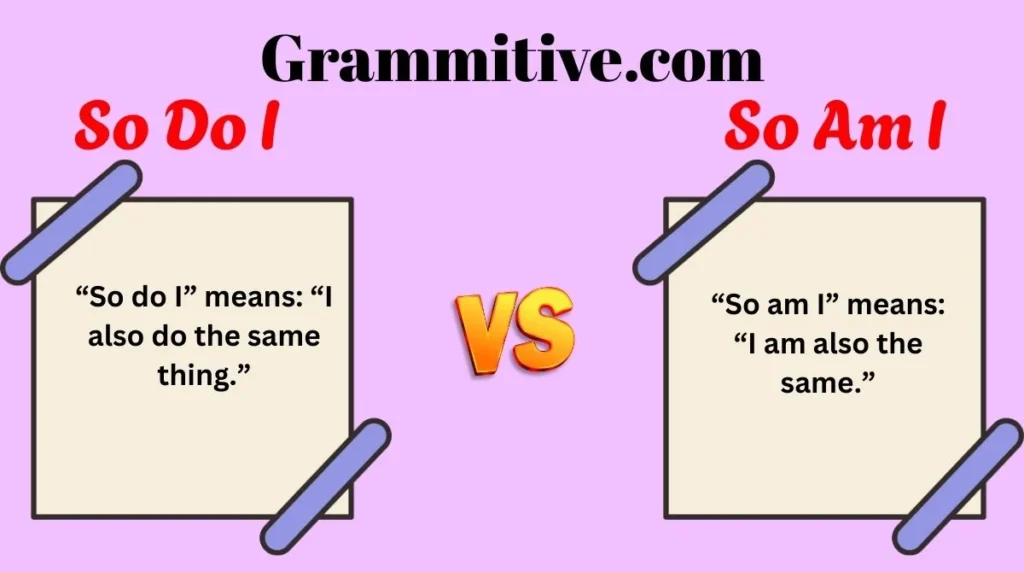
“So do I” means: “I also do the same thing.”
It shows agreement with someone.
We use it when the first sentence uses a normal action verb (like like, love, play, eat, work, study, want).
✅ When to use it
Use so + do/does/did + subject
when the sentence has present simple or past simple action verbs.
Most often, we use:
- So do I
- So does he/she
- So did I
✅ Grammar rule
Structure:
So + helping verb (do/does/did) + subject
Why “do”?
Because many English sentences in present simple use do/does as the helper.
Example:
- I like pizza.
→ So do I.
We use do to support the verb like.
✅ Example sentences (6–8)
- I love chocolate. → So do I.
- They play football every day. → So do we.
- She drinks tea in the morning. → So does he.
- I work on Sundays. → So do I.
- We watch movies at night. → So do they.
- I need help sometimes. → So do I.
- They study English online. → So do we.
- I enjoy reading books. → So do I.
Notice something important:
All these sentences use action verbs, not “be”.
⚠️ Common learner confusion
Many students say:
❌ I am happy. So do I.
This is wrong because am is not an action verb. It is the verb be.
So we cannot use do here.
We must match the verb type.
What Does “So Am I” Mean?
✅ Simple meaning
“So am I” means: “I am also the same.”
We use it when the first sentence uses the verb be (am/is/are/was/were).
This talks about:
- feelings
- states
- conditions
- identity
- descriptions
✅ When to use it
Use this pattern:
So + be verb + subject
If the sentence uses am/is/are, we repeat that same form.
✅ Grammar rule
Structure:
So + am/is/are/was/were + subject
We DO NOT use “do” here.
Because be verbs don’t need do-support.
✅ Example sentences (6–8)
- I am tired. → So am I.
- She is happy. → So am I.
- They are ready. → So are we.
- I am hungry. → So am I.
- He is late today. → So am I.
- We are busy. → So are they.
- I was nervous. → So was I.
- They were excited. → So were we.
All these sentences describe states, not actions.
⚠️ Common learner confusion
Students sometimes say:
❌ I am tired. So do I.
Wrong because tired is not an action.
We must use am.
Difference Between So Do I and So Am I (Detailed)
Understanding the difference becomes easy when you look at the grammar.
✅ Quick comparison table
| Feature | So do I | So am I |
|---|---|---|
| Verb type | Action verbs | Be verbs |
| Helper used | do/does/did | am/is/are/was/were |
| Talks about | actions/habits | feelings/states |
| Example | I like coffee | I am happy |
| Reply | So do I | So am I |
✅ Usage difference
So do I → actions
So am I → conditions or feelings
Think like this:
- Doing something → do
- Being something → be
✅ Grammar logic
English has two main patterns:
- Action verb sentences
→ need do/does/did for support - Be verb sentences
→ already have their own verb
So:
- I like tea → no helper → use DO
- I am happy → already has AM → repeat AM
✅ Sentence structure difference
Action:
I like music.
So + do + I
Be verb:
I am tired.
So + am + I
The helping verb always comes first.
✅ Meaning comparison
- So do I = I also do that action
- So am I = I also have that state/feeling
Small grammar change → big meaning difference
Grammar Rules You Must Remember
Rule #1 – Use “do” for action verbs
I watch TV. → So do I.
If you see verbs like eat, play, work, like → use do.
Rule #2 – Use “be” for feelings or states
I am sick. → So am I.
Happy, tired, busy, ready → always use be.
Rule #3 – Match the tense
Past tense must stay past.
I liked the movie. → So did I.
I was nervous. → So was I.
Don’t mix tenses.
Rule #4 – Keep the same subject order
Always:
So + verb + subject
NOT:
❌ So I do
❌ So I am
Always invert.
Common Mistakes Students Make
These mistakes happen because learners try to translate from their first language or memorize only one form.
❌ Mistake 1
I am happy. So do I.
✅ So am I.
Tip: Feeling = be verb.
❌ Mistake 2
I like pizza. So am I.
✅ So do I.
Tip: Action = do.
❌ Mistake 3
So I do.
✅ So do I.
Tip: Verb first, then subject.
❌ Mistake 4
Mixing tenses
I was tired. So am I.
✅ So was I.
Tip: Past stays past.
Easy correction tips
Ask yourself:
- Is it action or state?
- Is there a be verb?
- What tense?
Answer these, and you will choose correctly every time.
Easy Trick to Remember the Difference
Here’s a simple classroom trick students love.
🎯 Think: DO = DOING
If you can physically do it → use do.
- eat
- play
- work
- run
So → So do I
🎯 Think: AM = BEING
If it describes how you are → use am.
- tired
- happy
- sick
- ready
So → So am I
Doing → do
Being → be
That’s it.
Very simple logic.
Daily Life Examples (Very Important)
These sound exactly like real conversations.
- A: I love coffee in the morning.
B: So do I. - A: I’m really tired today.
B: So am I. - A: I watch YouTube every night.
B: So do I. - A: I’m nervous about the exam.
B: So am I. - A: I play games after work.
B: So do I. - A: I’m hungry already.
B: So am I. - A: I need more sleep.
B: So do I. - A: I’m ready to leave.
B: So am I. - A: I like this song.
B: So do I. - A: I’m bored.
B: So am I.
These are very natural and common in spoken English.
Practice Section
Choose the correct option.
Questions
- I am cold. → So ___ I.
- I like movies. → So ___ I.
- I was scared. → So ___ I.
- I eat rice every day. → So ___ I.
- I am busy today. → So ___ I.
Answers
- am
- do
- was
- do
- am
If you got 5/5, great job.
FAQs
1. What is the difference between so do I and so am I?
“So do I” agrees with actions. “So am I” agrees with feelings or states. The verb type decides which one to use.
2. Can we use these forms in questions?
No. They are short answers, not questions. For questions, say: “Do you?” or “Are you?”
3. Are these phrases formal or informal?
They are neutral. You can use them in daily speech, school, or even work conversations.
4. Can I always use so do I?
No. Only with action verbs. Using it with be verbs sounds wrong.
5. Do native speakers really use these?
Yes. Very often. These replies make conversations shorter and smoother.
6. What about negative sentences?
Use:
Neither do I / Neither am I
Example:
I don’t like tea. → Neither do I.
I’m not ready. → Neither am I.
Final Conclusion
Small grammar points like this can feel confusing at first. The sentences look almost the same, but one small word changes everything.
Many learners mix them for years because nobody clearly explains the difference between actions and states.
Once you notice that pattern, everything becomes easy.
If the sentence talks about doing something, use so do I.
If it talks about being something or feeling something, use so am I.
That’s the heart of the rule.
Listen to conversations, watch movies, and try saying these replies out loud. The more you practice, the more natural they feel. Soon you won’t even think about the grammar. Your brain will choose automatically.
Keep practicing a little every day. Short phrases like these make your English sound real and confident.

