
English looks simple at first. You learn basic words like sit, stand, chair, table, and everything feels easy. Then one day someone says:
“Sit in the chair.”
But later you hear:
“Don’t sit on my chair!”
Now your brain stops working.
You start thinking… which one is correct? In or on? Why are both used? Is one wrong? Is one American and the other British? Do they mean the same thing?
Many English learners struggle with small prepositions like in, on, and at. These tiny words cause big confusion. Even advanced students sometimes guess.
The problem is simple: your language may use only one word, but English changes the preposition based on position, shape, and meaning. That feels strange at first.
This topic is important because we use chairs every day — at home, at school, at work, in restaurants, everywhere. If you choose the wrong preposition, the sentence may sound unnatural or funny to native speakers.
After reading this guide, you will clearly understand:
- when to use in a chair
- when to use on a chair
- the grammar rules
- common mistakes
- easy tricks to remember
- real-life spoken examples
By the end, you won’t need to guess anymore. You’ll just know what sounds right.
What Does “Sit in a Chair” Mean?
Simple definition
Sit in a chair means your body is inside the space of the chair, usually with:
- your back against the backrest
- your legs down
- your body supported by the seat
You are using the chair normally and comfortably.
When to use it
Use in when:
- the chair surrounds or supports your body
- the chair has arms or a back
- you feel “inside” it
- you are sitting properly
Think of it like sitting inside a small space.
Grammar rule
We use in when someone or something is inside or enclosed by something.
A chair, especially an armchair or office chair, creates a small “space” around your body. That’s why English often uses in.
Structure:
sit + in + chair
Examples
- She sat in the chair and read a book.
- Grandpa is sleeping in his favorite chair.
- Please sit in this chair, not on the floor.
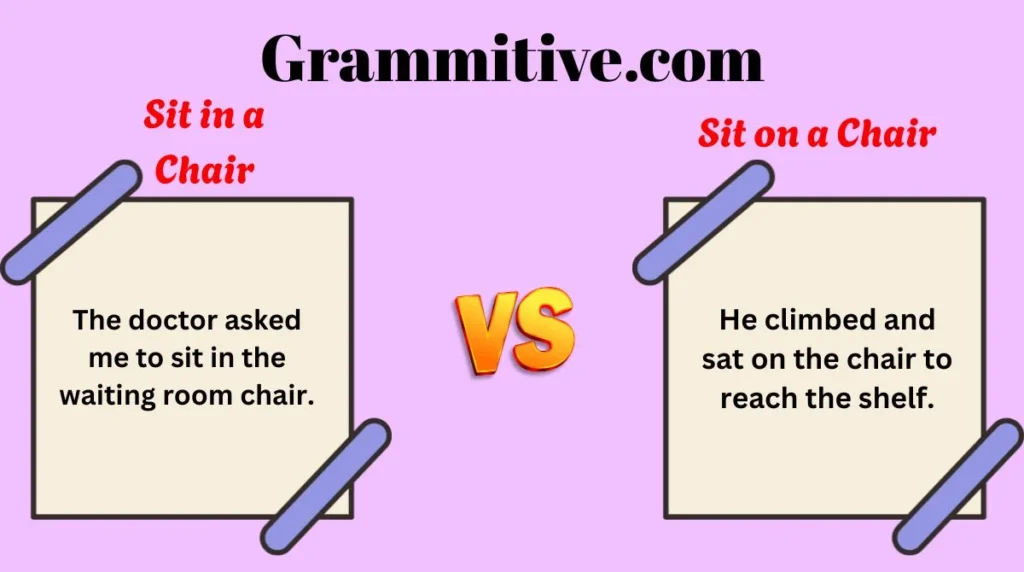
- The doctor asked me to sit in the waiting room chair.
- He leaned back in the chair and relaxed.
- I spent hours sitting in my office chair.
- The baby fell asleep in the high chair.
- She sat in the armchair by the window.
Common learner confusion
Many students think:
“A chair is flat, so it must be on.”
But English doesn’t always follow shape. It follows how we feel in the space.
If the chair supports your sides or back, English often chooses in.
What Does “Sit on a Chair” Mean?
Simple definition
Sit on a chair means your body is touching the surface of the chair, like sitting on top of it.
There is less feeling of “inside.”
When to use it
Use on when:
- you are simply touching the surface
- the chair is flat or simple
- you are not sitting normally
- you are perching, climbing, or balancing
- you treat the chair like any other object
Grammar rule
We use on when something is on top of a surface.
Just like:
- on the table
- on the bed
- on the floor
A chair can also be treated like a surface.
Structure:
sit + on + chair
Examples
- Don’t sit on the chair, it’s wet.
- He sat on the chair backwards.
- The child stood and then sat on the chair quickly.
- She sat on a folding chair at the picnic.
- The cat is sitting on my chair.
- I put my bag on the chair, then sat down.
- He climbed and sat on the chair to reach the shelf.
- They sat on plastic chairs outside.
Common learner confusion
Students often ask: “So is on wrong?”
No, it’s not wrong. It’s just less natural in many normal sitting situations.
Native speakers use on more when the chair feels like a simple object or flat surface.
Difference Between “In” and “On” (Detailed)
Both can be correct, but the meaning and feeling change.
Quick comparison table
| Point | Sit in a chair | Sit on a chair |
|---|---|---|
| Position | inside space | on surface |
| Feeling | supported, relaxed | just touching |
| Natural use | very common | less common |
| Chair type | armchair, office chair | stool, bench, flat chair |
| Image | body enclosed | body on top |
Usage difference
In sounds normal and comfortable.
You imagine someone sitting properly.
On sounds more physical or surface-based.
Sometimes it feels temporary or unusual.
Grammar logic
English prepositions often follow this idea:
- in = inside/enclosed
- on = surface/contact
Even though a chair isn’t fully closed like a box, it still creates a small “space” around you.
So the brain chooses in.
Sentence structure difference
Both follow the same pattern:
- sit in + noun
- sit on + noun
The structure is identical. Only the preposition changes.
Meaning comparison
Compare these:
- She sat in the chair and relaxed. → normal
- She sat on the chair → maybe casual or unusual
Another:
- Grandpa is sleeping in the chair → comfortable
- Grandpa is sleeping on the chair → sounds awkward
The first sounds more natural.
Grammar Rules You Must Remember
Rule #1: Use “in” for enclosed or supported seating
If the chair wraps around your body, use in.
Example:
He sat in the armchair near the fire.
Rule #2: Use “on” for flat or simple surfaces
If the seat feels like a flat board, on is okay.
Example:
We sat on wooden chairs at the park.
Rule #3: Use “on” for animals or objects
People use in, but objects often use on.
Example:
My phone is on the chair.
Rule #4: When unsure, “in” sounds more natural for people
If you don’t know which to choose, in is usually safer.
Example:
Please sit in this chair.
Common Mistakes Students Make
Why mistakes happen
Many languages use only one preposition. So learners translate directly.
Also, textbooks don’t explain the feeling difference.
Wrong vs correct examples
❌ Sit on the armchair.
✅ Sit in the armchair.
❌ Grandpa slept on the chair all afternoon.
✅ Grandpa slept in the chair all afternoon.
❌ I sat in the stool.
✅ I sat on the stool.
Easy correction tips
- armchair → in
- office chair → in
- stool/bench → on
- unsure → choose in
Easy Trick to Remember the Difference
Here’s a simple memory trick students love:
Imagine a bowl.
If the chair feels like a bowl that holds you → in
If it feels like a plate or table → on
Armchair = bowl → in
Bench = plate → on
Easy, right?
Your brain remembers shapes faster than rules.
Daily Life Examples (Very Important)
These sound like real conversations.
- “Come in and sit in this chair.”
- “Don’t sit on my chair, I just cleaned it.”
- “Dad fell asleep in the chair again.”
- “We sat on plastic chairs at the wedding.”
- “The dog is sitting on my chair!”
- “Please sit in the front chair.”
- “He turned the chair around and sat on it backwards.”
- “I sat in my office chair all day and my back hurts.”
- “The kids sat on small stools.”
- “She curled up in the chair with a blanket.”
Notice how natural in sounds for normal sitting.
Practice Section
Choose the correct option.
- She sat ___ the armchair. (in/on)
- The cat is sitting ___ my chair.
- We sat ___ plastic chairs outside.
- Grandpa slept ___ his chair.
- I put my bag ___ the chair.
Answers
- in
- on
- on
- in
- on
FAQs
What is the difference between “sit in a chair” and “sit on a chair”?
“In” suggests you are inside or supported by the chair. “On” means you are simply on the surface. “In” sounds more natural for normal sitting.
Can we use both in daily English?
Yes. Both are grammatically correct. But native speakers prefer “in” for most regular chairs and “on” for flat or simple seats.
Is “sit on a chair” wrong?
No, it’s not wrong. It just sounds less natural in some situations, especially with armchairs or comfortable chairs.
Do Americans and British people use them differently?
Not really. Both groups follow the same idea: “in” for enclosed seating and “on” for surfaces.
What about stools or benches?
Use “on” because they are flat.
Example: sit on a stool, sit on a bench.
Which one should beginners use?
Use “in” for people and normal chairs. It’s safer and sounds more natural most of the time.
Final Conclusion
Small words like in and on can feel confusing, but they follow simple logic once you see the pattern.
English often thinks about space and shape. If something surrounds or supports you like a small container, use in. If it’s just a flat surface, use on.
For chairs, most normal sitting uses in. That’s why you hear “sit in a chair” so often in everyday speech. “On a chair” is still correct, but it depends on the situation or the type of seat.
The best way to remember is to picture the chair. Does it hold you like a bowl? Choose in. Does it feel flat like a table? Choose on.
Practice with real-life sentences. Listen to native speakers. Say the phrases out loud. After a short time, the correct preposition will feel natural, not forced.
English gets easier when you notice these small details. Keep going — you’re improving every day.

I am Lucas Bennett, a digital content creator passionate about social media trends and online growth strategies.
I share practical insights and guides to help users better understand and navigate the digital world.