

Many English learners get confused when they see the words “current” and “currant.” At first look, they look almost the same.
Only one letter is different, but the meaning is completely different. This small spelling change often causes big mistakes in writing and speaking.
In daily English, “current” is used very often. You hear it in news, school, office talks, and even in casual conversations.
On the other hand, “currant” is not very common in speaking, but you may see it in food items like cakes, biscuits, and jams.
Because the spelling is so similar, learners sometimes mix them up. For example, someone might write “currant situation” instead of “current situation.”
This mistake can change the meaning completely and make the sentence sound wrong.
After reading this guide, you will clearly understand the meaning of both words, when to use them, and how to never confuse them again.
You will also learn easy tricks, daily life examples, and common mistakes that students make.
Everything is explained in very simple English so even beginners can understand easily.
4️⃣ What Does “Current” Mean?
The word “current” is used when we talk about something happening now or at present time. It is very common in English and is used in news, studies, work, and daily conversation.
Simple Definition:
“Current” means happening now, existing now, or related to the present time.
When to Use It:
We use “current” when we talk about:
- Present time situations
- Ongoing events
- Present conditions
- Latest or modern things
Grammar Rule:
“Current” is usually used as an adjective before a noun.
Example Sentences:
- This is my current job.
- What is your current address?
- She is happy with her current life.
- The current situation is very serious.
- I don’t like my current phone.
- We are discussing the current issue.
- The current weather is very cold.
- He is my current teacher at school.
Common Learner Confusion:
Many students think “current” means electricity only. That is partially true, but it is not the full meaning. “Current” can also mean anything happening now, not just electric flow.
Another confusion is spelling. Learners sometimes write “currant” instead of “current,” which is wrong in most situations.
5️⃣ What Does “Currant” Mean?
The word “currant” is much less common in daily speaking. It is mainly used for food items, especially small dried fruits.
Simple Definition:
“Currant” means a small dried fruit used in baking, cooking, or desserts.
When to Use It:
We use “currant” when talking about:
- Cakes and pastries
- Dry fruits
- Jams and sweets
- Cooking ingredients
Grammar Rule:
“Currant” is a noun. It refers to a thing (fruit), not time or situation.
Example Sentences:
- This cake has currants in it.
- I bought some dried currants from the market.
- She added currants to the pudding.
- The biscuit is full of sweet currants.
- I don’t like eating raw currants.
- These muffins contain raisins and currants.
- My grandmother makes jam with currants.
- The bakery uses currants in special bread.
Common Learner Confusion:
Many learners never hear this word in conversation, so they forget it exists. When they see it, they think it is a spelling mistake of “current.” But it is a real word with a very different meaning.
Another confusion is pronunciation. “Currant” sounds slightly different, but learners often pronounce it like “current,” which adds to the confusion.
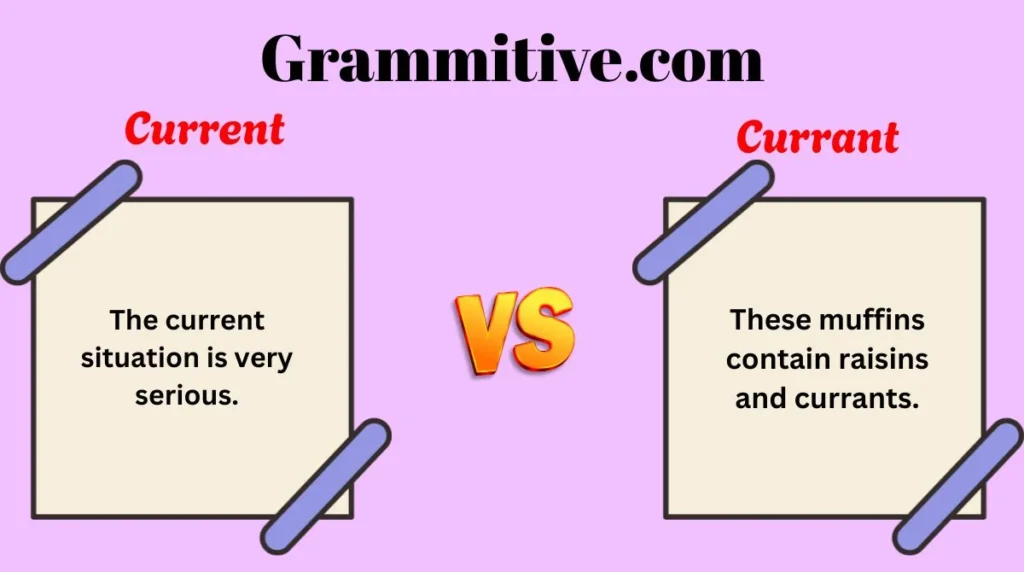
6️⃣ Difference Between Current and Currant (Detailed)
Now let’s clearly understand how these two words are different. Even though they look similar, their meaning, usage, and grammar are totally different.
Comparison Table:
| Feature | Current | Currant |
|---|---|---|
| Meaning | Happening now / present time | Small dried fruit |
| Word Type | Adjective / noun | Noun |
| Usage Area | News, time, daily life | Food, cooking, baking |
| Frequency | Very common | Less common |
| Example | Current situation is bad | Cake has currants |
Usage Difference:
- “Current” is used for time, events, and situations.
- “Currant” is used for food ingredients only.
Grammar Logic:
- “Current” works like describing words.
- “Currant” works like naming a thing.
Sentence Structure Difference:
- Current → adjective + noun
Example: current news, current job - Currant → noun (thing itself)
Example: eat currants, buy currants
Meaning Comparison:
- Current = now
- Currant = fruit
Even though they sound almost the same, they are not connected in meaning at all. One is about time, and the other is about food.
7️⃣ Grammar Rules You Must Remember
Rule #1: “Current” is used for present time
Example: I am busy with my current work.
Rule #2: “Currant” is always a noun (food item)
Example: She baked a cake with currants.
Rule #3: “Current” never refers to food
Wrong: This cake has current.
Correct: This cake has currants.
Rule #4: “Currant” never describes time or situation
Wrong: My currant situation is bad.
Correct: My current situation is bad.
8️⃣ Common Mistakes Students Make
Many students mix these words because they look similar. This is a very common spelling mistake in exams and writing.
Why mistakes happen:
- Similar spelling
- Same pronunciation for many learners
- Lack of vocabulary practice
- Guessing meaning without context
Wrong vs Correct Examples:
❌ My currant job is good.
✔ My current job is good.
❌ The currant situation is difficult.
✔ The current situation is difficult.
❌ I like current cake.
✔ I like currant cake.
Easy Correction Tips:
- Always check meaning, not spelling only
- Think: “Is it about time or food?”
- Practice both words separately
- Read sentences carefully before writing
9️⃣ Easy Trick to Remember the Difference
Here is a very simple memory trick that students can use forever:
👉 Think like this:
- Current = “Now” (Time word)
- Currant = “Crunchy food” (Fruit word)
Another trick:
- “Current” has “rent” inside → think of time and daily life (like paying rent every month).
- “Currant” has “ran” sound → think of raisins and dried fruits.
You can also remember:
- Current = Calendar (time)
- Currant = Cake (food)
This small imagination trick helps your brain store the difference easily.
🔟 Daily Life Examples (Very Important)
Here are real-life spoken English examples:
- What is your current plan for today?
- I am not happy with my current phone.
- The current weather is very hot.
- She is talking about current events in class.
- My current teacher is very kind.
- This shop sells cakes with currants.
- I like biscuits with currants inside.
- Do you want currants in your dessert?
- My current mood is very good today.
- They are discussing the current issue in meeting.
1️⃣1️⃣ Practice Section
Choose the correct word:
- My ___ situation is not good.
- This cake has dried ___.
- What is your ___ job?
- I bought some ___ from the store.
- The ___ news is very shocking.
Answers:
- current
- currants
- current
- currants
- current
1️⃣2️⃣ FAQs
1. What is the main difference between current and currant?
“Current” means happening now or present time. “Currant” is a small dried fruit used in food.
2. Can we use current in questions?
Yes. For example: What is your current job? It is very common in questions.
3. Is currant used in daily English?
Not much in speaking. It is mostly used in food and cooking vocabulary.
4. Why do students confuse these words?
Because both words look and sound very similar, but their meanings are very different.
5. Is current formal or informal?
“Current” is used in both formal and informal English. It is very flexible.
6. Can currant be used in writing essays?
Only if you are writing about food, recipes, or cooking topics.
1️⃣3️⃣ Final Conclusion
Understanding the difference between “current” and “currant” is important for clear English writing.
Even though they look almost the same, their meanings are completely different. One is connected to time and situations, while the other is related to food.
Learners often make mistakes because they focus only on spelling. The best way to avoid confusion is to always think about meaning first.
If you are talking about something happening now, use “current.” If you are talking about food or baking, use “currant.”
With practice, this difference will become very easy. Try using both words in your own sentences daily.
The more you practice, the more natural it will feel. English becomes easy when you understand small differences like this clearly.
Keep learning step by step, and your confidence will grow.

I am Lucas Bennett, a digital content creator passionate about social media trends and online growth strategies.
I share practical insights and guides to help users better understand and navigate the digital world.