
English has many small phrases that look almost the same but feel very different.
One classic example is “whether it be” and “whether it is.”
At first glance, they seem identical. Only one tiny word changes: be or is.
But that small change can confuse even good English learners.
You might hear:
- Whether it is sunny or rainy, we will go.
- Whether it be sunny or rainy, we will go.
Both sound correct. Both appear in books. Both appear in speech.
So… which one should you use?
This question bothers many students because English teachers don’t always explain it clearly. Some say one is formal.
Some say both are fine. Others talk about strange grammar words like subjunctive mood, which sounds scary.
The truth is much simpler than it looks.
In daily life, you mostly need “whether it is.”
But sometimes you’ll see “whether it be” in formal or traditional English.
After reading this guide, you will clearly understand:
- what each phrase means
- when to use each one
- the grammar rules behind them
- common mistakes
- easy tricks to remember
- and lots of real-life examples
By the end, this topic will feel natural, not confusing.
What Does “Whether It Be” Mean?
Simple definition
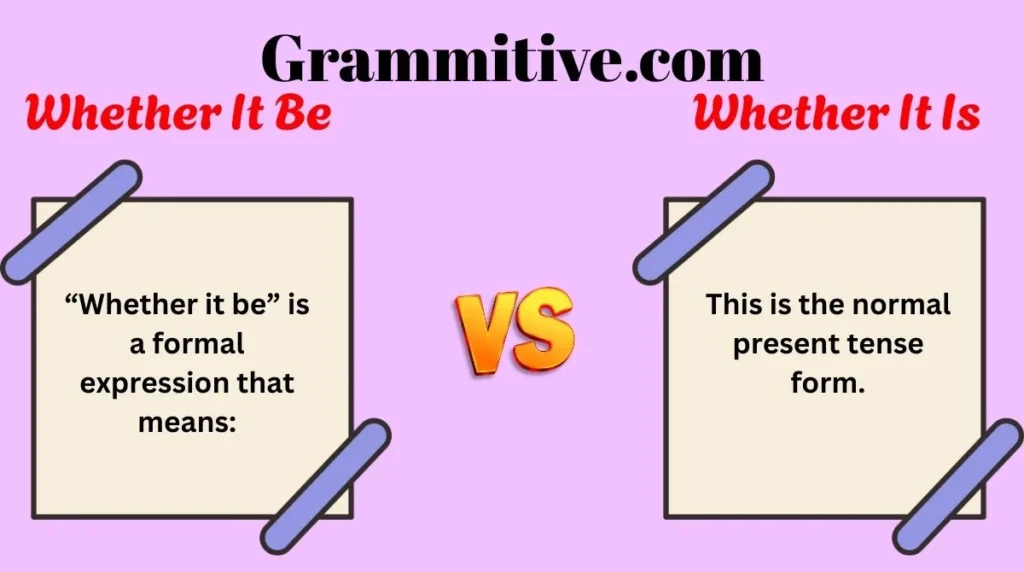
“Whether it be” is a formal expression that means:
👉 no matter what it is
👉 even if it is
👉 whatever the case may be
It uses the subjunctive form “be”, not “is.”
Don’t worry about the big grammar word. Think of it like this:
It sounds more formal, traditional, or literary.
You often see it in:
- speeches
- essays
- formal writing
- old-fashioned English
- legal or academic texts
It is not very common in daily conversation.
When to use it
Use “whether it be” when:
- writing formally
- giving a speech
- sounding poetic or serious
- using traditional grammar style
In normal everyday talk, it can sound too stiff or unnatural.
Grammar rule
“Be” here is the base form of the verb.
It comes from the subjunctive mood, which we use to talk about:
- possibilities
- uncertain situations
- hypothetical ideas
So the structure looks like:
whether + subject + be
Example sentences
- Whether it be day or night, the hospital stays open.
- Whether it be rain or snow, the mail is delivered.
- Whether it be big or small, every gift matters.
- Whether it be truth or rumor, people will talk.
- Whether it be today or tomorrow, we must finish.
- Whether it be rich or poor, everyone deserves respect.
- Whether it be luck or skill, he always wins.
- Whether it be love or fear, emotions guide us.
Notice something?
These sentences sound formal and serious.
You might read them in a book or speech, not in a casual chat with friends.
Common learner confusion
Many learners think:
❌ “Be is wrong grammar.”
But it’s not wrong.
It’s just less common and more formal.
Another confusion:
❌ “It sounds old, so it must be incorrect.”
Not true. It’s still correct — just stylistically different.
What Does “Whether It Is” Mean?
Simple definition
“Whether it is” means:
👉 if it is
👉 no matter if it is
👉 in any case
This is the normal present tense form.
It is the version people use every day.
When to use it
Use “whether it is” in:
- daily conversation
- emails
- normal writing
- school work
- social media
- modern English
If you are unsure which to choose, pick this one.
It’s safer and more natural.
Grammar rule
“Is” is simply:
👉 present tense of “to be”
Structure:
whether + subject + is
No special grammar rules. Very simple.
Example sentences
- Whether it is sunny or cloudy, we will go outside.
- Whether it is cheap or expensive, I like it.
- Whether it is morning or evening, she studies.
- Whether it is true or false, we need proof.
- Whether it is big or small, the problem matters.
- Whether it is today or tomorrow, call me.
- Whether it is easy or hard, I will try.
- Whether it is hot or cold, he wears a jacket.
These sound natural and modern.
This is how people really speak.
Common learner confusion
Some students think:
❌ “Is is less correct than be.”
Actually, it’s the opposite.
“Is” is the most normal and common choice.
Another confusion:
❌ “Only formal English is correct.”
No. Everyday English is also correct.
Difference Between “Whether It Be” and “Whether It Is”
Here is the big picture.
Comparison Table
| Feature | Whether it be | Whether it is |
|---|---|---|
| Grammar type | Subjunctive | Normal present |
| Tone | Formal, literary | Everyday, natural |
| Common today? | Rare | Very common |
| Sounds | Serious, traditional | Casual, modern |
| Best for | Essays, speeches | Conversation, general writing |
| Safe for learners? | Sometimes confusing | Always safe |
Usage difference
Think of it like clothing:
- whether it be → suit and tie
- whether it is → jeans and T-shirt
Both are correct.
But one is more formal.
Grammar logic
“Be” shows possibility or uncertainty.
“Is” shows simple present reality.
But in real life, the meaning difference is very small.
Most of the time, they mean exactly the same thing.
The difference is mostly style, not meaning.
Sentence structure difference
Both follow:
whether + subject + verb
Only the verb changes.
- whether it be
- whether it is
Everything else stays the same.
Meaning comparison
Look:
- Whether it be right or wrong…
- Whether it is right or wrong…
Meaning? Almost identical.
So don’t overthink it.
Grammar Rules You Must Remember
Rule #1: Use “is” in everyday English
✔ Whether it is late or early, call me.
This sounds normal and natural.
Rule #2: Use “be” for formal or traditional writing
✔ Whether it be fact or fiction, the story is interesting.
Good for essays or speeches.
Rule #3: Don’t mix tenses
❌ Whether it be raining or was sunny
✔ Whether it be raining or sunny
Keep grammar consistent.
Rule #4: When unsure, choose “is”
If you feel confused, always choose “is.”
It is almost never wrong.
Common Mistakes Students Make
Why mistakes happen
Students often:
- memorize rules without understanding
- copy old books
- think formal English is always better
- overuse “be”
Mistake 1
❌ Whether it be sunny, we go outside.
This sounds incomplete.
✔ Whether it is sunny, we go outside.
Mistake 2
❌ Whether it be cold or hot, I am liking it.
Two problems: “be” + wrong tense.
✔ Whether it is cold or hot, I like it.
Mistake 3
❌ Using “be” in casual speech
“Hey, whether it be later, text me.”
Sounds strange.
✔ Whether it is later, text me.
Easy correction tips
Ask yourself:
👉 Am I speaking casually? → use is
👉 Am I writing a formal speech? → maybe be
Easy Trick to Remember the Difference
Here’s a simple memory trick.
Think: B = Bookish
Be → Book English
Formal. Old style. Literary.
Think: I = Instant life
Is → everyday life
Modern. Natural. Common.
So:
- Talking to friends → is
- Writing a speech → be
This trick helps students remember fast.
Daily Life Examples (Very Important)
These sound like real conversations.
- Whether it is raining, we still have practice.
- Whether it is cheap or not, I want it.
- Whether it is today or tomorrow, just call me.
- Whether it is good or bad, tell me the truth.
- Whether it is busy or quiet, the store stays open.
- Whether it is far or near, I’ll drive you.
- Whether it is your fault or mine, let’s fix it.
- Whether it is morning or night, he drinks coffee.
- Whether it is hard or easy, she keeps trying.
- Whether it is online or offline, the class continues.
Notice something?
All use is.
Because this is how people actually speak.
Practice Section
Choose the correct option.
Questions
- Whether it ___ sunny or cloudy, we will go. (be / is)
- Whether it ___ true or not, we must check. (be / is)
- Whether it ___ day or night, the shop is open. (be / is – formal essay)
- Whether it ___ expensive or cheap, I like it. (be / is)
- Whether it ___ luck or skill, he won. (be / is – speech)
Answers
- is
- is
- be
- is
- be
FAQs
1. What is the difference between “whether it be” and “whether it is”?
Both mean almost the same thing. The difference is style. “Be” is formal and traditional. “Is” is modern and common in daily English.
2. Which one is more common in conversation?
“Whether it is” is far more common. Native speakers use it in normal speech and writing every day.
3. Can we use “whether it be” in speaking?
Yes, but it may sound formal or old-fashioned. It’s better for speeches or formal writing, not casual talk.
4. Is “whether it be” old English?
Not exactly old, but it sounds traditional or literary. It comes from the subjunctive grammar style.
5. Is one grammatically more correct?
No. Both are correct. The choice depends on tone and formality.
6. What should beginners use?
Beginners should use “whether it is.” It’s simpler, safer, and sounds natural.
Final Conclusion
Small grammar differences often feel bigger than they really are. This is one of those cases.
Both whether it be and whether it is are correct English. They share almost the same meaning. The main difference is tone. One sounds formal and literary. The other sounds natural and modern.
For everyday life, school, texting, or talking with friends, use “whether it is.”
It will always sound right.
Save “whether it be” for formal essays, speeches, or special writing where you want a serious or classic tone.
Don’t worry too much about complicated grammar terms. Focus on what sounds natural.
With a little practice, this choice will become automatic. Soon, you won’t even have to think about it.
Keep reading, keep listening, and keep using English every day. That’s how real learning happens.

I am Lucas Bennett, a digital content creator passionate about social media trends and online growth strategies.
I share practical insights and guides to help users better understand and navigate the digital world.