
Many English learners get confused when they see words like themselves and themself. At first look, both seem almost the same.
They even come from the same root word “them.” Because of this, students often wonder which one is correct and when to use it.
English can feel tricky because small changes in spelling can change meaning, formality, and correctness.
Some teachers say one form is wrong, while modern English writers sometimes use both. This creates even more confusion for learners.
In daily life, we often use reflexive pronouns like “myself,” “yourself,” and “themselves.” But when we deal with gender-neutral or singular “they,” things become less clear. T
hat is where themself starts appearing in some modern writing.
After reading this guide, everything will become simple. You will clearly understand:
- What themselves means
- What themself means
- When to use each one
- Why both forms exist
- And how native speakers actually use them today
By the end, you will feel more confident in writing and speaking correct English without hesitation. Let’s make this confusing topic very easy step by step.
What Does “Themselves” Mean?
Themselves is a reflexive pronoun used when talking about more than one person. It refers back to a group of people already mentioned in the sentence.
Simple Definition
“Themselves” means “they” doing something to “they.”
When to Use It
Use themselves when:
- You are talking about two or more people
- The action returns to the same group
- You want to show emphasis or reflexive action
Grammar Rule
Plural subject + reflexive action = themselves
Example Sentences
- The students helped themselves to food.
- They blamed themselves for the mistake.
- The children dressed themselves quickly.
- The players prepared themselves for the match.
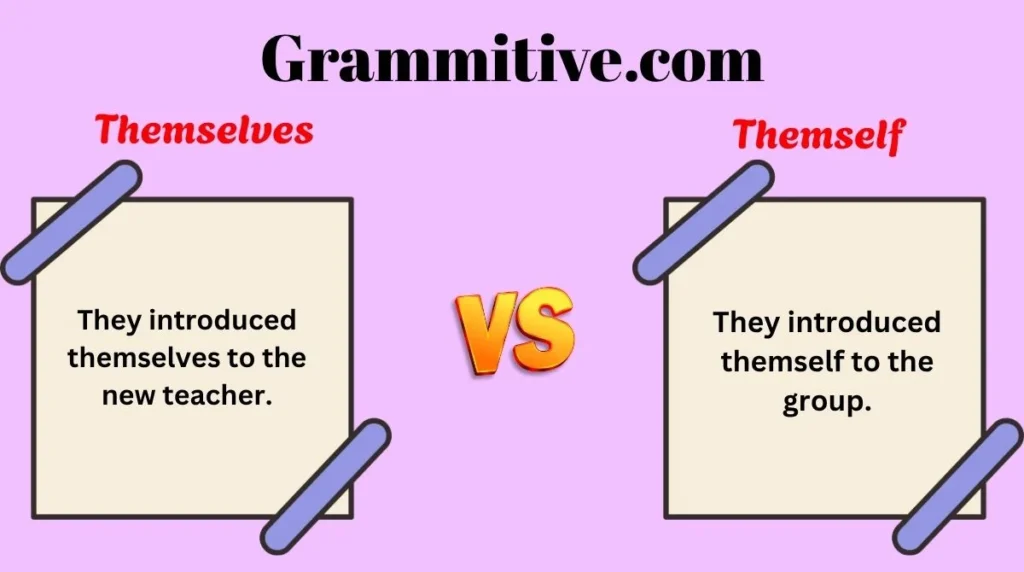
- They introduced themselves to the new teacher.
- The workers hurt themselves during training.
- The friends enjoyed themselves at the party.
- The girls taught themselves English.
Common Learner Confusion
Many learners think “themself” can replace “themselves” in all cases. But that is not true in standard English. When referring to a group of people, themselves is always correct.
What Does “Themself” Mean?
Themself is a newer and less traditional form. It is used when “they” refers to one person in a gender-neutral way.
Simple Definition
“Themself” means “they” referring to one person instead of a group.
When to Use It
Use themself when:
- Talking about one person who prefers “they/them” pronouns
- Writing informal or modern inclusive English
- Avoiding gender-specific pronouns like “himself” or “herself”
Grammar Rule
Singular “they” (modern use) + reflexive action = themself (in some styles)
Example Sentences
- Someone left a message for themself.
- Each person should ask themself this question.
- The student prepared themself for the test.
- They introduced themself to the group.
- The artist designed the logo by themself.
- A person should trust themself more.
- They reminded themself to stay calm.
- The guest found themself lost in the city.
Common Learner Confusion
Some grammar books still say themself is incorrect. But modern English, especially spoken English and online writing, is slowly accepting it. Still, in formal writing, many teachers prefer themselves even for singular “they.”
Difference Between Themselves and Themself (Detailed)
Even though both words look similar, their usage is different in grammar, style, and acceptance.
Comparison Table
| Feature | Themselves | Themself |
|---|---|---|
| Number | Plural | Singular (modern use) |
| Usage | Standard English | Modern/informal English |
| Grammar acceptance | Fully correct | Debated/limited use |
| Refers to | Group of people | One person (they) |
| Formal writing | Yes | Sometimes avoided |
| Example | They enjoyed themselves | They prepared themself |
Usage Difference
- Themselves is used for groups.
- Themself is used for one person using “they.”
Grammar Logic
English reflexive pronouns usually match the subject:
- I → myself
- You → yourself
- He → himself
- They → themselves / themself (modern variation)
Sentence Structure Difference
- Plural: They + verb + themselves
→ They enjoyed themselves. - Singular (modern): They + verb + themself
→ They prepared themself.
Meaning Comparison
Both words show that the action returns to the subject. The difference is only about number and style, not meaning.
Grammar Rules You Must Remember
Rule #1: Plural always takes “themselves”
The group of people uses themselves.
- Example: The boys helped themselves.
Rule #2: Singular “they” can take reflexive form
Modern English allows:
- themself (informal)
- themselves (formal)
Rule #3: Formal writing prefers “themselves”
Even for singular “they,” many exams and books prefer:
- They introduced themselves.
Rule #4: Context decides correctness
Your sentence should match clarity and audience.
- Informal chat → themself is okay
- Academic writing → themselves preferred
Common Mistakes Students Make
Mistake #1: Using “themself” for groups
❌ The children hurt themself.
✔ The children hurt themselves.
Mistake #2: Overusing “themself” in exams
Students think it is modern and better, but teachers may mark it wrong in formal exams.
Mistake #3: Mixing singular and plural
❌ Each student helped themselves.
✔ Each student helped themself / themselves (depends on style).
Why These Mistakes Happen
- Lack of grammar rules clarity
- Influence from social media English
- Confusion about singular “they”
Easy Correction Tip
Always check if the subject is one person or a group before choosing the reflexive pronoun.
Easy Trick to Remember the Difference
Think like this:
- “Themselves” = many people → S for School group
- “Themself” = single person → S for Solo
Another simple idea:
- If you can say “they are many,” use themselves
- If “they is one person,” you can use themself
Daily Life Examples (Very Important)
- They enjoyed themselves at the wedding.
- The kids made themselves breakfast.
- She told them to introduce themselves.
- The players prepared themselves for the final match.
- Each person should ask themself before deciding.
- They found themselves in a difficult situation.
- The students tested themselves before the exam.
- A writer should express themself freely.
- They congratulated themselves after success.
- The team pushed themselves to win.
Practice Section
Choose the correct word:
- The children helped (themselves / themself).
- Each person should ask (themselves / themself).
- They introduced (themselves / themself) to the class.
- The player prepared (themselves / themself).
- The friends enjoyed (themselves / themself).
Answers
- themselves
- themself / themselves (both possible in modern English)
- themselves
- themself / themselves
- themselves
FAQs
1. What is the main difference between themselves and themself?
“Themselves” is used for groups, while “themself” is used for a single person using “they.” Both show reflexive action but differ in number and style.
2. Is themself correct in English?
It is correct in modern and informal English when referring to singular “they.” However, many formal styles still prefer “themselves.”
3. Can we use themselves for one person?
Yes, especially in formal writing. Many style guides accept “they themselves” or simply “themselves” for singular “they.”
4. Is themself formal or informal?
“Themself” is mostly informal. It is common in spoken English and modern writing but less accepted in academic contexts.
5. Why do people use themself now?
Because English is becoming more gender-neutral. “Themself” helps refer to one person without using “he” or “she.”
6. Which one should I use in exams?
Use “themselves” unless your teacher clearly allows “themself.” Exams usually prefer traditional grammar rules.
Final Conclusion
Understanding themselves vs themself becomes simple once you know the difference between plural and singular use.
“Themselves” is the standard and widely accepted form used for groups of people. It is safe for exams, formal writing, and professional English.
“Themself” is a newer form used when “they” refers to one person. It is becoming more popular in modern English, especially in casual writing and inclusive language.
However, it is still not fully accepted in all grammar books or academic settings.
The key idea is not to memorize rules blindly but to understand the context.
Ask yourself: am I talking about one person or many people? That answer will guide your choice.
With practice, this topic becomes very easy. Read examples, write your own sentences, and pay attention when native speakers use these words. O
ver time, you will naturally choose the correct form without thinking too much.

I am Lucas Bennett, a digital content creator passionate about social media trends and online growth strategies.
I share practical insights and guides to help users better understand and navigate the digital world.