
Many English learners get confused between “jist” and “gist.” At first glance, both words sound the same.
When you hear someone speak, it is almost impossible to tell which spelling they mean. This is where the confusion begins.
Some students start writing “jist” because that’s how the word sounds. Others see “gist” in books or online and feel unsure if it’s correct or just a typo.
This small spelling difference can create big doubts, especially for beginners and non-native speakers.
Understanding the correct word is very important. You may need it in school, exams, emails, or daily conversations.
Using the wrong spelling can make your writing look weak or unprofessional.
After reading this lesson, everything will become clear. You will learn the real meaning, the correct usage, and why one word is right while the other is not.
You will also see easy examples, simple rules, and a few tricks that will help you remember it forever.
What Does “Jist” Mean?
Simple Definition
The word “jist” is not a correct English word. It does not exist in standard English dictionaries.
When Do People Use It?
People often write “jist” by mistake when they actually mean “gist.” This happens because both words sound exactly the same when spoken.
Grammar Rule
There is no grammar rule for “jist” because it is not a valid word. It is simply a misspelling.
Example Sentences (Incorrect Usage)
These examples show how learners mistakenly use “jist”:
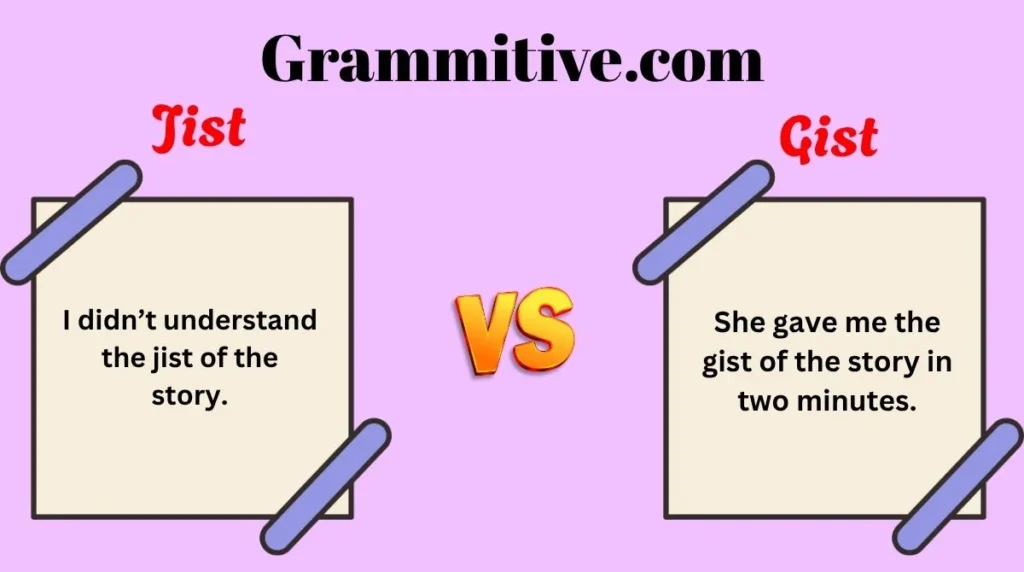
- ❌ I didn’t understand the jist of the story.
- ❌ Can you tell me the jist of the meeting?
- ❌ I got the jist of what he said.
- ❌ What is the jist of this article?
- ❌ She explained the jist very well.
- ❌ I only read the jist, not the whole text.
- ❌ He quickly shared the jist of the news.
Common Learner Confusion
The confusion comes from pronunciation. When we say “gist,” it sounds like “jist.” English spelling is not always phonetic, which means words are not always written the way they sound.
So learners think:
- “If it sounds like ‘jist,’ maybe it is spelled ‘jist.’”
But this is incorrect.
👉 Important point:
“Jist” is just a spelling mistake. It should always be replaced with “gist.”
What Does “Gist” Mean?
Simple Definition
“Gist” means the main idea or the most important point of something.
It is used when you want to talk about the basic meaning without giving all the details.
When to Use It
Use “gist” when:
- You summarize something
- You don’t want to explain everything
- You understand the general idea, not every detail
Grammar Rule
- “Gist” is a noun
- It is usually used with phrases like:
- the gist of something
- get the gist
- understand the gist
Example Sentences
- I didn’t read the whole book, but I got the gist.
- Can you explain the gist of the lesson?
- I understand the gist of your idea.
- She gave me the gist of the story in two minutes.
- The teacher explained the gist clearly.
- I missed the meeting, but I know the gist.
- He only shared the gist, not the details.
- Do you get the gist of what I’m saying?
Common Learner Confusion
Many learners:
- Spell it as “jist”
- Think both spellings are acceptable
But remember:
👉 Only “gist” is correct in English.
Difference Between Jist and Gist (Detailed)
Quick Comparison Table
| Feature | Jist ❌ | Gist ✅ |
|---|---|---|
| Correct spelling | No | Yes |
| Meaning | No meaning | Main idea or summary |
| Part of speech | None | Noun |
| Usage | Incorrect | Correct in all contexts |
| Example | ❌ the jist of the story | ✅ the gist of the story |
Usage Difference
- “Jist” → Always wrong
- “Gist” → Always correct
Even if many people use “jist” online, it is still considered a mistake.
Grammar Logic
“Gist” follows normal noun usage:
- the gist of the story
- the gist of the message
- the gist of the article
You cannot apply grammar rules to “jist” because it is not a real word.
Sentence Structure Difference
Correct structure:
- I got the gist of the conversation
- She explained the gist of the topic
Incorrect structure:
- I got the jist of the conversation ❌
Meaning Comparison
- “Jist” → No meaning
- “Gist” → Main idea
So there is no real comparison in meaning. One exists, the other doesn’t.
Grammar Rules You Must Remember
Rule #1: “Gist” is Always a Noun
✔ Correct: I understand the gist.
❌ Incorrect: I gist the idea.
You cannot use it as a verb.
Rule #2: Always Use “of” After Gist
✔ Correct: the gist of the story
❌ Incorrect: the gist the story
Example:
I know the gist of your plan.
Rule #3: Never Write “Jist”
✔ Correct: gist
❌ Incorrect: jist
Example:
Correct → I got the gist.
Wrong → I got the jist.
Rule #4: Use “Gist” for General Understanding
✔ Correct: I didn’t read everything, but I got the gist.
Use it when you understand the main idea, not details.
Common Mistakes Students Make
Why Mistakes Happen
- Same pronunciation
- English spelling confusion
- Lack of reading practice
Mistake #1: Writing “Jist”
❌ I got the jist
✔ I got the gist
👉 Tip: Always double-check spelling.
Mistake #2: Using Gist as a Verb
❌ I gist your point
✔ I understand your point
👉 Tip: “Gist” is a noun, not a verb.
Mistake #3: Missing “of”
❌ the gist the story
✔ the gist of the story
👉 Tip: Remember the phrase “gist of.”
Easy Correction Tips
- Think: G = General idea
- Always write “gist,” never “jist”
- Read more English texts
Easy Trick to Remember the Difference
Here’s a simple trick:
👉 Gist starts with “G” → G = General idea
So:
- Gist = General meaning
- Jist = Just wrong 😄
Another way:
- If you see “jist,” imagine a red cross ❌
- If you see “gist,” think “correct” ✅
This small trick helps many students remember easily.
Daily Life Examples (Very Important)
These are simple, real-life sentences:
- I didn’t watch the full video, but I got the gist.
- Can you tell me the gist quickly?
- I understand the gist of your message.
- He explained the gist in simple words.
- I missed the class, so tell me the gist.
- She shared the gist of the meeting.
- I don’t need details, just the gist.
- Did you get the gist of the joke?
- He didn’t explain everything, only the gist.
- I read fast and understood the gist.
These are common in daily English.
Practice Section
Choose the correct word: gist or jist
- I got the ___ of the story.
- Can you explain the ___ of this lesson?
- He told me the ___ of the meeting.
- I didn’t understand the ___ clearly.
- She shared the ___ in short.
Answers
- gist
- gist
- gist
- gist
- gist
👉 All answers are “gist” because “jist” is incorrect.
FAQs
1. What is the difference between jist and gist?
“Gist” is a correct English word that means the main idea. “Jist” is just a spelling mistake and has no meaning.
2. Can we use gist in questions?
Yes, you can.
Example: “Did you get the gist of the story?”
It is very common in spoken English.
3. Is gist formal or informal?
“Gist” is neutral. You can use it in both formal and informal situations like school, emails, or conversations.
4. Why do people write jist instead of gist?
Because both words sound the same. Learners often write based on sound, which causes this mistake.
5. Is jist ever correct in English?
No, “jist” is never correct. It is always considered a spelling error.
6. How can I remember the correct spelling?
Use the trick:
G = General idea → Gist
This helps you remember easily.
Final Conclusion
The confusion between “jist” and “gist” is very common, especially for beginners. Both words sound the same, but only one is correct. That word is “gist.”
“Gist” means the main idea or the general meaning of something. It is used when you don’t want to explain everything in detail.
On the other hand, “jist” is simply a spelling mistake and should never be used in proper English.
By remembering a few simple rules and practicing regularly, you can avoid this mistake easily.
Focus on correct spelling, read more English, and try using “gist” in your daily conversations.
Small improvements like this can make your English clearer and more confident. Keep practicing, and soon you won’t even think about this confusion again.

I am Lucas Bennett, a digital content creator passionate about social media trends and online growth strategies.
I share practical insights and guides to help users better understand and navigate the digital world.