
English learners often get confused between “beware” and “be aware.” Both sound similar, but they are used very differently.
Using the wrong one can make your sentence sound strange or even change the meaning completely.
Understanding this difference is essential if you want to speak English confidently, especially in everyday conversations, emails, or warnings.
Many beginners mix these two because they both deal with attention or caution.
However, one is more about warning someone of danger, while the other is about noticing something or being conscious of it.
Even native speakers sometimes pause to think: should I say “be aware” or “beware”?
By the end of this guide, you will clearly understand:
- What beware really means and when to use it
- What be aware really means and how it is different
- Grammar rules for both phrases
- Common mistakes and easy tricks to remember the difference
- Real-life examples you can use in daily English
This article is designed for beginners, students, and non-native speakers.
I will explain everything in simple words, with lots of examples, and even practice sentences so you can remember easily.
Once you finish reading, you will feel confident using both correctly in any situation.
What Does “Beware” Mean?
Definition:
“Beware” is a verb used to warn someone about danger or something harmful. It is a short form of “be careful of.”
When to Use:
Use “beware” when you want someone to pay attention to danger or avoid a risk. It often appears in signs, warnings, or serious advice.
Grammar Rule:
- “Beware” is followed by “of” when naming the danger.
- It is imperative, meaning it gives a command or warning.
- Example structure:
Beware of + noun
Example Sentences:
- Beware of the dog. (Warning: the dog might bite)
- Beware of slippery floors. (Warning: the floor is slippery)
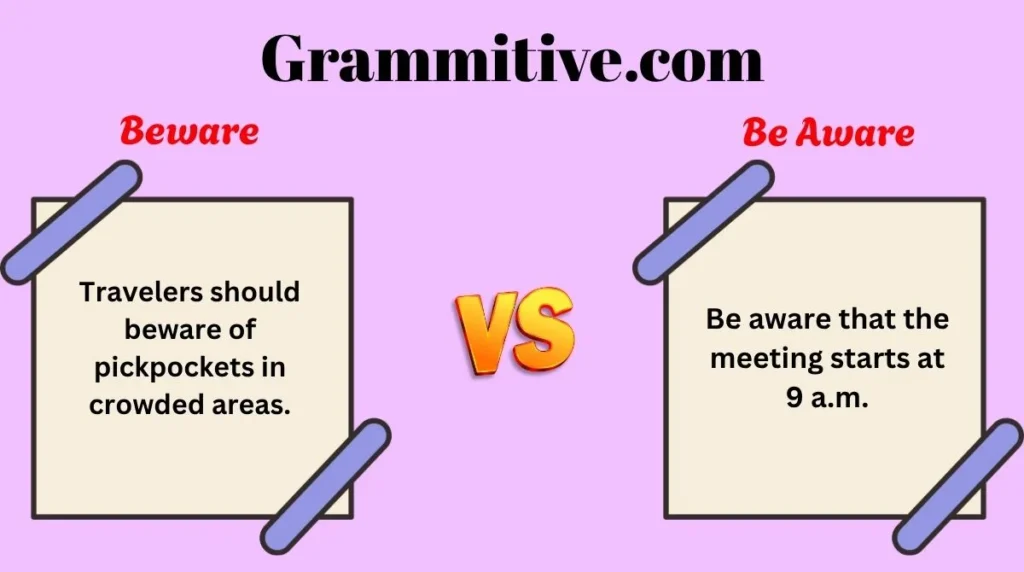
- Travelers should beware of pickpockets in crowded areas.
- Beware of strangers offering help.
- Beware of scams online.
- Hikers should beware of sudden storms.
- Beware of eating too much sugar. (Warning about health risk)
- Beware of the icy road ahead.
Common Learner Confusion:
Many students confuse “beware” with “be aware.” Remember:
- Beware = warning of danger
- Be aware = just notice or realize something
A mistake would be saying: “Be aware of the dog.” – It doesn’t sound like a warning. It just means “notice the dog.”
What Does “Be Aware” Mean?
Definition:
“Be aware” is a phrase used to mean “know about something” or “notice something.” It doesn’t imply danger, only awareness or attention.
When to Use:
Use “be aware” when you want someone to pay attention to information, rules, or situations. It is common in formal instructions, advice, or reminders.
Grammar Rule:
- Structure:
Be aware + of + noun/verb-ing - Can be used in questions, statements, and warnings, but is softer than “beware.”
Example Sentences:
- Be aware of your surroundings. (Notice what is happening)
- Be aware of the rules before you start.
- You should be aware of your rights.
- Be aware that the meeting starts at 9 a.m.
- Be aware of the new traffic laws.
- Students must be aware of the deadlines.
- Be aware that prices may increase next month.
- Be aware of the consequences before making a decision.
Common Learner Confusion:
- Some learners wrongly use “beware” in situations that are just informative:
- ❌ “Beware that the meeting starts at 9 a.m.” – sounds too dramatic
- ✅ “Be aware that the meeting starts at 9 a.m.” – correct and natural
Difference Between Beware and Be Aware
Understanding the difference is easier when we compare meaning, grammar, and usage side by side.
| Feature | Beware | Be Aware |
|---|---|---|
| Meaning | Warn someone about danger | Make someone notice or know something |
| Grammar | Imperative verb + of | Verb phrase “be aware” + of/noun/that-clause |
| Tone | Strong warning | Informative or advisory |
| Common Use | Signs, urgent advice, caution | Instructions, advice, reminders |
| Example | Beware of the dog. | Be aware that the dog is friendly. |
| Danger Involved? | Yes, often implies risk | Not necessarily; just knowledge |
| Formality | Informal or neutral | Can be formal or neutral |
Usage Logic:
- If you want someone to avoid harm, use beware.
- If you want someone to notice or consider something, use be aware.
Sentence Structure Difference:
- Beware: Verb + of + noun → Beware of the icy road.
- Be aware: Be aware + of/that + noun/clause → Be aware that the road may be icy.
Grammar Rules You Must Remember
Rule #1: “Beware” is Always a Command
- ❌ “I am beware of snakes.” – Wrong
- ✅ “Beware of snakes.” – Correct
Rule #2: “Beware” is Followed by “Of”
- ❌ “Beware snakes.” – Wrong
- ✅ “Beware of snakes.” – Correct
Rule #3: “Be Aware” Can Use “Of” or “That”
- ✅ “Be aware of the rules.”
- ✅ “Be aware that the rules may change.”
Rule #4: Tense and Form
- “Beware” is imperative; no past or future form.
- “Be aware” can be used in different tenses with helping verbs:
- “You should be aware of this.”
- “They were aware of the problem.”
Common Mistakes Students Make
Mistake #1: Confusing danger vs awareness
- ❌ “Be aware of the dog.” – sounds wrong if warning needed
- ✅ “Beware of the dog.” – correct warning
Mistake #2: Forgetting “of” after beware
- ❌ “Beware snakes.” – wrong
- ✅ “Beware of snakes.” – correct
Mistake #3: Using beware formally
- ❌ “Please beware that the prices may increase.” – too harsh
- ✅ “Please be aware that the prices may increase.” – correct
Tip:
- Think “beware = danger, be aware = notice”.
- Always add “of” after beware.
Easy Trick to Remember the Difference
Here’s a simple trick:
- B in beware = Bad things → use for danger
- A in aware = Attention → use for noticing or thinking
Real-life logic:
- You beware of a snake because it can bite (danger).
- You be aware of your homework because you need to finish it (information).
Daily Life Examples
Here are some examples you can use in real conversations:
- Beware of the dog! – in a park or street
- Be aware of the traffic when crossing the street.
- Beware of pickpockets in crowded places.
- Be aware that your phone bill is due tomorrow.
- Beware of scams online.
- Be aware of the new schedule for classes.
- Beware of wet floors in the mall.
- Be aware that it might rain later today.
- Beware of strangers offering free gifts.
- Be aware of your surroundings when jogging at night.
Notice how “beware” is urgent, while “be aware” is informative.
Practice Section
Choose the correct option in each sentence:
- _______ of the icy roads ahead.
a) Beware
b) Be aware - _______ that the meeting will start on time.
a) Beware
b) Be aware - Travelers should _______ of pickpockets in the city.
a) Beware
b) Be aware - Students must _______ of the new homework rules.
a) Beware
b) Be aware - _______ of the wet floor sign.
a) Beware
b) Be aware
Answers:
- a) Beware
- b) Be aware
- a) Beware
- b) Be aware
- a) Beware
FAQs
1. What is the difference between beware and be aware?
Beware is a warning about danger. Be aware means noticing or knowing something. Beware = risk, be aware = attention.
2. Can we use beware in questions?
No. “Beware” is a command, not used in questions. Use “be aware” instead for questions.
3. Is be aware formal or informal?
It is neutral and can be both formal and informal. It works in emails, advice, and spoken English.
4. Can beware be used for non-danger situations?
Rarely. It usually implies risk or harm. For information or advice, use “be aware.”
5. How to remember beware vs be aware easily?
Think: B = Bad/danger (beware), A = Attention/notice (be aware).
6. Can be aware use “that” clauses?
Yes. Example: “Be aware that prices may increase.”
Final Conclusion
Knowing the difference between beware and be aware is crucial for speaking English naturally.
One warns about danger, the other draws attention to information. Beginners often mix them, but with practice and real-life examples, you can quickly master their use.
Always remember: beware = danger, be aware = notice. Try making your own sentences every day, and read signs, instructions, or warnings in English.
The more you see these words in context, the easier it will be to choose the right one.
Once you get comfortable, using “beware” and “be aware” will feel automatic, making your English sound much more natural and confident.

I am Lucas Bennett, a digital content creator passionate about social media trends and online growth strategies.
I share practical insights and guides to help users better understand and navigate the digital world.