

Many English learners feel confused when they see words like underwent and undergone. At first, both words look very similar.
They come from the same base verb undergo, and both talk about something that already happened. So naturally, students start wondering:
Which one should I use? Are they the same?
This confusion is very common, especially for beginners and non-native speakers. Even intermediate learners sometimes mix them up in writing and speaking.
The problem usually comes from not understanding verb forms, especially past simple and past participle forms.
In daily English, you may hear sentences like, “He underwent surgery” or “She has undergone training.”
These are very common in real life, especially when talking about medical situations, changes, or experiences. So learning the correct usage is very important.
After reading this guide, you will clearly understand:
- What underwent means
- What undergone means
- The exact difference between them
- How to use them correctly in sentences
- Common mistakes and how to avoid them
By the end, you will feel more confident using these words in both writing and speaking.
What Does “Underwent” Mean?
Simple Definition:
Underwent is the past simple form of the verb undergo. It means something happened in the past and is finished.
When to Use It
Use underwent when you are talking about a completed action in the past. It does not need helping verbs like has, have, or had.
Grammar Rule
- Base verb: undergo
- Past simple: underwent
- Structure:
Subject + underwent + object
Example Sentences
- He underwent surgery last year.
- She underwent a big change in her life.
- The company underwent major improvements.
- They underwent training before starting the job.
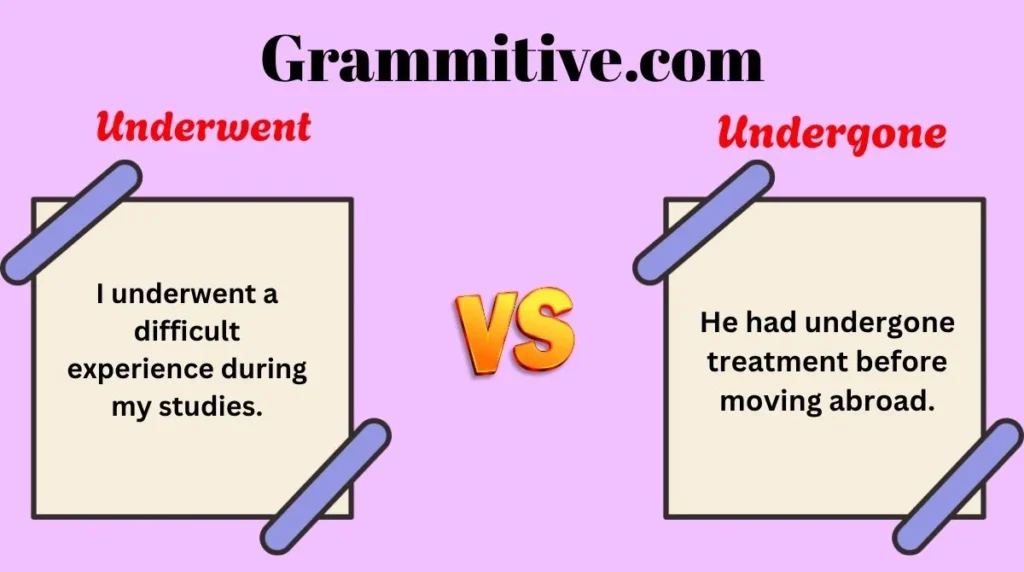
- I underwent a difficult experience during my studies.
- The building underwent repairs after the storm.
- He underwent a lot of stress during exams.
- The system underwent testing before launch.
Common Learner Confusion
Many students try to use underwent with helping verbs like has or have, which is incorrect.
❌ He has underwent surgery.
✅ He has undergone surgery.
Remember: underwent is only for past simple, not for perfect tenses.
What Does “Undergone” Mean?
Simple Definition:
Undergone is the past participle form of undergo. It is used with helping verbs like has, have, or had.
When to Use It
Use undergone in perfect tenses, such as:
- Present perfect
- Past perfect
- Future perfect
Grammar Rule
- Base verb: undergo
- Past participle: undergone
- Structure:
Subject + has/have/had + undergone + object
Example Sentences
- He has undergone surgery recently.
- She has undergone many changes in life.
- They have undergone special training.
- The company has undergone major improvements.
- I have undergone a tough time this year.
- The building has undergone repairs.
- He had undergone treatment before moving abroad.
- By next year, she will have undergone full training.
Common Learner Confusion
Some learners forget to use helping verbs.
❌ He undergone surgery.
✅ He has undergone surgery.
Also, some students use undergone as a past simple verb, which is incorrect.
❌ He undergone surgery last year.
✅ He underwent surgery last year.
Difference Between Underwent and Undergone (Detailed)
Understanding the difference becomes easy when you focus on grammar structure and time.
Comparison Table
| Feature | Underwent | Undergone |
|---|---|---|
| Verb Form | Past Simple | Past Participle |
| Time | Finished past | Used in perfect tenses |
| Helping Verb Needed | No | Yes (has/have/had) |
| Example | He underwent surgery | He has undergone surgery |
Usage Difference
- Underwent is used when the action is completely finished in the past.
- Undergone is used when the action connects to the present or another time.
Grammar Logic
Think of underwent as a standalone verb.
It does not need support from other verbs.
Think of undergone as a helper form.
It must always come with has, have, or had.
Sentence Structure Difference
- Underwent:
➤ She underwent surgery yesterday. - Undergone:
➤ She has undergone surgery.
Meaning Comparison
Both words have the same basic meaning:
to experience something difficult or important
But the difference is in how the sentence is built, not the meaning itself.
Grammar Rules You Must Remember
Rule #1: Use “Underwent” for Past Simple
Use underwent when the time is clearly in the past.
✔ He underwent surgery in 2022.
Rule #2: Use “Undergone” with Helping Verbs
Always use undergone with has, have, or had.
✔ She has undergone treatment.
Rule #3: Never Use “Underwent” with “Has/Have”
❌ He has underwent training.
✔ He has undergone training.
Rule #4: Never Use “Undergone” Alone
❌ She undergone a change.
✔ She has undergone a change.
Common Mistakes Students Make
Why Mistakes Happen
- Similar spelling
- Same meaning
- Confusion about verb forms
- Weak understanding of perfect tenses
Wrong vs Correct Examples
❌ He has underwent surgery.
✔ He has undergone surgery.
❌ She undergone training last year.
✔ She underwent training last year.
❌ They undergone many changes.
✔ They have undergone many changes.
Easy Correction Tips
- Look for helping verbs (has/have/had)
- If you see one → use undergone
- If not → use underwent
Easy Trick to Remember the Difference
Here’s a simple trick:
👉 Underwent = Went = Past
👉 Undergone = Done = With “has/have/had”
Think like this:
- “Went” works alone → underwent
- “Done” needs help → undergone
This small trick helps you remember quickly during exams or speaking.

Daily Life Examples (Very Important)
These are common spoken English sentences:
- I underwent a medical test yesterday.
- She has undergone a big change recently.
- He underwent training before joining the job.
- They have undergone many challenges together.
- I underwent a stressful week.
- She has undergone surgery twice.
- The car underwent repairs last month.
- The system has undergone updates.
- He underwent a personality change after college.
- We have undergone a lot this year.
These examples show how natural and useful these words are in daily conversation.
Practice Section
Choose the correct option:
- He has ______ surgery.
(underwent / undergone) - She ______ training last year.
(underwent / undergone) - They have ______ many changes.
(underwent / undergone) - I ______ a difficult time yesterday.
(underwent / undergone) - He had ______ treatment before moving.
(underwent / undergone)
Answers
- undergone
- underwent
- undergone
- underwent
- undergone
FAQs
1. What is the difference between underwent and undergone?
Underwent is past simple, used for completed actions. Undergone is past participle, used with helping verbs like has or have.
2. Can we use “undergone” without helping verbs?
No. Undergone always needs has, have, or had. Without them, the sentence is incorrect.
3. Is “underwent” used in present tense?
No. It is only used for past actions that are finished.
4. Can I say “has underwent”?
No, this is incorrect. The correct form is “has undergone.”
5. Is this used in formal or informal English?
Both words are slightly more formal, but they are still used in daily conversations, especially in serious situations.
6. Why do these words confuse learners?
Because they look similar and come from the same verb. The real difference is in grammar, not meaning.
Final Conclusion
Understanding the difference between underwent and undergone becomes much easier once you focus on verb forms.
Both words come from undergo and share the same meaning, but they belong to different grammar structures.
Underwent is used for simple past actions. It stands alone and talks about something that already happened.
On the other hand, undergone is used in perfect tenses and always needs helping verbs like has, have, or had.
The key is to check your sentence. If there is a helping verb, use undergone. If not, and the action is in the past, use underwent.
Practice is very important. Try making your own sentences and speaking them out loud.
Over time, the difference will feel natural, and you will use both words correctly without thinking too much.
Keep learning step by step. English becomes easier when you understand the small details.

I am Lucas Bennett, a digital content creator passionate about social media trends and online growth strategies.
I share practical insights and guides to help users better understand and navigate the digital world.