

English learners often get confused between phrases like “in the east coast” and “on the east coast.”
At first glance, these prepositions—”in” and “on”—may seem interchangeable. After all, both can describe a location.
But in English, using the wrong one can make a sentence sound unnatural or even incorrect. This confusion is common not only for beginners but also for advanced learners.
Understanding the difference between “in” and “on” is important because these words appear everywhere:
in conversation, writing, directions, news, and stories. Knowing the correct usage will help you sound more fluent, accurate, and confident.
Imagine talking about living somewhere or giving directions but accidentally saying “in the east coast”—a native speaker would notice immediately.
Grammar is not just rules; it’s how we communicate naturally.
By the end of this guide, you will clearly understand when to use “in the east coast” versus “on the east coast.”
You will learn simple grammar rules, see examples from real-life conversations, and even have practice exercises to test yourself.
This lesson is designed to be easy to read, simple to understand, and full of helpful tips, so you can finally feel confident using these phrases correctly in everyday English.
What Does “In the East Coast” Mean?
The phrase “in the east coast” is often used by learners but it is actually considered grammatically incorrect by native speakers. Let’s break it down.
Simple Definition
“In” is a preposition that usually refers to something inside a space, area, or boundary. We use it when we talk about cities, countries, rooms, or other enclosed areas.
For example:
- “I live in New York.”
- “She is in her room.”
When Learners Use It
Some learners say “in the east coast” because they think of the coast as a large area or region. This makes sense logically because we often say “in the south,” “in the north,” or “in Europe.” But English has a special rule for coasts and islands.
Grammar Rule
The correct rule is:
- Use “in” for enclosed spaces, countries, cities, and neighborhoods.
- Do not use “in” with coasts, shores, or surfaces. Use “on” instead.
Incorrect Examples (Learners Often Say These)
- I live in the east coast of the United States. ❌
- She enjoys holidays in the east coast. ❌
- There are many beaches in the east coast. ❌
Why It Confuses Learners
Learners know that “in” is used for large areas, but they forget that “coast” is seen as a line or surface, not an enclosed area. English treats coasts differently from countries or cities.
What Does “On the East Coast” Mean?
Now let’s talk about the correct phrase: “on the east coast.”
Simple Definition
“On” is a preposition that usually refers to surfaces or lines. When we say “on the east coast,” we mean the eastern edge of a country that touches the ocean.
When to Use It
- To talk about living or being at the coast.
- To describe geography, like cities along the coast.
- To indicate general location along the edge of a country or region.
Grammar Rule
- Use “on” for surfaces, streets, islands, and coasts.
- Think of it as standing on a line or edge rather than being inside a place.
Correct Examples
- I live on the east coast of the United States. ✅
- Many tourists enjoy vacations on the east coast. ✅
- The hurricane hit cities on the east coast. ✅
- She moved to Florida, which is on the east coast. ✅
- We have friends who live on the east coast. ✅
- The company has offices on the east coast. ✅
- Many famous universities are located on the east coast. ✅
- Beaches on the east coast are crowded in summer. ✅
Common Learner Confusion
The confusion comes from mixing the logic of large areas (where you use “in”) and surfaces (where you use “on”). Coasts are considered surfaces in English, so “on the east coast” is always correct.
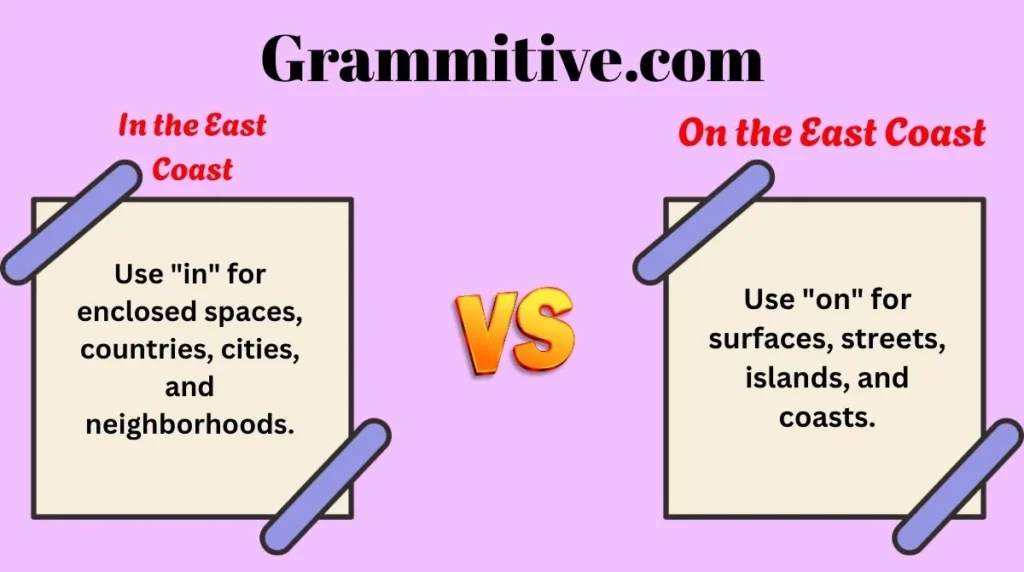
Difference Between “In the East Coast” and “On the East Coast”
Here is a detailed comparison to make it clear:
| Feature | In the East Coast | On the East Coast |
|---|---|---|
| Correctness | ❌ Incorrect | ✅ Correct |
| Grammar Logic | Used for enclosed areas | Used for surfaces or lines |
| Common Usage | Rare, often learner error | Standard in spoken and written English |
| Example Sentence | I live in the east coast. ❌ | I live on the east coast. ✅ |
| When to Use | Not recommended | Always for coasts or shores |
| Real-life Conversations | Sounds unnatural | Natural and fluent |
Explanation
- “In” makes it sound like the east coast is an enclosed box, which it is not.
- “On” treats the coast as a line along the ocean, which matches English grammar logic.
- Even when referring to large areas along the east coast, always use “on.”
Grammar Rules You Must Remember
Rule #1: Use “in” for enclosed areas
- Cities, countries, rooms, neighborhoods
- Example: I live in London. ✅
Rule #2: Use “on” for surfaces and lines
- Coasts, streets, islands, edges
- Example: I live on Main Street. ✅
Rule #3: Use “on” for coasts
- Even if it is a large region
- Example: Many people vacation on the east coast. ✅
Rule #4: Think logically about the preposition
- Ask yourself: Am I inside it or standing on it?
- Inside → in
- On top/surface → on
- Example: I am in the city but on the coast. ✅
Common Mistakes Students Make
Mistake #1: Using “in” with coasts
- Wrong: I grew up in the east coast. ❌
- Correct: I grew up on the east coast. ✅
- Tip: Remember coasts are surfaces, not enclosed areas.
Mistake #2: Confusing “in” and “on” with countries and islands
- Wrong: I live on Germany. ❌
- Correct: I live in Germany. ✅
- Tip: Use “in” for countries, islands, and cities, unless the island is small or a surface line.
Mistake #3: Overgeneralizing from “in” with regions
- Wrong: I live in the north coast. ❌
- Correct: I live on the north coast. ✅
- Tip: Regions along water are almost always “on.”
Mistake #4: Thinking “on” is informal
- Wrong assumption: “On the east coast” is casual. ❌
- Reality: It is grammatically correct and natural in all contexts. ✅
Easy Trick to Remember the Difference
Think of a line along the water. When you are talking about a coast, imagine standing on the edge of the land, not inside it. That edge is why English uses “on”.
Memory Trick:
- Inside → in (inside a room, city, or country)
- Surface/Edge → on (coast, street, island edge)
This trick works for other similar prepositions too:
- On the beach ✅
- On the island ✅
- In the city ✅
- In the country ✅

Daily Life Examples
- My cousin lives on the east coast of Canada.
- We are planning a trip to Florida on the east coast.
- The storm caused damage to homes on the east coast.
- Many tech companies are based on the east coast.
- I grew up on the east coast, near the Atlantic Ocean.
- The summer festival happens every year on the east coast.
- Beaches on the east coast are always busy in July.
- I love seafood restaurants on the east coast.
- Universities on the east coast are known worldwide.
- Cruise ships depart from cities on the east coast.
Practice Section
Choose the correct option:
- I live ___ the east coast of the USA.
- a) in ✅
- b) on ❌
- Many people vacation ___ the east coast.
- a) on ✅
- b) in ❌
- She moved ___ New York.
- a) on ❌
- b) in ✅
- The hurricane affected cities ___ the east coast.
- a) in ❌
- b) on ✅
- I spent my summer ___ the east coast last year.
- a) on ✅
- b) in ❌
Answers: 1-b, 2-a, 3-b, 4-b, 5-a
FAQs
1. What is the difference between “in the east coast” and “on the east coast”?
- “In the east coast” is incorrect because coasts are not enclosed areas. “On the east coast” is correct for locations along the coastline.
2. Can we use “in the east coast” in questions?
- No, native speakers use “on the east coast.” Example: Are you living on the east coast?
3. Is “on the east coast” formal or informal?
- It is neutral and correct for both formal and informal English.
4. Can we use “in” with other coasts?
- No, always use “on”. Example: On the west coast, on the north coast.
5. What about islands?
- Use “in” for big islands and countries (e.g., in Japan). Use “on” for small islands or edges (e.g., on Long Island).
6. Why is “on” used instead of “in” for coasts?
- Because English treats coasts as surfaces or lines, not enclosed areas. “On” shows standing on a line.
Final Conclusion
Learning the difference between “in the east coast” and “on the east coast” is easier when you understand the logic behind prepositions.
Coasts are surfaces, so we always use “on.” Countries, cities, and enclosed spaces use “in.”
By remembering this simple rule, you can avoid common mistakes and sound natural in English.
Practice using “on the east coast” in sentences, conversations, and writing. Soon, it will feel completely normal.
Prepositions can be tricky, but with clear examples and practice, you will master them.

I am Lucas Bennett, a digital content creator passionate about social media trends and online growth strategies.
I share practical insights and guides to help users better understand and navigate the digital world.