
English learners often get confused when they see phrases like “answer to the question” and “answer of the question.”
This confusion comes from small words called prepositions—like for, to, and of—that change the meaning of a sentence completely.
Many beginners ask, “Which one is correct?” or “Can I use both?” The truth is, using the wrong preposition can make your sentence sound strange or even wrong in English.
Understanding the correct usage of answer to the question versus answer of the question is essential for speaking, writing, and reading English correctly.
You will see these phrases in school exams, emails, online articles, and everyday conversation. Choosing the right preposition helps you sound natural and clear.
By the end of this guide, you will understand exactly when to use to and when to use of with “answer.”
You’ll also learn the grammar rules behind them, common mistakes students make, easy memory tricks, and real-life examples.
This will make it simple for you to write correct sentences and feel confident using English in daily life.
What Does “Answer to” Mean?
The phrase “answer to” is the most common and natural way to connect the word answer with a question, problem, or situation. It shows the relationship between the answer and the question.
Definition
“Answer to” means the reply or solution given in response to a question or problem.
When to Use It
- When referring to a specific question or problem.
- In both formal and informal situations.
- In spoken and written English.
Grammar Rule
- Use “answer to + [noun/question]”
- Example structure: answer to the question/problem/challenge
Examples
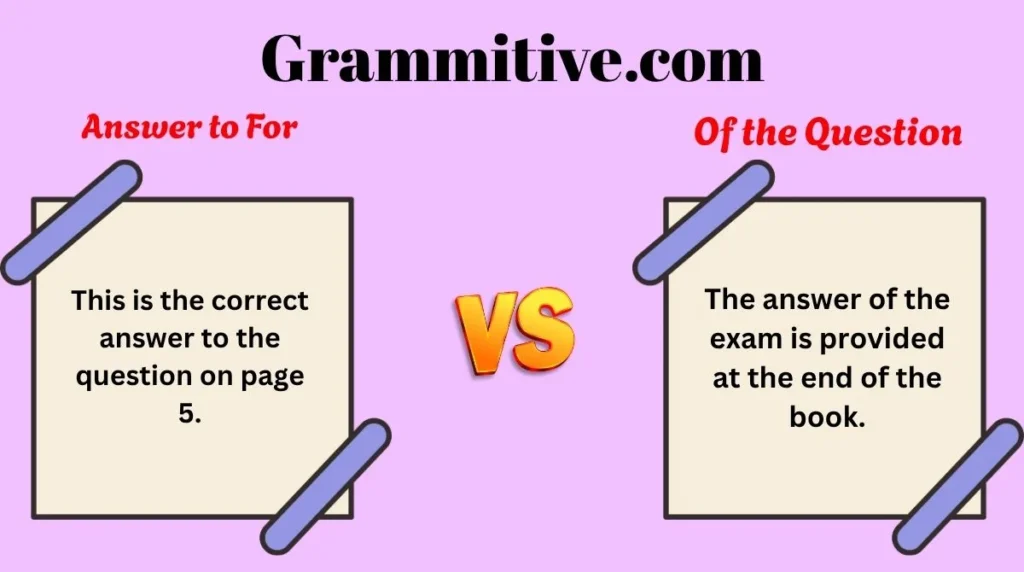
- This is the correct answer to the question on page 5.
- I don’t know the answer to your problem.
- She gave a quick answer to the teacher’s query.
- The student couldn’t find the answer to the puzzle.
- Can you provide an answer to this difficult question?
- He didn’t have an immediate answer to my request.
- The company finally found an answer to the customer’s complaint.
- I found the answer to yesterday’s riddle online.
Common Learner Confusion
Beginners often say answer of the question, thinking it’s the same. This is not standard English and sounds awkward. Remember: “to” shows the connection between the answer and the question, which is why it is correct.
What Does “Answer of” Mean?
The phrase “answer of” is less common in modern English. It is mostly used in formal or poetic contexts, and sometimes to indicate ownership rather than response.
Definition
“Answer of” can mean the content or result of an answer, but it is rarely used in daily speech.
When to Use It
- Mostly in literary or historical English.
- When emphasizing the answer itself rather than its connection to a question.
- Rarely in exams or conversation.
Grammar Rule
- Use “answer of + [noun]” when emphasizing the answer itself.
- Example structure: the answer of the students / the answer of the letter
Examples
- The answer of the student was carefully written.
- Scholars studied the answer of the ancient text.
- I noted the answer of each participant in the survey.
- The answer of the problem is in the appendix.
- His answer of refusal surprised everyone.
- The answer of the exam is provided at the end of the book.
- She highlighted the answer of the riddle on the board.
- The answer of the questionnaire is confidential.
Common Learner Confusion
- Many students replace to with of, thinking it’s interchangeable.
- Using answer of the question in normal conversation sounds unnatural.
- Remember: “of” emphasizes ownership, not the connection.
Difference Between “Answer to” and “Answer of”
Understanding the subtle difference can make your English sound native.
| Feature | Answer to | Answer of |
|---|---|---|
| Meaning | Shows response to a question/problem | Shows ownership or content of an answer |
| Preposition | To | Of |
| Usage | Most common in daily English, exams, conversations | Rare, formal, literary, or historical usage |
| Sentence structure | Answer to + question/problem | Answer of + noun (rare) |
| Naturalness | Very natural | Can sound awkward in conversation |
| Examples | “Answer to the question is correct.” | “Answer of the student was detailed.” |
Usage Difference
- Use “answer to” whenever you mean a reply or solution.
- Use “answer of” only if focusing on the answer itself as a noun or object.
Grammar Logic
- To links the answer toward something, which makes sense for a reply.
- Of indicates possession, which is less common in modern English for this context.
Sentence Structure Difference
- Answer to: subject + verb + answer to + question
Example: “I know the answer to the test question.” - Answer of: subject + verb + answer of + noun (rare)
Example: “The answer of the students was analyzed.”
Meaning Comparison
- Answer to the question → “This is the solution you were looking for.”
- Answer of the question → “This is the content of the answer itself.”
Grammar Rules You Must Remember
Rule #1: Always Use “Answer to” for Questions
- Correct: She wrote the answer to the question.
- Incorrect: She wrote the answer of the question.
Rule #2: “Of” Shows Possession or Description
- Correct: The answer of the students was impressive.
- Incorrect: The answer to the students was impressive.
Rule #3: Use “Answer to” in Spoken English
- Always stick with “answer to” in conversation:
Example: “Do you know the answer to this riddle?”
Rule #4: Use “Answer of” Only in Formal Writing
- Example: “The answer of the committee was published in the report.”
Common Mistakes Students Make
Many students say things like:
- “I don’t know the answer of the question.”
- “Please give me the answer of the problem.”
Why this happens:
- They translate from their native language literally.
- They confuse “to” and “of” as interchangeable.
Corrected Examples:
- Wrong: I don’t know the answer of the question.
- Correct: I don’t know the answer to the question.
Easy Correction Tip:
Ask yourself: Am I replying to something, or talking about the answer itself?
- Reply → use to
- Ownership → use of
Easy Trick to Remember the Difference
Think of it this way:
- Answer to = direction → the answer goes to the question.
- Answer of = belongs to → the answer of the student.
A simple memory trick:
- If you can replace it with “for” in your head: answer to the question = answer for the question → sounds correct.
- If it emphasizes “belonging,” then “of” is acceptable but rarely used.
This logic works in real-life conversations and exams.
Daily Life Examples
Here are real-life examples you can use every day:
- Do you know the answer to the homework question?
- I finally found the answer to my problem.
- She couldn’t think of an answer to the teacher’s question.
- The student asked for the answer to yesterday’s test.
- Can you give me the answer to this tricky puzzle?
- I wrote the answer to the assignment in my notebook.
- The teacher explained the answer to the question very clearly.
- He emailed the answer to the customer’s inquiry.
- We discussed the answer to the survey question in class.
- I found the answer to the riddle online.
Notice how “answer to” is used naturally in every conversation.
Practice Section
Choose the correct option:
- I don’t know the ___ this question.
a) answer to
b) answer of - She wrote the ___ the homework clearly.
a) answer to
b) answer of - Can you give me the ___ the test question?
a) answer to
b) answer of - The ___ the students was detailed.
a) answer to
b) answer of - He sent the ___ the customer complaint yesterday.
a) answer to
b) answer of
Answers:
- a) answer to
- a) answer to
- a) answer to
- b) answer of
- a) answer to
FAQs
1. What is the difference between “answer to” and “answer of”?
“Answer to” shows a reply to a question. “Answer of” emphasizes ownership of the answer, rarely used.
2. Can we use “answer of” in questions?
Not normally. In spoken or exam English, always use “answer to” for questions.
3. Is “answer to” formal or informal?
It is natural in both formal and informal English. Always correct to use.
4. Is “answer of the question” correct?
It sounds unnatural. Only use “answer of” when focusing on ownership in formal writing.
5. Can I say “answer for the question”?
Some learners say it, but “answer to the question” is correct and sounds more natural.
6. How can I remember which preposition to use?
Think: the answer goes to the question. Ownership or content → of.
Final Conclusion
Understanding answer to the question versus answer of the question is a small but powerful step in mastering English.
Using the wrong preposition can confuse readers or listeners, but using the right one shows clarity and confidence.
Beginners often struggle with this because their native language might not use prepositions in the same way.
Remember the simple trick:
- Reply → use to
- Ownership → use of
Practice using “answer to” in conversations, homework, and emails. Soon, it will become natural, and you won’t have to think twice.
English is all about small details like this, and mastering them makes a big difference in how native-like you sound.
Keep practicing, notice how native speakers use these phrases, and correct mistakes gently.
With time, “answer to the question” will feel automatic every time you speak or write.

I am Lucas Bennett, a digital content creator passionate about social media trends and online growth strategies.
I share practical insights and guides to help users better understand and navigate the digital world.