

English learners often stumble over small phrases that seem simple but hide tricky grammar rules. One of these is “couple of hours” versus “couple hours.”
At first glance, they look almost the same. But using them correctly can make your English sound fluent and natural—or awkward and wrong.
Many students, especially non-native speakers, mix these phrases because in everyday conversation, people speak quickly, sometimes dropping words.
You might hear someone say, “It will take a couple hours,” and think it’s correct. But grammatically, there’s a subtle difference that can change the way your sentence feels.
Why does it matter? Understanding the difference improves your spoken English, writing, and comprehension.
It helps you sound like a native speaker and avoid common mistakes. This knowledge is not just for exams—it’s for real-life situations, from chatting with friends to writing emails at work.
By the end of this guide, you will clearly know:
- What “couple of hours” means and when to use it
- Why “couple hours” is considered informal or less correct
- How to choose the right phrase depending on grammar and style
- Simple tricks and examples that make remembering easy
We’ll explore definitions, grammar rules, examples, common mistakes, and real-life usage. You’ll even get practice sentences to test yourself.
What Does “Couple of Hours” Mean?
Definition:
The phrase “couple of hours” refers to two hours or roughly two hours. The word “couple” is a noun meaning “two,” and “of hours” shows the measurement of time.
When to use it:
Use “couple of hours” in both spoken and written English to indicate approximately two hours. This is considered the standard and grammatically correct form.
Grammar rule:
- “Couple” always requires “of” when followed by a plural noun.
- Structure: couple + of + plural noun
- Example: couple of days, couple of friends, couple of questions
Example sentences:
- I’ll be back in a couple of hours.
- She finished the project in just a couple of hours.
- We waited for a couple of hours at the airport.
- Can you give me a couple of minutes to think?
- He stayed there for a couple of weeks before moving.
- They spent a couple of hours fixing the car.
- A couple of hours ago, it started raining.
- I’ll call you in a couple of hours once I arrive.
Common learner confusion:
Many students drop “of” because they hear native speakers skip it in fast speech. For example: “It takes a couple hours” sounds natural when spoken, but it’s less formal and grammatically incomplete.
What Does “Couple Hours” Mean?
Definition:
“Couple hours” is an informal, colloquial version of “couple of hours”. It drops the word “of”, which is required in standard grammar.
When to use it:
- Mainly in spoken English
- Common in American casual conversation
- Often used for brevity or casual text messages
Grammar rule:
- Technically, “couple” is a noun, so it should have “of” before a plural noun.
- Without “of”, it becomes an adjective-like modifier, which is informal.
Example sentences:
- I’ll be back in a couple hours.
- She finished it in a couple hours, no problem.
- We waited for a couple hours at the bus stop.
- Can you give me a couple hours to complete this?
- He’ll arrive in a couple hours.
- They fixed the car in a couple hours.
- I’ll see you in a couple hours at the café.
- It started raining a couple hours ago.
Common learner confusion:
- Students often assume dropping “of” is always acceptable because they hear it in movies or TV shows.
- Remember: it’s not incorrect in casual speech, but it’s not suitable for writing, exams, or formal conversation.
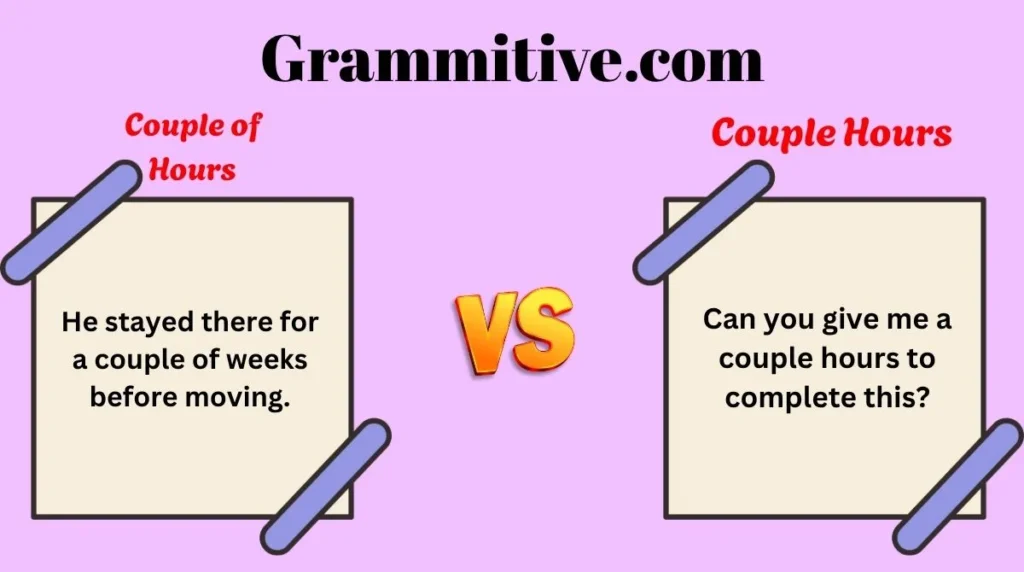
Difference Between Couple of Hours and Couple Hours
Understanding the difference becomes clear when you look at grammar, style, and usage side by side.
| Feature | Couple of Hours | Couple Hours |
|---|---|---|
| Grammar | Correct standard form | Informal, casual |
| Structure | couple + of + plural noun | couple + plural noun |
| Formality | Formal & neutral | Informal & spoken |
| Usage | Writing, speaking, professional contexts | Mostly spoken, texting, casual chats |
| Example | I’ll return in a couple of hours. | I’ll return in a couple hours. |
| Native feel | Standard and safe | Sounds casual, like quick speech |
| Exam-friendly | ✅ Yes | ❌ Not recommended |
Grammar logic:
- “Couple” is a noun, so it needs “of” before a plural noun to be grammatically complete.
- Dropping “of” turns it into a phrase that sounds like an adjective, which is why native speakers do it in conversation, but grammarians mark it as informal.
Sentence structure difference:
- Correct: “I’ll wait for a couple of hours before leaving.”
- Casual: “I’ll wait for a couple hours before leaving.”
Meaning comparison:
- Both phrases communicate roughly the same time (around two hours).
- The difference is formal correctness versus casual usage.
Grammar Rules You Must Remember
Rule #1: Always use “of” in formal writing
- Correct: I need a couple of hours to finish this.
- Wrong: I need a couple hours to finish this.
Rule #2: “Couple” + “of” + plural noun
- Correct: A couple of friends joined the party.
- Wrong: A couple friends joined the party.
Rule #3: Use “couple hours” only in spoken English
- Spoken example: “Can you wait a couple hours?”
- Writing example: Avoid it; use “couple of hours” instead.
Rule #4: Time and quantity phrases often require “of”
- Correct: couple of days, pair of shoes, bunch of flowers
- Incorrect: couple days, pair shoes, bunch flowers
Common Mistakes Students Make
Why mistakes happen:
- Learners imitate casual speech from TV, movies, or friends.
- “Of” feels unnecessary in fast conversation.
- Exams and formal writing require strict grammar rules.
Wrong vs Correct examples:
- Wrong: I’ll finish this in a couple hours.
Correct: I’ll finish this in a couple of hours. - Wrong: We waited a couple hours at the train station.
Correct: We waited a couple of hours at the train station. - Wrong: Can you lend me a couple minutes?
Correct: Can you lend me a couple of minutes?
Easy correction tips:
- Ask yourself: “Am I writing formally or speaking casually?”
- Formal → always use “of”
- Casual speech → dropping “of” is okay, but avoid it in writing
Easy Trick to Remember the Difference
Think of “of” as glue that connects “couple” to the noun. Without it, the phrase feels loose and incomplete.
Memory trick:
- Imagine: “a couple of hours” = two solid hours glued together.
- “Couple hours” = floating hours, less formal, just spoken.
Real-life logic:
- Writing an email to your teacher? Use “couple of hours”.
- Chatting with a friend? “See you in a couple hours” works fine.

Daily Life Examples
Here are examples from everyday conversations:
- I’ll meet you in a couple of hours at the café.
- Can you wait a couple of hours before calling again?
- She finished the homework in a couple of hours.
- He’ll arrive in a couple hours—I just texted him.
- We’ll leave in a couple of hours, so get ready.
- It takes a couple of hours to drive to the beach.
- I’ll check the report in a couple hours.
- They repaired the car in a couple of hours.
- A couple of hours ago, it started snowing.
- I’ll call you back in a couple hours, don’t worry.
Notice how casual speech drops “of”, but in written English, including “of” always sounds better.
Practice Section
Choose the correct option for each sentence:
- I’ll be ready in a (couple of hours / couple hours).
- She stayed there for a (couple of weeks / couple weeks).
- Can you wait a (couple of minutes / couple minutes)?
- He fixed the bike in a (couple of hours / couple hours).
- A (couple of days / couple days) ago, we visited the museum.
Answers:
- couple of hours
- couple of weeks
- couple of minutes
- couple of hours
- couple of days
FAQs
1. What is the difference between “couple of hours” and “couple hours”?
- “Couple of hours” is correct in formal writing; “couple hours” is casual spoken English.
2. Can we use “couple hours” in questions?
- Yes, but only in informal speech. Example: “Can you wait a couple hours?”
3. Is “couple of hours” formal or informal?
- It’s neutral and correct in both formal and informal English.
4. Why do native speakers say “couple hours” sometimes?
- They drop “of” in fast, casual conversation for brevity.
5. Can “couple of hours” be used in text messages?
- Yes, but many people shorten it to “couple hours” in texting.
6. What other phrases are similar to “couple of hours”?
- A few hours, a pair of hours, several hours. Remember to include “of” in formal usage.
Final Conclusion
Mastering “couple of hours” vs “couple hours” may seem small, but it makes a big difference in how fluent and natural your English sounds. Always remember:
in writing and formal speech, include “of”. In casual conversation, you can drop it without major issues.
Practice noticing how native speakers use these phrases in movies, YouTube videos, or real conversations.
Try using both forms in sentences until it feels natural. The more you practice, the faster your brain learns the grammar instinctively.
By understanding this tiny but important detail, you take one step closer to sounding like a confident English speaker, ready for both professional and casual settings.

I am Lucas Bennett, a digital content creator passionate about social media trends and online growth strategies.
I share practical insights and guides to help users better understand and navigate the digital world.