
Many English learners feel confused when they see words like “thus” and “hence.” At first look, both words seem very similar.
They both talk about results or reasons. Because of this, students often mix them up in writing and speaking.
These words are common in formal English, academic writing, business emails, and exams.
But even in daily English, you may hear them in speeches, explanations, or reports. The problem is not that they are difficult words.
The real problem is that learners are never clearly told how they are different.
Sometimes students write sentences like “I was late, thus I missed the bus” or “It was raining, hence I stayed home.”
Both sound correct, but many learners still feel unsure when to use which word. That confusion can affect writing scores, professional emails, and even spoken clarity.
After understanding this guide, everything will feel simple. You will clearly know what “thus” means, what “hence” means, and how they behave in sentences.
You will also see real-life examples, common mistakes, and an easy trick that helps you remember the difference forever.
By the end, you will feel confident using both words in the right place without guessing. Let’s make this confusion disappear step by step in a very simple way.
4️⃣ What Does “Thus” Mean?
“Thus” is a word used to show a result or conclusion. It means “so,” “therefore,” or “in this way.” It is often used in formal writing and sometimes in spoken English when someone is explaining something clearly.
Simple definition:
“Thus” shows the result of something that happened before.
When to use it:
Use “thus” when you want to explain what happened because of something.
Grammar rule:
“Thus” is usually used in the middle or at the beginning of a sentence and is followed by a result.
Example sentences:
- It started raining, thus we canceled the trip.
- She studied hard, thus she passed the exam.
- The road was blocked, thus we took another route.
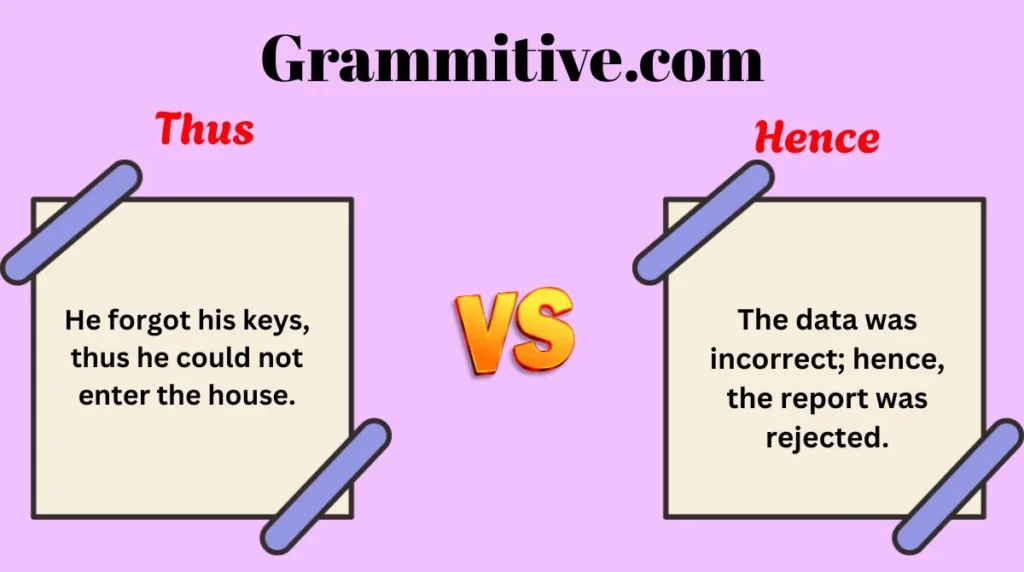
- He forgot his keys, thus he could not enter the house.
- The shop closed early, thus we went home.
- The lights went out, thus the meeting stopped.
- She was sick, thus she did not come to school.
- The prices increased, thus people bought less.
Common learner confusion:
Many students think “thus” is old-fashioned or too formal. That is not true. It is still used in reports, essays, and professional writing. The main confusion happens when learners try to use it like casual spoken English, where “so” is more common.
5️⃣ What Does “Hence” Mean?
“Hence” is also used to show a result or reason. It is similar to “therefore” or “for this reason.” It is slightly more formal than “thus” and is very common in academic and written English.
Simple definition:
“Hence” means “for this reason” or “as a result.”
When to use it:
Use “hence” when you want to explain why something happens or to show a clear conclusion.
Grammar rule:
“Hence” is often used at the beginning of a sentence and is followed by a comma.
Example sentences:
- It was very cold; hence, we stayed inside.
- He was tired; hence, he went to bed early.
- The data was incorrect; hence, the report was rejected.
- She did not study; hence, she failed the test.
- The road was wet; hence, the accident happened.
- He lost his job; hence, he moved to another city.
- The weather was bad; hence, the match was canceled.
- There was no electricity; hence, the class was stopped.
Common learner confusion:
Students often place “hence” incorrectly inside sentences without punctuation. Another mistake is using it in very casual speech, where it can sound too formal or unnatural. In spoken English, people usually prefer “so” instead.
6️⃣ Difference Between “Thus” and “Hence” (Detailed)
Although both words show results, they are not used in the same way. The difference is mainly about tone, placement, and style.
Comparison Table
| Feature | Thus | Hence |
|---|---|---|
| Meaning | So / Therefore | For this reason |
| Formality | Formal | More formal |
| Position | Middle or start | Mostly start |
| Punctuation | No strict rule | Usually followed by comma |
| Usage | Explaining result | Explaining reason |
| Spoken English | Rare | Very rare |
| Written English | Common | Very common |
Usage Difference:
- “Thus” focuses more on showing the result of an action.
- “Hence” focuses more on explaining the reason or cause of something.
Grammar Logic:
- “Thus” connects action → result
- “Hence” connects cause → result
Sentence Structure Difference:
- Thus: Action, thus result
Example: He was late, thus he missed the train. - Hence: Cause; hence, result
Example: He was late; hence, he missed the train.
Meaning Comparison:
Both can sometimes replace each other, but the tone changes slightly. “Hence” feels more logical and reasoning-based, while “thus” feels more like a direct outcome.
7️⃣ Grammar Rules You Must Remember
Rule #1: “Thus” shows direct result
If one action clearly leads to another result, use “thus.”
Example: It rained heavily, thus the match was stopped.
Rule #2: “Hence” often starts a sentence
“Hence” is usually placed at the beginning with a semicolon before it.
Example: The machine broke; hence, production stopped.
Rule #3: “Thus” is smoother in writing flow
Use it when you want your sentence to feel connected and smooth.
Example: She worked hard, thus she succeeded.
Rule #4: “Hence” sounds more logical and formal
Use it in academic writing or formal reasoning.
Example: The results were unclear; hence, further research is needed.
8️⃣ Common Mistakes Students Make
Mistake 1: Using both words like casual speech
Wrong: I was hungry thus hence I ate food.
Correct: I was hungry, thus I ate food.
Mistake 2: Wrong punctuation with “hence”
Wrong: It was late hence we left.
Correct: It was late; hence, we left.
Mistake 3: Overusing in speaking
Many learners try to use these words in daily conversation. Native speakers usually say “so” instead.
Mistake 4: Mixing meaning
Wrong thinking: both are exactly the same in every situation.
Truth: They are similar but not identical in tone and structure.
Easy correction tip:
If your sentence sounds too heavy or formal, replace with “so.” If writing formally, choose “thus” or “hence” carefully.
9️⃣ Easy Trick to Remember the Difference
Here is a simple memory trick:
- “Thus = This result”
- “Hence = Here’s the reason”
Think like this:
- “Thus” shows what happens next (result).
- “Hence” shows why it happens (reason).
Another simple idea:
- Thus = action leads to result
- Hence = reason leads to result
If you remember just this, you will rarely make mistakes again.
🔟 Daily Life Examples (Very Important)
- I forgot my umbrella, thus I got wet.
- It was too hot, hence we turned on the fan.
- She was tired, thus she slept early.
- The food was bad; hence, we did not finish it.
- I missed the bus, thus I was late for work.
- The shop was closed; hence, we went back home.
- He didn’t study, thus he failed the test.
- It was a holiday, hence the office was closed.
- The phone was broken, thus I couldn’t call you.
- The weather was bad; hence, the picnic was canceled.
1️⃣1️⃣ Practice Section
Choose the correct word (thus / hence):
- It was raining heavily; ___ we stayed home.
- She forgot her notes, ___ she could not answer.
- He was sick, ___ he did not attend class.
- The shop was closed, ___ we went back.
- I was tired, ___ I slept early.
Answers:
- hence
- thus
- hence
- hence
- thus
1️⃣2️⃣ FAQs
1. What is the difference between thus and hence?
Both show results, but “thus” shows direct outcome while “hence” shows reason or cause. “Hence” is more formal.
2. Can we use thus in speaking English?
Yes, but it is rare. In daily speaking, people usually say “so” instead of “thus.”
3. Is hence formal or informal?
“Hence” is formal and mostly used in writing, academic work, and reports.
4. Can thus and hence be used interchangeably?
Sometimes yes, but not always. The tone and sentence structure may change.
5. Where should we place hence in a sentence?
Usually at the beginning after a semicolon, followed by a comma.
6. Which is more common in exams?
Both appear in exams, but “thus” is more common in sentence completion and essays.
1️⃣3️⃣ Final Conclusion
Understanding the difference between “thus” and “hence” makes your English writing clearer and more professional.
Both words show results, but they work in slightly different ways. “Thus” focuses more on direct results, while “hence” explains reasons and logical outcomes in a more formal style.
Many learners struggle with these words because they look similar, but once you see their structure and usage, the confusion becomes easy to solve.
The key is practice. Try using both words in simple sentences first, then slowly apply them in writing tasks or exams.
Remember the simple trick: “Thus = result” and “Hence = reason.” This small idea will help you avoid mistakes in the future.
Keep reading, keep practicing, and don’t worry about perfection. With time, these words will become a natural part of your English.
Small grammar improvements like this can make a big difference in how confident your English sounds.

I am Lucas Bennett, a digital content creator passionate about social media trends and online growth strategies.
I share practical insights and guides to help users better understand and navigate the digital world.