
Many English learners get confused when they try to speak or write simple daily sentences like asking about value, effort, or results.
One of the most common mistakes is saying “Does it worth it?” instead of “Is it worth it?”. At first, both may sound similar, but only one is grammatically correct in English.
This confusion happens because learners often try to directly translate from their native language into English.
In many languages, a verb like “does” is used to form questions, so students naturally try to apply the same rule everywhere.
But English does not always work in that way, especially with phrases like “worth it.”
Understanding this difference is very important because this phrase is used in daily conversations, exams, interviews, and even social media.
If you use it incorrectly, your sentence may sound unnatural or wrong to native speakers.
After reading this guide, you will clearly understand why “Is it worth it?” is correct, why “Does it worth it” is wrong, and how to use “worth it” confidently in real-life English.
You will also learn simple grammar rules, common mistakes, and easy tricks that will help you never forget the correct form again.
4️⃣ What Does “Worth It” Mean?
Before understanding the grammar mistake, it is important to first understand the phrase “worth it.”
✅ Simple Definition
“Worth it” means something is valuable enough to justify the time, money, effort, or risk spent on it.
In simple words:
👉 If something gives you good results or happiness after effort, it is “worth it.”
📌 When to Use “Worth It”
You use “worth it” when:
- You want to talk about value
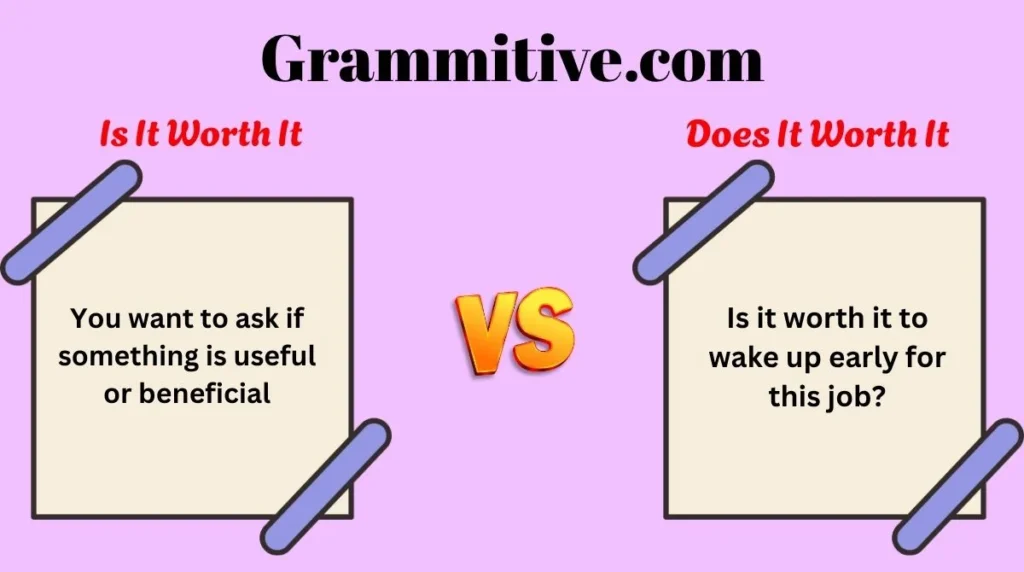
- You want to ask if something is useful or beneficial
- You are comparing effort vs result
- You are giving an opinion about experience
📘 Grammar Rule
“Worth it” is an adjective phrase, not a verb.
This is very important:
❌ It does NOT need “does” or “do”
✔ It works with “is / was / was it”
✏️ Example Sentences
- This movie is worth it.
- The trip was worth it.
- Is this phone worth it?
- The effort was worth it in the end.
- It is not worth it to argue.
- The long wait was worth it.
- Was the cost worth it?
- The experience is worth it for students.
⚠️ Common Learner Confusion
Many students think “worth” is a verb because it looks like one. So they incorrectly try:
❌ Does it worth it?
But “worth” never works like a normal verb in this structure. That is the main reason for confusion.
5️⃣ What Does “Is It Worth It?” Mean?
Now let’s understand the correct question form.
✅ Simple Definition
“Is it worth it?” means:
👉 “Is the result or benefit good enough compared to the effort or cost?”
This is a complete and correct English question.
📌 When to Use “Is It Worth It?”
You use it when:
- Asking for advice
- Comparing effort vs reward
- Making decisions
- Talking about risks or benefits
📘 Grammar Rule
This sentence uses:
- “Is” = helping verb (to be verb)
- “it” = subject
- “worth it” = adjective phrase
Structure:
👉 Is + subject + worth it?
✏️ Example Sentences
- Is it worth it to study abroad?
- Is it worth it to buy this phone?
- Is it worth it to wake up early for this job?
- Is it worth it to travel so far?
- Is it worth it to learn coding?
- Is it worth it to spend money on ads?
- Is it worth it to watch this series?
- Is it worth it to change your career now?
⚠️ Common Learner Confusion
Students often replace “is” with “does,” thinking all questions need “does.” But “worth it” does not work with “does” because it is not a normal action verb.
6️⃣ Difference Between “Is It Worth It” and “Does It Worth It” (Detailed)
This is the most important part of the lesson.
❌ First Phrase: Does It Worth It
- This is grammatically incorrect
- “Worth” is not a verb here
- “Does” cannot be used with adjective phrases like this
✔ Correct Phrase: Is It Worth It
- Grammatically correct
- Uses “to be” verb (is)
- Natural in spoken and written English
📊 Comparison Table
| Feature | Is it worth it? | Does it worth it? |
|---|---|---|
| Grammar Type | Correct | Incorrect |
| Verb Used | “Is” (to be verb) | “Does” (wrong here) |
| Natural English | Yes | No |
| Meaning | Clear and correct | Confusing |
| Usage | Daily conversation | Never used |
🧠 Usage Difference
- “Is it worth it?” → Asking about value or benefit
- “Does it worth it?” → Not valid English structure
🧾 Sentence Structure Difference
✔ Correct:
- Is + it + worth it?
❌ Incorrect:
- Does + it + worth it? (wrong because “worth” is not a verb)
💡 Meaning Comparison
Only one carries meaning in real English:
- ✔ Is it worth it? → meaningful question
- ❌ Does it worth it? → no real meaning in grammar
7️⃣ Grammar Rules You Must Remember
📌 Rule #1: “Worth it” is not a verb
✔ It is an adjective phrase
Example: This phone is worth it.
📌 Rule #2: Use “is/was” not “does”
✔ Correct: Is it worth it?
❌ Wrong: Does it worth it?
📌 Rule #3: “Worth” always needs a subject like “it”
✔ Correct: It is worth it
❌ Wrong: Is worth it (missing subject)
📌 Rule #4: You can use “worth” with -ing form
✔ Example: It is worth watching
✔ Example: It is worth trying
8️⃣ Common Mistakes Students Make
❌ Mistake 1: Using “does”
Wrong: Does it worth it?
Correct: Is it worth it?
👉 Why it happens:
Students try to apply normal question rules.
❌ Mistake 2: Dropping “is”
Wrong: It worth it
Correct: It is worth it
❌ Mistake 3: Mixing verb forms
Wrong: Does it worth?
Correct: Is it worth it?
💡 Easy Fix Tips
- Always think: “worth = value, not action”
- Use “is” instead of “does”
- Remember it as a fixed phrase
9️⃣ Easy Trick to Remember the Difference
Here is a very simple trick:
👉 “Worth it = value, not action”
If there is no action, you never use “does.”
So:
- Action → does/do
- State/value → is/are
Since “worth it” talks about value, always use IS.
🔟 Daily Life Examples (Spoken English)
Here are natural conversations you will hear daily:
- Is it worth it to go there today?
- Yeah, it is totally worth it.
- I don’t think it is worth it.
- Is it worth it to buy this bag?
- This job is worth it for experience.
- Is it worth it to wait in this line?
- The course is worth it for beginners.
- Is it worth it to travel in summer?
- It is definitely worth it.
- Is it worth it to upgrade your phone now?
1️⃣1️⃣ Practice Section
Choose the correct sentence:
- (A) Does it worth it? (B) Is it worth it?
- (A) It worth it (B) It is worth it
- (A) Is it worth it? (B) Does it worth?
- (A) Does this worth it? (B) Is this worth it?
- (A) It is worth it (B) Does it worth it?
✅ Answers:
- B
- B
- A
- B
- A
1️⃣2️⃣ FAQs
❓ 1. What is the correct: “is it worth it” or “does it worth it”?
“Is it worth it” is correct. “Does it worth it” is wrong because “worth” is not a verb.
❓ 2. Can we use “does” with worth?
No, “does” is only used with action verbs, not adjective phrases like “worth it.”
❓ 3. Is “worth it” formal or informal?
It is neutral. You can use it in both formal and informal situations.
❓ 4. Can we say “it worth it”?
No, it is incorrect. You must say “it is worth it.”
❓ 5. Why do people say “does it worth it”?
Because they directly translate from their native language, but English grammar does not work that way.
❓ 6. Can we use “worth it” with -ing form?
Yes. Example: It is worth watching, It is worth trying.
1️⃣3️⃣ Final Conclusion
Understanding the difference between “is it worth it” and “does it worth it” is very important for speaking correct English.
Many learners make this mistake because they try to use “does” everywhere in questions, but English grammar does not work like that.
The phrase “worth it” is not a verb—it is an adjective phrase that talks about value, benefit, or result. That is why it always needs “is,” not “does.”
Once you remember this simple rule, your English will sound much more natural and confident.
Practice it in daily conversations, and soon it will become automatic for you. The more you use it correctly, the more fluent you will sound.
Keep practicing, keep speaking, and don’t worry about small mistakes—they are part of learning. Every correct sentence you use brings you one step closer to fluent English.

I am Lucas Bennett, a digital content creator passionate about social media trends and online growth strategies.
I share practical insights and guides to help users better understand and navigate the digital world.