
Many English learners get confused when they hear sentences like “I have lunch” and “I have a lunch.”
They sound almost the same, but in real English, only one is usually correct. This small difference creates big confusion for students, especially when speaking or writing in daily life.
If you are learning English, you may also wonder why we sometimes say “have breakfast,” “have dinner,” but we rarely say “have a breakfast” or “have a dinner.”
The same confusion happens with lunch. Some learners think both forms are correct, while others avoid using them completely because they are not sure.
This topic is very important because “have lunch” is used every day in conversations, school life, office talks, and even casual chats with friends.
If you understand it correctly, your spoken English will sound much more natural and confident.
After reading this lesson, you will clearly understand the difference between “have lunch” and “have a lunch.”
You will also learn when each form is correct, why English speakers prefer one form, and how to avoid common mistakes.
Simple examples and easy explanations will help you use this phrase correctly in real life without hesitation.
4️⃣ What Does “Have Lunch” Mean?
“Have lunch” is a very common English expression. It means to eat your midday meal. In simple words, it refers to the action of eating lunch, not the lunch itself as a thing.
✔️ Simple Definition:
“Have lunch” means to eat lunch during the day, usually between breakfast and dinner.
✔️ When to Use It:
We use “have lunch” when we talk about the action of eating, not the food as a single item.
✔️ Grammar Rule:
- “Have lunch” is a verb phrase.
- “Lunch” here is an uncountable noun when used in this way.
- No article (a/an) is used before “lunch.”
✔️ Example Sentences:
- I have lunch at 1 PM every day.
- She has lunch with her friends at school.
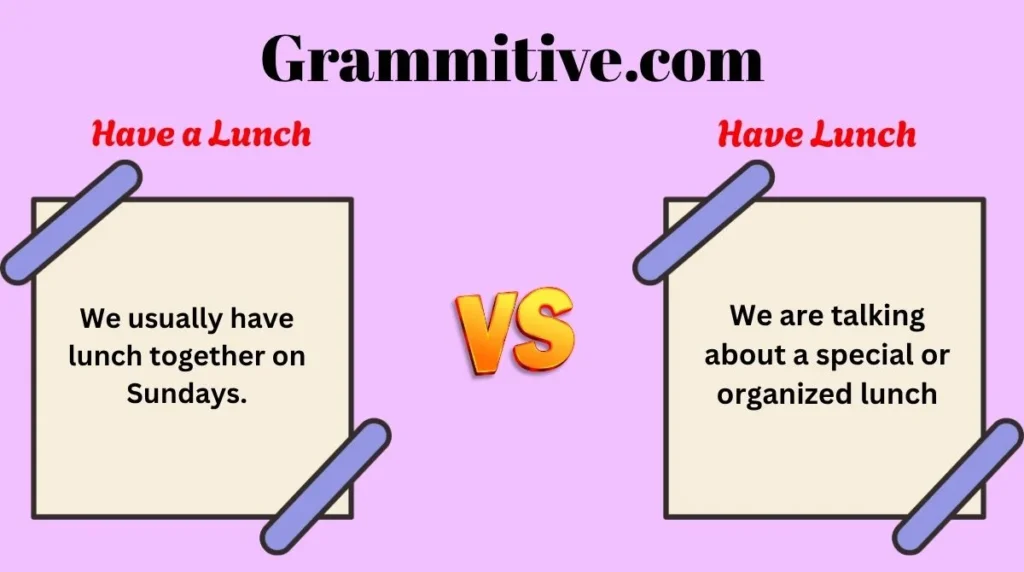
- We usually have lunch together on Sundays.
- Do you want to have lunch with me?
- They don’t have lunch at home today.
- He had lunch early because of the meeting.
- I never skip lunch.
- My parents have lunch at the office cafeteria.
✔️ Common Learner Confusion:
Many students think “lunch” is a normal countable noun, so they say “a lunch.” But in daily English, when we talk about eating, we treat it as a general activity. That is why “have lunch” sounds natural and correct.
5️⃣ What Does “Have a Lunch” Mean?
Now let’s talk about “have a lunch.” This form is not commonly used in everyday English, but it is not completely wrong in all situations. It depends on the meaning.
✔️ Simple Definition:
“Have a lunch” means a specific lunch event or a special meal. It is used when you talk about a particular lunch as an occasion.
✔️ When to Use It:
We use “have a lunch” when:
- We are talking about a special or organized lunch
- We want to focus on the event, not just eating
- We describe a formal or planned meal
✔️ Grammar Rule:
- “Lunch” becomes a countable noun in special cases.
- We use “a” when we refer to one specific lunch event.
✔️ Example Sentences:
- We had a lunch meeting with the manager.
- They arranged a lunch for new students.
- I attended a business lunch yesterday.
- She organized a lunch for the team.
- It was a special lunch at the hotel.
- We enjoyed a lunch with our relatives.
- He invited me to a lunch event.
- The company hosted a lunch for employees.
✔️ Common Learner Confusion:
Students often think both forms are interchangeable. But native speakers usually do NOT say “a lunch” unless they are talking about a formal or specific event. In normal daily life, “have lunch” is always preferred.
6️⃣ Difference Between Have Lunch and Have a Lunch (Detailed)
Understanding the difference becomes easier when we compare them side by side.
✔️ Comparison Table:
| Feature | Have Lunch | Have a Lunch |
|---|---|---|
| Meaning | Eating lunch (general activity) | A specific lunch event |
| Usage | Everyday English | Formal or special situations |
| Article “a” | Not used | Used |
| Natural sound | Very natural | Less common |
| Context | Daily routine | Meetings, events |
| Verb type | General action | Specific occasion |
✔️ Usage Difference:
- “Have lunch” is used for daily life.
- “Have a lunch” is used for planned or special occasions.
✔️ Grammar Logic:
English often removes articles when talking about meals in general:
- have breakfast
- have lunch
- have dinner
But when we talk about an event, we add “a”:
- a business lunch
- a charity lunch
✔️ Sentence Structure Difference:
- I have lunch at 2 PM. (routine)
- I had a lunch with my boss. (specific event)
✔️ Meaning Comparison:
One talks about a habit, and the other talks about a single event. That is the key difference.
7️⃣ Grammar Rules You Must Remember
✔️ Rule #1: No Article in Daily Meals
We do not use “a/an” before meals in general use.
- I have lunch at noon.
✔️ Rule #2: Use “A” for Special Events
When lunch is an organized event, we use “a.”
- They had a lunch for guests.
✔️ Rule #3: “Have” Works as an Action Verb
“Have” means eat in this context.
- She has lunch early every day.
✔️ Rule #4: Context Decides Meaning
Meaning changes depending on situation.
- Have lunch = normal routine
- Have a lunch = special occasion
8️⃣ Common Mistakes Students Make
Many learners make simple but repeated mistakes with this phrase.
❌ Mistake 1:
I have a lunch at 1 PM.
✔️ Correct:
I have lunch at 1 PM.
❌ Mistake 2:
We eat a lunch together daily.
✔️ Correct:
We have lunch together daily.
❌ Mistake 3:
She is having a lunch now.
✔️ Correct:
She is having lunch now.
✔️ Why These Mistakes Happen:
Students try to translate directly from their native language. In many languages, meals are treated as countable nouns, but English works differently.
✔️ Easy Fix:
Remember: no “a” in daily meals.
9️⃣ Easy Trick to Remember the Difference
Here is a very simple trick:
👉 If you can replace it with “eat lunch,” do NOT use “a.”
- I eat lunch → I have lunch ✔️
👉 If it sounds like an event, then “a” is okay.
- Business lunch → a lunch meeting ✔️
✔️ Real-Life Logic:
Think like this: daily meals are habits, not objects. But events are like special programs, so they need “a.”
This small idea will save you from most mistakes.
🔟 Daily Life Examples (Very Important)
Here are real spoken English examples you can use:
- I have lunch at school every day.
- Let’s have lunch together tomorrow.
- She is having lunch right now.
- We usually have lunch at 1 PM.
- They had a lunch meeting today.
- Do you want to have lunch outside?
- I don’t like having lunch alone.
- My father has lunch at the office.
- We had a lunch with our teacher.
- I missed lunch because I was busy.
1️⃣1️⃣ Practice Section
Choose the correct sentence:
- I (have / have a) lunch at 2 PM.
- They (had / had a) lunch meeting yesterday.
- She always (has / has a) lunch at school.
- We (have / have a) lunch with friends daily.
- He is (having / having a) lunch now.
✔️ Answers:
- have
- had a
- has
- have
- having
1️⃣2️⃣ FAQs
❓ 1. What is the difference between have lunch and have a lunch?
“Have lunch” means eating a normal meal. “Have a lunch” means a special or organized lunch event. The first is everyday English, while the second is formal.
❓ 2. Is “have a lunch” correct English?
Yes, but only in special situations like meetings or events. In daily conversation, it sounds unnatural.
❓ 3. Can we say “have lunch” in questions?
Yes. For example: “Do you have lunch at school?” This is very common and natural.
❓ 4. Is “have lunch” formal or informal?
It is neutral. You can use it in both formal and informal situations.
❓ 5. Why don’t we use “a” with lunch?
Because “lunch” is treated as a general activity, not a countable object in daily English.
❓ 6. What are similar expressions?
We also say:
- have breakfast
- have dinner
- have tea
1️⃣3️⃣ Final Conclusion
Understanding the difference between “have lunch” and “have a lunch” helps you speak more natural English.
The key idea is simple: daily meals are actions, not objects. That is why we say “have lunch” in normal situations.
However, when lunch becomes a planned event or formal meeting, we can say “a lunch.”
Most English learners make mistakes because they try to translate directly from their native language.
But English has its own natural patterns, and once you understand them, everything becomes easier.
Try using these phrases in your daily conversations. The more you practice, the more natural your English will sound.
Focus on real-life usage, not just rules. With time, you will stop thinking and start speaking correctly without effort.

I am Lucas Bennett, a digital content creator passionate about social media trends and online growth strategies.
I share practical insights and guides to help users better understand and navigate the digital world.