
Many English learners feel confused when they hear the words synopsis and summary. At first, both seem almost the same.
Both talk about giving a shorter version of something. So naturally, students ask: “Are they the same?” or “When should I use which one?”
This confusion is very common, especially for beginners and non-native speakers. Even some advanced learners mix them up in writing, exams, and daily conversations.
The problem is not just vocabulary—it is about understanding the purpose behind each word.
In daily English, these words are used in school, work, movies, books, and even online content.
For example, when you describe a movie to a friend or write about a story in an exam, choosing the right word matters.
Using the wrong one can change the meaning or sound unnatural.
After reading this guide, you will clearly understand:
- What synopsis means
- What summary means
- The exact difference between them
- When and how to use each word correctly
Everything is explained in simple English, with real examples that feel natural and easy to remember.
What Does “Synopsis” Mean?
A synopsis is a short and clear description of the main idea or plot of a story, movie, book, or project.
It focuses on the big picture, not every small detail.
Simple Definition:
A synopsis gives a quick overview of a story or content, usually highlighting the main events.
When to Use It:
- When describing a movie or book
- When writing about a story idea
- In school assignments
- In creative writing or scripts
Grammar Note:
- “Synopsis” is a noun
- Plural form: synopses
Examples:
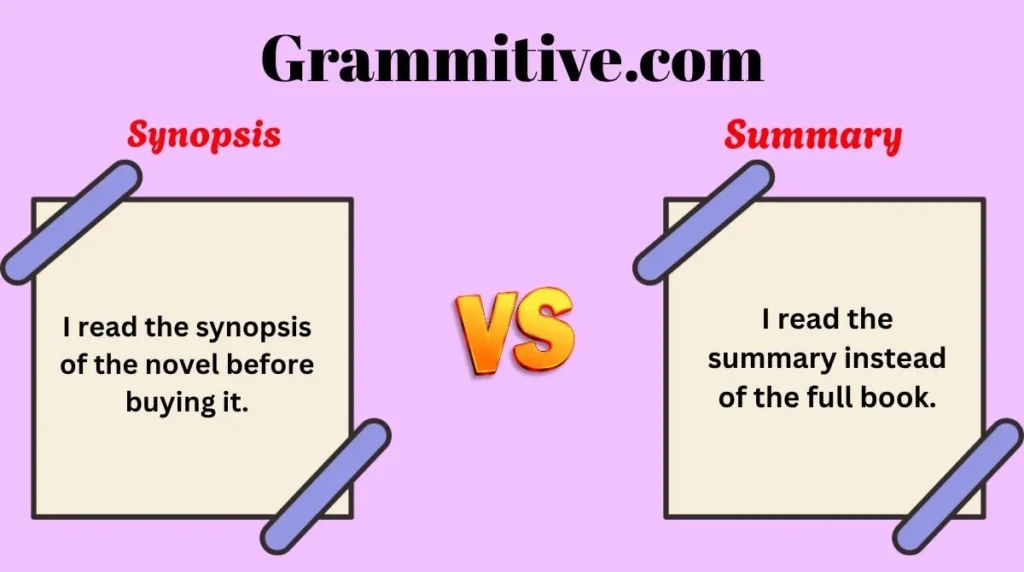
- I read the synopsis of the novel before buying it.
- The movie synopsis sounds very interesting.
- She wrote a short synopsis of her story.
- The teacher asked for a synopsis of the play.
- I always check the synopsis before watching a film.
- His synopsis explained the main idea clearly.
- The website shows a brief synopsis of each movie.
- The synopsis helped me understand the story quickly.
Common Learner Confusion:
Many students think a synopsis must include all details. That is not correct. A synopsis only gives main points, not full explanations.
What Does “Summary” Mean?
A summary is a shorter version of a text that includes the main points and important details.
It explains the content in a simple and clear way.
Simple Definition:
A summary tells the main ideas of something in fewer words.
When to Use It:
- In school assignments
- While studying a chapter
- In exams
- In reports or articles
Grammar Note:
- “Summary” is a noun
- Plural form: summaries
Examples:
- I wrote a summary of the chapter.
- Please give a summary of the story.
- His summary was short but clear.
- The teacher checked my summary.
- She made a summary of the article.
- This summary explains everything simply.
- I read the summary instead of the full book.
- The summary helped me revise quickly.
Common Learner Confusion:
Some learners think a summary is just a few lines. That is not always true. A summary can be longer than a synopsis because it may include more details and explanations.
Difference Between Synopsis and Summary (Detailed)
Understanding the difference is easier when you compare them side by side.
Comparison Table:
| Feature | Synopsis | Summary |
|---|---|---|
| Meaning | Brief overview of a story | Short version with main points |
| Detail Level | Very general | More detailed |
| Purpose | Show idea or plot | Explain content clearly |
| Usage | Movies, books, scripts | Study, exams, articles |
| Length | Usually shorter | Can be slightly longer |
| Focus | Big picture | Key points + details |
Usage Difference
A synopsis is used when you want to introduce something quickly.
A summary is used when you want to explain something in a shorter form.
For example:
- Movie website → synopsis
- School homework → summary
Grammar Logic
Both words are nouns, but their use depends on context.
- “Write a synopsis” → creative or descriptive context
- “Write a summary” → academic or informational context
Sentence Structure Difference
Synopsis Example:
- The synopsis of the movie is very exciting.
Summary Example:
- The summary of the chapter includes all key points.
Meaning Comparison
- Synopsis = short preview
- Summary = short explanation
That is the easiest way to see the difference.
Grammar Rules You Must Remember
Rule #1: Both Are Nouns
You cannot use them as verbs.
✔ Correct: I wrote a summary.
❌ Wrong: I summary the text.
Rule #2: Use “a” or “the” Before Them
They are countable nouns.
✔ A synopsis
✔ The summary
Rule #3: Use “of” After Them
Both are usually followed by “of”.
✔ A synopsis of the movie
✔ A summary of the article
Rule #4: Do Not Mix Their Purpose
Use the correct word based on situation.
✔ Movie → synopsis
✔ Study → summary
Common Mistakes Students Make
Mistake 1: Using Them as the Same
❌ I wrote a synopsis of my lesson for exam.
✔ I wrote a summary of my lesson for exam.
Why? Exams usually need detailed explanation, not just overview.
Mistake 2: Adding Too Much Detail in Synopsis
❌ The synopsis explains every scene.
✔ The synopsis gives only the main idea.
Tip: Keep synopsis short and simple.
Mistake 3: Making Summary Too Short
❌ My summary is only one line.
✔ My summary explains the key points clearly.
Tip: A summary needs enough detail to explain the idea.
Mistake 4: Wrong Context Use
❌ Read the summary of the movie before watching.
✔ Read the synopsis of the movie before watching.
Easy Trick to Remember the Difference
Here is a simple trick:
👉 Synopsis = “Sneak Peek”
👉 Summary = “Short Explanation”
Think like this:
- When you open Netflix or YouTube, you see a synopsis
- When you study for exams, you make a summary
Another way:
- Synopsis → Before you watch/read
- Summary → After you read
This simple idea helps students remember easily.
Daily Life Examples (Very Important)
Here are real-life sentences you can use in conversations:
- Did you read the synopsis of this movie?
- The synopsis looks boring, so I skipped it.
- Can you give me a summary of this chapter?
- I didn’t understand the story, so I read a summary.
- The teacher asked for a summary, not a synopsis.
- I always check the synopsis before watching a film.
- His summary helped me understand the lesson.
- The synopsis was short but interesting.
- She wrote a good summary in simple words.
- I prefer reading a summary before exams.
These sentences are very common in daily English.
Practice Section
Choose the correct word: synopsis or summary
- I read the ______ before watching the movie.
- Please write a ______ of the chapter.
- The teacher asked for a ______ of the story.
- The website shows a short ______ of each film.
- His ______ explained the lesson clearly.
Answers:
- synopsis
- summary
- summary
- synopsis
- summary
FAQs
What is the difference between synopsis and summary?
A synopsis gives a short overview of a story, while a summary explains the main points in more detail. A synopsis is more general, and a summary is more detailed.
Can we use synopsis in questions?
Yes, you can use it in questions. For example: “Can you tell me the synopsis of this movie?” It sounds natural and correct.
Is summary formal or informal?
“Summary” is used in both formal and informal English. It is very common in school, exams, and daily conversation.
Is synopsis only used for movies?
No, it is not only for movies. It can be used for books, plays, and stories. But it is most commonly used for films and creative content.
Which one is longer: synopsis or summary?
A summary is usually longer because it includes more details. A synopsis is shorter and more general.
Can I use summary instead of synopsis?
Sometimes yes, but not always. In movies or story descriptions, “synopsis” is more natural. In study or exams, “summary” is better.
Final Conclusion
Understanding the difference between synopsis and summary becomes easy when you focus on their purpose.
A synopsis gives a quick overview, like a preview of a story. A summary explains the main points in a shorter form but with more detail.
Both words are useful in daily English. You will see them in school, movies, books, and even online content. Choosing the right word helps you sound more natural and confident.
The key idea is simple:
- Use synopsis for general ideas and story previews
- Use summary for explaining key points clearly
Practice using both words in sentences. Try writing a synopsis of a movie and a summary of a lesson. The more you use them, the easier they will feel.
Learning small differences like this improves your English step by step. Keep going, stay curious, and enjoy the process.

I am Lucas Bennett, a digital content creator passionate about social media trends and online growth strategies.
I share practical insights and guides to help users better understand and navigate the digital world.