
Many English learners get stuck when they try to use “is” and “are” in sentences. It looks simple, but in real life, it becomes confusing very fast.
One small mistake can change the whole meaning of a sentence. That is why students often ask: “Should I say he is or he are?” or “Why does it change with words?”
The truth is, this confusion happens because both words are forms of the verb “to be,” but they are used in different situations.
In spoken English, we use them all the time—when we talk about people, things, places, and daily activities.
So if you learn this topic properly, your English will instantly sound more natural and correct.
After reading this guide, you will clearly understand when to use “is” and when to use “are.”
You will see simple rules, real-life examples, common mistakes, and easy tricks that make everything clear.
Even if grammar has always felt difficult, this explanation will help you feel more confident while speaking and writing English.
4️⃣ What Does “Is” Mean?
“Is” is a verb that comes from the verb “to be.” It is used when we talk about one person, one thing, or one place (singular subject).
✔️ Simple Definition:
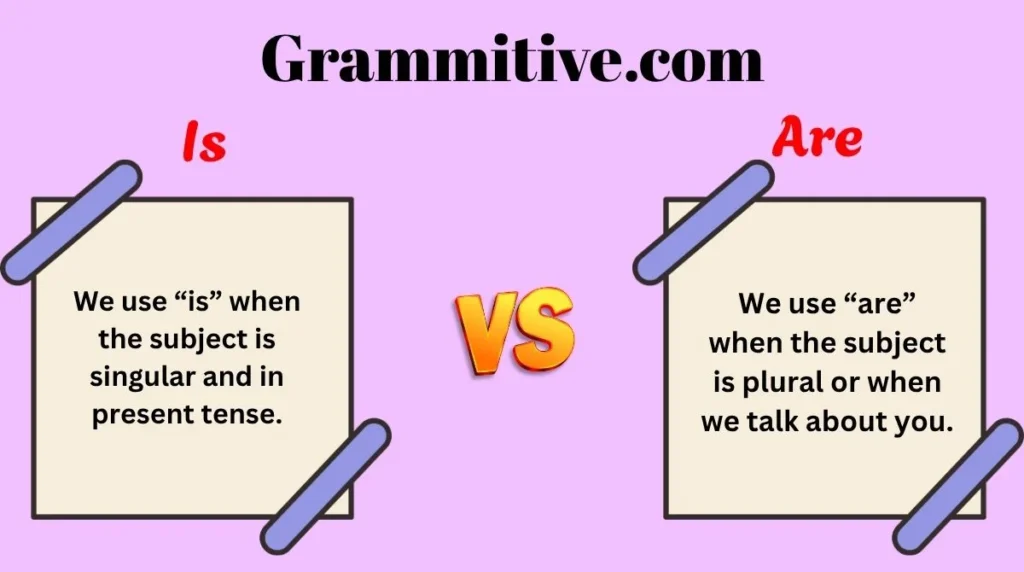
We use “is” when the subject is singular and in present tense.
✔️ When to Use “Is”:
- With he, she, it
- With singular nouns (one boy, one cat, one car)
- With names of one person or thing
✔️ Grammar Rule:
Singular subject + is + rest of sentence
✔️ Example Sentences:
- He is a doctor.
- She is very smart.
- It is raining today.
- Ali is my friend.
- The cat is sleeping.
- This book is mine.
- The car is new.
- Karachi is a big city.
✔️ Common Learner Confusion:
Many learners wrongly say:
- ❌ He are my brother
- ❌ She are happy
The correct form is:
- ✔️ He is my brother
- ✔️ She is happy
A simple way to remember: if it is one person or one thing, “is” is usually the correct choice.
5️⃣ What Does “Are” Mean?
“Are” is also a form of the verb “to be.” It is used when we talk about more than one person or thing (plural subject).
✔️ Simple Definition:
We use “are” when the subject is plural or when we talk about you.
✔️ When to Use “Are”:
- With we, you, they
- With plural nouns (boys, cars, students)
✔️ Grammar Rule:
Plural subject + are + rest of sentence
✔️ Example Sentences:
- They are my friends.
- We are ready.
- You are very kind.
- The boys are playing football.
- The books are on the table.
- These shoes are new.
- The dogs are barking.
- My parents are at home.
✔️ Common Learner Confusion:
Wrong sentences:
- ❌ They is my friends
- ❌ We is going home
Correct sentences:
- ✔️ They are my friends
- ✔️ We are going home
A simple tip: if there is more than one person or thing, “are” is the safe choice.
6️⃣ Difference Between “Is” and “Are” (Detailed)
The main difference is based on number (singular vs plural).
✔️ Comparison Table:
| Feature | Is | Are |
|---|---|---|
| Subject type | Singular | Plural |
| Used with | He, She, It | We, You, They |
| Meaning | One person/thing | More than one |
| Example | She is happy | They are happy |
✔️ Usage Difference:
- “Is” focuses on one subject
- “Are” focuses on multiple subjects
✔️ Grammar Logic:
English grammar always matches the verb with the subject. If the subject is singular, we use “is.” If the subject is plural, we use “are.”
✔️ Sentence Structure Difference:
- Singular: He is + adjective/noun
- Plural: They are + adjective/noun
✔️ Meaning Comparison:
- She is tired → one person
- They are tired → many people
Even a small change in “is” or “are” changes the number of people you are talking about.
7️⃣ Grammar Rules You Must Remember
✔️ Rule #1: Use “is” with singular subjects
- The dog is cute.
✔️ Rule #2: Use “are” with plural subjects
- The dogs are cute.
✔️ Rule #3: “You” always takes “are”
Even if “you” means one person:
- You are my best friend.
✔️ Rule #4: In questions, verb comes first
- Is she coming?
- Are they ready?
8️⃣ Common Mistakes Students Make
Many learners make mistakes because they translate directly from their native language. Another reason is rushing while speaking.
❌ Wrong vs ✔️ Correct:
- ❌ He are my teacher
✔️ He is my teacher - ❌ They is playing
✔️ They are playing - ❌ You is smart
✔️ You are smart - ❌ It are cold
✔️ It is cold
✔️ Why Mistakes Happen:
- Lack of practice
- Confusion between singular and plural
- Speaking too fast
- Forgetting subject rules
✔️ Easy Fix Tips:
- Always check if subject is one or many
- Practice simple daily sentences
- Read English out loud
9️⃣ Easy Trick to Remember the Difference
Here is a very simple trick:
👉 Think:
- One = is
- Many = are
Another memory trick:
- “He, She, It → is” (sounds like “his” sound group)
- “We, You, They → are” (group words = plural)
Imagine a classroom:
- One student is sitting → “is”
- Many students are sitting → “are”
This mental picture helps you remember quickly.
🔟 Daily Life Examples
Here are natural spoken English sentences:
- She is cooking dinner.
- They are watching TV.
- I am tired, but he is happy.
- We are going to school.
- The shop is open.
- The children are playing outside.
- My phone is charging.
- Your friends are waiting.
- It is very hot today.
- The teachers are in the staff room.
These are the kind of sentences you use every day in real life conversations.
1️⃣1️⃣ Practice Section
Choose the correct option:
- He ___ my brother.
- They ___ playing football.
- The cat ___ sleeping.
- We ___ ready.
- She ___ very kind.
✔️ Answers:
- is
- are
- is
- are
- is
1️⃣2️⃣ FAQs
❓ 1. What is the main difference between is and are?
“Is” is used for singular subjects, while “are” is used for plural subjects. It depends on how many people or things you are talking about.
❓ 2. Can we use “are” with he or she?
No, “he” and “she” are singular subjects, so we use “is,” not “are.”
❓ 3. Why is “you” always followed by “are”?
In English grammar, “you” is treated as plural form for verb agreement, so it always takes “are.”
❓ 4. Is “is” formal or informal?
Both. “Is” is used in all types of English—formal writing and casual speaking.
❓ 5. What happens if I use wrong form?
The sentence becomes grammatically incorrect and may confuse the listener.
❓ 6. How can I practice is vs are easily?
Practice daily sentences, speak aloud, and pay attention while reading English books or watching videos.
1️⃣3️⃣ Final Conclusion
Understanding the difference between “is” and “are” is one of the first big steps in learning English grammar.
It may look small, but it affects every sentence you speak or write. Once you clearly understand singular and plural subjects, this rule becomes very easy.
The key idea is simple: one person or thing takes “is,” and more than one takes “are.”
With regular practice, your brain will automatically choose the correct form without thinking too much.
Try using these words in your daily conversations. Make small sentences, speak them out loud, and correct yourself when needed.
Slowly, it will become natural. English is not about memorizing rules only—it is about using them in real life. Keep practicing, and your confidence will grow step by step.

I am Lucas Bennett, a digital content creator passionate about social media trends and online growth strategies.
I share practical insights and guides to help users better understand and navigate the digital world.