

English learners often struggle with the phrases “one or more is” and “one or more are.”
At first glance, they may look simple, but they can be tricky because they depend on how we think about singular and plural subjects.
Mixing them up can make sentences sound awkward or even incorrect. Knowing when to use each form is important because it helps you speak and write clearly.
These phrases appear a lot in daily English. For example, when you say, “One or more students is late” or “One or more students are late,” it changes the way your sentence sounds.
Even native speakers sometimes pause to think before deciding which one to use.
By the end of this article, you will clearly understand the difference between “one or more is” and “one or more are.”
You will know the rules, common mistakes, and simple tricks to remember which one to use.
With plenty of examples and practice, this guide will make these confusing phrases easy for you.
Whether you are writing emails, chatting with friends, or answering exams, you will feel confident using them correctly every time.
What Does “One or More Is” Mean?
Definition: The phrase “one or more is” treats the subject as singular. You use it when thinking about each item individually, or when the first part of the subject (“one”) is the focus.
When to use it:
- When the sentence emphasizes a single item.
- When the verb must match the singular “one.”
Grammar rule:
- “One” is singular.
- When a singular word comes first in a compound subject connected by “or,” the verb usually agrees with the singular.
- Formula: One or more + singular noun + is + complement
Example sentences:
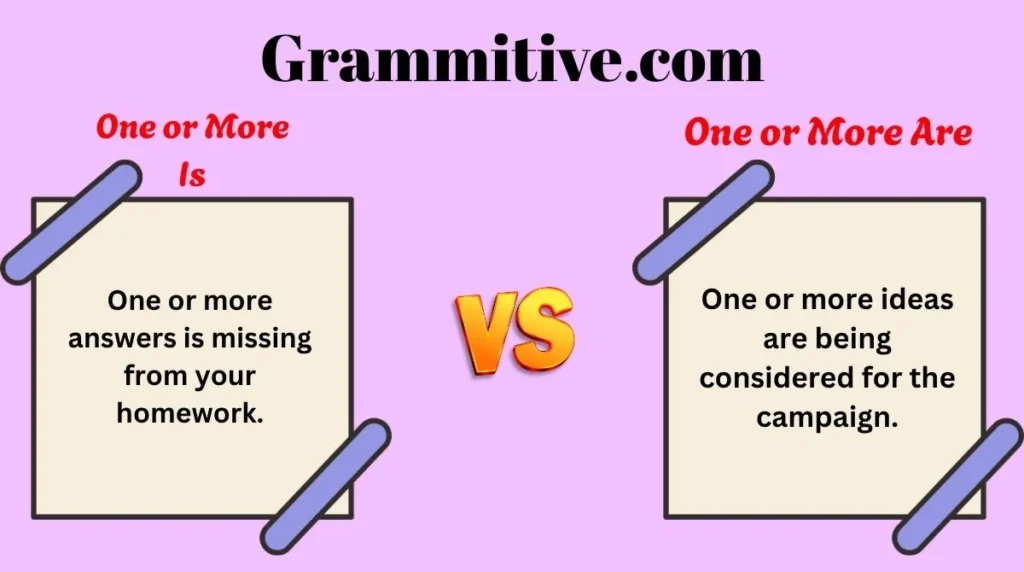
- One or more answers is missing from your homework.
- One or more keys is lost on this table.
- One or more students is required to attend the seminar.
- One or more documents is missing from the file.
- One or more books is needed for the project.
- One or more chairs is broken in the classroom.
- One or more ideas is excellent, but we need to choose the best.
Common learner confusion:
- Many learners automatically use “are” because they see “more” and think plural.
- The trick is to focus on “one” first—it sets the verb as singular.
What Does “One or More Are” Mean?
Definition: The phrase “one or more are” treats the subject as plural. You use it when thinking about all items collectively, not just the first item.
When to use it:
- When the sentence emphasizes multiple items together.
- When you consider the action applies to all of them.
Grammar rule:
- “More” indicates plurality.
- When the focus is on the plural part (“more”), the verb must be plural.
- Formula: One or more + plural noun + are + complement
Example sentences:
- One or more students are absent today.
- One or more books are missing from the shelf.
- One or more emails are unread in your inbox.
- One or more chairs are broken in the hall.
- One or more options are available for selection.
- One or more cars are parked illegally.
- One or more ideas are being considered for the campaign.
Common learner confusion:
- Learners see “one” and think singular, so they use “is” incorrectly.
- If the action applies to multiple things together, the plural “are” is correct.
Difference Between “One or More Is” and “One or More Are”
Here is a clear comparison to help understand the difference:
| Feature | One or More Is | One or More Are |
|---|---|---|
| Focus | Singular, emphasizes “one” | Plural, emphasizes “more” |
| Verb | Singular (is) | Plural (are) |
| Meaning | Refers to one item individually | Refers to multiple items collectively |
| Example | One or more answers is correct. | One or more answers are correct. |
| Sentence Logic | Action applies to the first item | Action applies to all items |
Usage difference:
- If you want to stress a single item, use is.
- If you talk about multiple items together, use are.
Sentence structure difference:
- Singular: One or more + singular noun + is + complement.
- Plural: One or more + plural noun + are + complement.
Meaning comparison:
- “Is” suggests: maybe only one item matters.
- “Are” suggests: multiple items are relevant.
Grammar Rules You Must Remember
Rule #1: Focus on the first item in “or”
- The verb usually agrees with the first subject.
- Example: One or more mistakes is acceptable. (singular focus)
Rule #2: Consider plurality if action applies to multiple items
- Use are when multiple items are affected.
- Example: One or more mistakes are found in the essay. (plural focus)
Rule #3: Look at the noun, not just the number word
- The noun after “more” decides if the sentence sounds natural plural.
- Example: One or more chairs are broken. (plural noun)
Rule #4: Context matters
- Sometimes both are grammatically correct, but the meaning changes.
- Example:
- One or more students is late. (thinking individually)
- One or more students are late. (thinking collectively)
Common Mistakes Students Make
Mistake 1: Always using “is”
- Wrong: One or more books is missing.
- Correct: One or more books are missing.
- Tip: Check if you mean multiple items.
Mistake 2: Always using “are”
- Wrong: One or more answer are correct.
- Correct: One or more answer is correct.
- Tip: Focus on the first item for singular.
Mistake 3: Ignoring context
- Wrong: One or more emails is unread. (if many emails)
- Correct: One or more emails are unread.
- Tip: Ask: How many items are involved?
Easy correction tips:
- Identify the first subject after “or”.
- Decide if action affects one or many.
- Choose verb: is (singular), are (plural).
Easy Trick to Remember the Difference
Think like this:
- “Is” = Imagine one thing. Focus on the first item.
- “Are” = Imagine a group of things. Focus on the collective items.
Example:
- One or more apples is rotten. (thinking: maybe only one apple matters)
- One or more apples are rotten. (thinking: multiple apples are rotten)
Tip for students: Say the sentence out loud. If it sounds like you are talking about one, use is. If it sounds like talking about many, use are.

Daily Life Examples
- One or more friends is coming to my party. (singular focus)
- One or more friends are coming to my party. (plural focus)
- One or more lights is out in the office. (singular)
- One or more lights are out in the office. (plural)
- One or more computers is not working properly. (singular)
- One or more computers are not working properly. (plural)
- One or more teachers is unavailable today. (singular)
- One or more teachers are unavailable today. (plural)
- One or more emails is unread in my inbox. (singular)
- One or more emails are unread in my inbox. (plural)
Practice Section
Choose the correct verb (is/are) for each sentence:
- One or more students ___ absent today.
- One or more books ___ missing from the library.
- One or more keys ___ on the table.
- One or more cars ___ parked illegally.
- One or more answers ___ correct.
Answers:
- are
- are
- is
- are
- is
FAQs
Q1: What is the difference between “one or more is” and “one or more are”?
- “Is” focuses on a single item; “are” focuses on multiple items collectively.
Q2: Can we use “one or more” in questions?
- Yes, e.g., “Is one or more students absent today?” or “Are one or more students absent today?” depending on focus.
Q3: Is “one or more is” formal or informal?
- It is formal, commonly used in writing and official contexts.
Q4: Can “one or more are” be used in official documents?
- Yes, especially when the sentence refers to multiple items or people.
Q5: How do I know which verb to use?
- Check if you are talking about one item (use is) or multiple items (use are).
Q6: Is it wrong to use both interchangeably?
- Not always grammatically wrong, but meaning may change, so context is key.
Final Conclusion
Understanding “one or more is” and “one or more are” is essential for speaking and writing clear English.
The difference may seem small, but it affects the meaning and correctness of your sentences.
By focusing on whether you mean one item or multiple items, practicing with examples, and using the memory trick, you can use these phrases correctly every time.
Regular practice with daily sentences, conversations, and written work will make these grammar points second nature.
Keep practicing, read carefully, and soon these phrases will feel natural in your English.

I am Lucas Bennett, a digital content creator passionate about social media trends and online growth strategies.
I share practical insights and guides to help users better understand and navigate the digital world.