
English has many small words that create big confusion. Prepositions are famous for this. Words like in, on, at, from, of, and to look simple, but one small change can make a sentence sound strange or even wrong.
One common question students often ask in class is this:
Should I say “independent from” or “independent of”?
Both phrases look similar. Both seem logical. And both are sometimes heard in real life. That’s why learners feel unsure.
You might read one form in a book, hear another in a movie, and then wonder which one your teacher will mark as correct.
This topic matters more than you think. We use independent when we talk about people, countries, companies, children, money, and even ideas.
It’s a very common word in daily English. Using the wrong preposition can make your English sound unnatural.
By the end, you’ll clearly understand:
- what independent really means
- when to use of
- when from is possible
- the grammar logic
- common mistakes
- easy memory tricks
- lots of real-life examples
After reading carefully, you won’t hesitate again. You’ll choose the correct form naturally — like a native speaker.
What Does “Independent” Mean?
Let’s start with the main word first.
Simple meaning
Independent means:
👉 not controlled by others
👉 not needing help
👉 free to decide for yourself
If you are independent, you stand on your own.
When do we use it?
We use independent to talk about:
- people
- children
- adults
- countries
- businesses
- systems
- money
- decisions
Basic grammar rule
Most of the time, independent is followed by “of.”
Structure:
independent + of + noun/pronoun
Example:
She is independent of her parents.
Examples
- She is independent of her family.
- The country became independent of British rule.
- He wants to be financially independent of his parents.
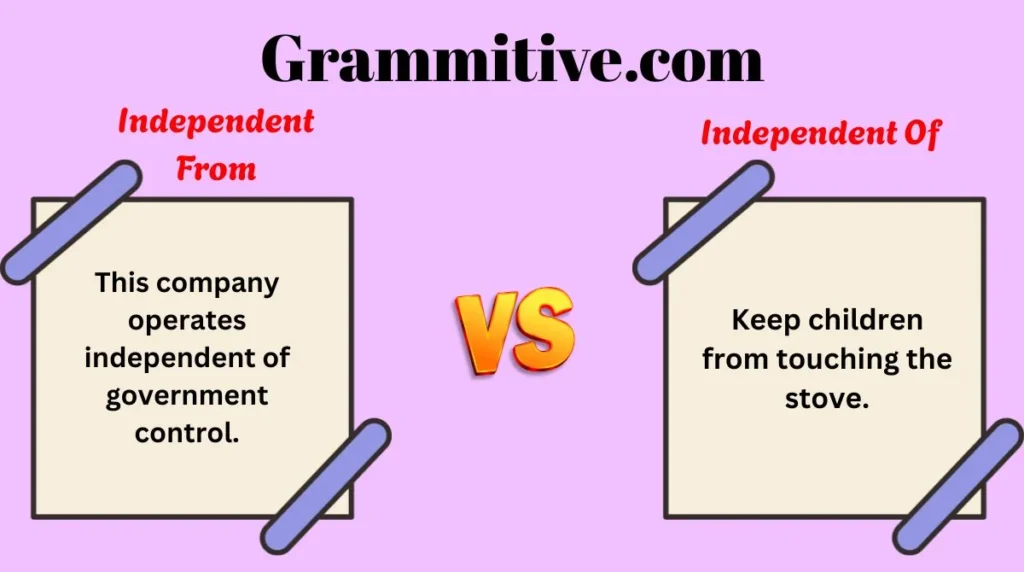
- This company operates independent of government control.
- The two systems are independent of each other.
- My sister is very independent of others’ opinions.
- Children should learn to be independent of constant help.
- The research is independent of political pressure.
Common learner confusion
Many students think:
❌ “from” sounds more natural
❌ “from” means separation, so it must be correct
But English doesn’t always follow logic. Some adjectives simply prefer certain prepositions. And independent + of is the standard pattern.
What Does “From” Mean?
Now let’s understand the second word.
Simple meaning
From usually means:
👉 starting point
👉 origin
👉 distance
👉 separation
It answers questions like:
- Where?
- Where did it come from?
- Away from what?
When do we use it?
We use from with:
- places (from school, from home)
- time (from Monday)
- sources (from my friend)
- separation (away from danger)
Grammar idea
Structure:
verb/adjective + from + noun
Examples:
- come from
- protect from
- far from
- free from
Examples
- She came from Canada.
- Stay away from the fire.
- This cheese is made from milk.
- He learned English from movies.
- The hotel is far from the airport.
- Protect your skin from the sun.
- We recovered from the illness.
- Keep children from touching the stove.
Where confusion begins
Because from often shows separation, students think:
👉 “independent from” = separate
This feels logical. And yes — sometimes native speakers say it. But it’s not the main or traditional form.
Difference Between Independent Of and Independent From (Detailed)
This is the key part.
Both forms exist, but they are not equal in usage.
Quick comparison table
| Feature | Independent of | Independent from |
|---|---|---|
| Commonness | Very common | Less common |
| Standard grammar | Yes | Sometimes acceptable |
| Formal writing | Preferred | Rare |
| Meaning | Not controlled by | Separate or unaffected |
| Exams/tests | Safe choice | Risky |
Usage difference
Independent of
Means:
👉 not influenced
👉 not controlled
👉 not depending on
Example:
The child is independent of his parents.
(He doesn’t rely on them.)
Independent from
Often means:
👉 separate
👉 not connected
👉 physically or logically apart
Example:
The two departments work independent from each other.
(They operate separately.)
But many teachers still prefer of here too.
Grammar logic
Some adjectives are simply fixed with certain prepositions:
- afraid of
- proud of
- tired of
- independent of
These are collocations. You must memorize them.
Even if “from” sounds logical, English tradition prefers of.
Sentence structure difference
Independent of
→ focus on freedom or lack of control
Independent from
→ focus on separation
Examples:
- She is independent of her parents. (doesn’t depend on them)
- The lab is independent from the main building. (separate location)
Notice the slight change in feeling.
Meaning comparison
Consider:
- The company is independent of the government.
→ Not controlled by government - The company is independent from the government.
→ Sounds like separate organizations
Both work, but the first is more natural.
Grammar Rules You Must Remember
Rule #1 – Use “independent of” for people
✅ She is independent of her family.
❌ She is independent from her family.
Rule #2 – Use “of” for control or influence
✅ The media should be independent of politics.
❌ independent from politics
Rule #3 – “From” may appear for physical separation
Sometimes acceptable:
✅ The office is independent from the factory.
But still, many writers prefer of.
Rule #4 – In exams or formal writing, always choose “of”
This is the safest option.
If you are unsure → use “of.”
You will almost never be wrong.
Common Mistakes Students Make
Why mistakes happen
- direct translation from their language
- “from” feels logical
- hearing casual speech
- guessing instead of memorizing collocations
Mistake 1
❌ I want to be independent from my parents.
✅ I want to be independent of my parents.
Tip: talking about money or emotional support → use of.
Mistake 2
❌ This country is independent from Britain.
✅ This country is independent of Britain.
Tip: history or politics → of.
Mistake 3
❌ She became independent from help.
✅ She became independent of help.
Tip: if meaning “not needing” → of.
Easy correction tip
When you say:
- not controlled
- not needing
- free from influence
Automatically choose of.
Easy Trick to Remember the Difference
Here’s a simple classroom trick students love.
Think:
👉 OF = free OF control
Say it fast:
“free of control”
“independent of control”
Both use of.
It feels natural together.
Another trick:
Imagine cutting a rope.
If you cut control or dependence → of
If you talk about distance or location → maybe from
But again, of wins most of the time.
So your brain rule can be:
👉 90% = of
👉 10% = from
Easy.
Daily Life Examples (Spoken English Style)
These sound natural in everyday conversation.
- My daughter is very independent of us now.
- He wants to be independent of his parents’ money.
- That newspaper is independent of the government.
- She moved out to become independent of her family.
- Our team works independent of the main office.
- Kids should learn to be independent of constant help.
- This app runs independent of internet connection.
- I like being independent of other people’s opinions.
- The two projects are independent of each other.
- He tries to stay emotionally independent of toxic friends.
Notice how smooth of sounds.
Practice Section
Choose the correct option.
Questions
- She is independent ___ her parents.
a) of
b) from - The country became independent ___ colonial rule.
a) of
b) from - This system works independent ___ the internet.
a) of
b) from - He wants to be financially independent ___ his family.
a) of
b) from - The two buildings are independent ___ each other.
a) of
b) from
Answers
1 → of
2 → of
3 → of (preferred)
4 → of
5 → of
If you chose mostly of, you’re doing great.
FAQs
What is the difference between independent of and independent from?
“Independent of” means not controlled or not depending on something. It is the standard form. “Independent from” sometimes means separate, but it’s less common.
Which one is more correct in grammar?
“Independent of” is the traditional and safer choice. Most grammar books recommend it.
Can we use independent from in modern English?
Yes, some native speakers use it, especially in American English. But it’s still less common and may sound informal.
Is independent of formal or informal?
It works in both formal and informal English. It’s perfect for essays, exams, and professional writing.
Can we use it in questions?
Yes.
Example:
Are you independent of your parents now?
Why do learners mix them up?
Because “from” suggests separation, which feels logical. But English collocations don’t always follow logic. They must be learned by usage.
Final Conclusion
Small grammar choices can change how natural your English sounds. The pair “independent from or independent of” is a perfect example. Both exist, but they are not equal.
In most situations, independent of is the correct and trusted form. It expresses freedom, lack of control, and not depending on someone. It’s the version teachers expect and the one you’ll see in books, exams, and newspapers.
“Independent from” sometimes appears when talking about separation, but it’s less common and can feel uncertain. When in doubt, don’t guess. Choose of and move on with confidence.
The best way to remember is practice. Read sentences, make your own examples, and notice how native speakers use it. Soon it will feel automatic.
Language becomes easier step by step. Keep going — you’re doing better than you think.

I am Lucas Bennett, a digital content creator passionate about social media trends and online growth strategies.
I share practical insights and guides to help users better understand and navigate the digital world.