
Many English learners feel confused when they hear sentences like:
“I woke up early this morning.”
“I called you earlier this morning.”
Both sound similar. Both talk about the morning. Both use time.
So naturally, students ask, “Are they the same? Can I use either one?”
This small difference creates big problems in daily English.
You might pause while speaking.
You might choose the wrong word in an exam.
Or you may sound unnatural in conversation.
The truth is simple: these two phrases are not interchangeable. They talk about different ideas about time. One focuses on how early something happened. The other compares one time with another.
Native speakers understand this difference without thinking. But learners need clear rules and easy logic.
Once you understand the meaning, you will:
- speak more naturally
- avoid grammar mistakes
- sound confident in conversations
- write better English
- and understand movies and daily speech more easily
By the end, the difference will feel obvious and easy — like tying your shoes.
What Does “Early This Morning” Mean?
Simple meaning
“Early this morning” means at the beginning of the morning or very soon after you wake up.
It focuses on time of day, not comparison.
Think:
👉 How early was it?
Answer: Early in the morning.
When to use it
Use this phrase when you talk about:
- sunrise time
- before work or school
- before most people wake up
- the first part of the morning (around 5–8 a.m.)
You are not comparing times.
You are simply describing how early something happened.
Grammar rule
Structure:
Subject + verb + early this morning
Examples:
- I woke up early this morning.
- She left early this morning.
“Early” works as an adverb of time here.
Examples (6–8 sentences)
- I woke up early this morning to exercise.
- We had a meeting early this morning.
- It rained early this morning.
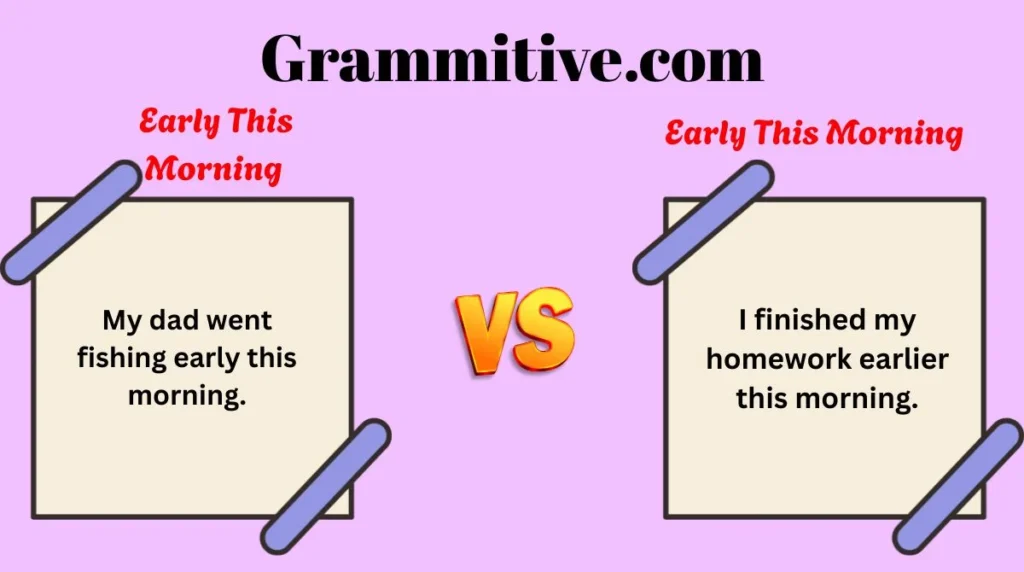
- My dad went fishing early this morning.
- The phone rang early this morning.
- She cooked breakfast early this morning.
- I felt tired because I got up early this morning.
- The birds were singing early this morning.
Common learner confusion
Many students think “early” means “before now.”
That’s wrong.
It means early in the day, not before another time.
For example:
❌ I finished the report early this morning than you.
This is incorrect because “early” cannot compare.
Comparison needs earlier, not early.
What Does “Earlier This Morning” Mean?
Simple meaning
“Earlier this morning” means:
👉 Before now (but still today’s morning)
It shows comparison.
You are comparing:
- now vs before now
OR - one past time vs another past time
When to use it
Use it when:
- talking later in the morning
- explaining something happened before this moment
- referring back to something already done
Imagine it is 10:30 a.m.
You say:
“I saw her earlier this morning.”
This means you saw her before 10:30 a.m.
Grammar rule
Structure:
Subject + verb + earlier this morning
“Earlier” is the comparative form of “early”.
Comparative = comparing two times.
Examples (6–8 sentences)
- I talked to the teacher earlier this morning.
- She called me earlier this morning.
- We had coffee earlier this morning.
- I finished my homework earlier this morning.
- He looked tired earlier this morning.
- It was colder earlier this morning.
- I sent you an email earlier this morning.
- The power went out earlier this morning.
Common learner confusion
Students often think “earlier” means “very early.”
Not always.
It just means before now, not necessarily 6 a.m. or sunrise.
If it’s 11 a.m., 9:30 a.m. is still “earlier.”
So the focus is comparison, not “how early.”
Difference Between Early This Morning and Earlier This Morning (Detailed)
Here is the heart of the problem.
Both talk about morning.
But the logic is completely different.
Comparison Table
| Feature | Early this morning | Earlier this morning |
|---|---|---|
| Meaning | beginning of morning | before now |
| Type | description | comparison |
| Grammar | adverb | comparative adverb |
| Focus | how early | when compared to now |
| Example | I woke up early | I called you earlier |
Usage difference
Use early when describing the time itself.
Use earlier when comparing two times.
Grammar logic
Early → base form
Earlier → comparative form
Just like:
- fast → faster
- small → smaller
- early → earlier
Comparatives always compare something.
Sentence structure difference
Early:
I woke up early this morning.
Earlier:
I woke up earlier this morning than usual.
Notice:
- “earlier” often connects to another time
- sometimes it is understood but not spoken
Meaning comparison
Early = 6 a.m.
Earlier = before now (maybe 9 a.m.)
So:
At 7 a.m.
❌ earlier this morning (sounds strange)
At 11 a.m.
✅ earlier this morning (natural)
Grammar Rules You Must Remember
Rule #1 – “Early” describes time of day
Use it for the first part of the morning.
Example:
I jogged early this morning.
Rule #2 – “Earlier” compares two times
Use it when something happened before now.
Example:
I saw him earlier this morning.
Rule #3 – Comparatives often connect with “than”
Earlier often works with “than.”
Example:
I arrived earlier this morning than yesterday.
Rule #4 – Don’t mix meanings
Never use “early” for comparison.
Wrong:
❌ I met her early than you.
Correct:
✅ I met her earlier than you.
Common Mistakes Students Make
Why mistakes happen
- both phrases look similar
- both talk about morning
- many languages don’t have this difference
- learners translate directly from their first language
Wrong vs correct examples
❌ I talked to her early this morning before class.
✅ I talked to her earlier this morning before class.
❌ The meeting finished earlier because we started early.
✅ The meeting finished early because we started early.
Easy correction tips
Ask yourself:
- Am I describing the time? → early
- Am I comparing with another time? → earlier
This question fixes 90% of mistakes.
Easy Trick to Remember the Difference
Here’s a simple classroom trick.
Think of the letters
Early = no comparison
Earlier = extra letters → comparison
“ER” reminds you of “comparison” like:
- tall → taller
- fast → faster
So:
ER = comparing
If you are comparing times, use earlier.
If not, use early.
Simple and reliable.
Daily Life Examples (Very Important)
These sound natural in real conversations.
- I woke up early this morning to catch the bus.
- Did you call me earlier this morning?
- It was very quiet early this morning.
- I sent you the file earlier this morning.
- She left early this morning for the airport.
- We spoke earlier this morning about the meeting.
- The kids were sleepy early this morning.
- I already ate breakfast earlier this morning.
- The sun looked beautiful early this morning.
- The boss emailed me earlier this morning.
Say them out loud.
They feel different in your mouth.
That’s how you know which one fits.
Practice Section
Choose the correct option:
1
I woke up (early / earlier) this morning to study.
2
We met (early / earlier) this morning before class.
3
It was very cold (early / earlier) this morning at 5 a.m.
4
She called me (early / earlier) this morning, around 9.
5
I usually wake up (early / earlier) than my sister.
Answers
1 → early
2 → earlier
3 → early
4 → earlier
5 → earlier
FAQs
What is the difference between early this morning and earlier this morning?
“Early” describes the beginning of the day. “Earlier” compares one time with another. One describes time, the other compares time.
Can we use earlier this morning in questions?
Yes. It sounds very natural.
Example: “Did you call me earlier this morning?”
Is early this morning formal or informal?
It works in both. You can use it in daily speech, emails, and formal writing. It’s neutral English.
Can both be used in the same sentence?
Yes.
Example: “I woke up early this morning and finished my work earlier than usual.”
Which one is more common in conversation?
Both are common. It depends on meaning. “Earlier” is often used when talking later in the day.
Can I say earlier today instead?
Yes. “Earlier today” is similar but broader. It includes morning, afternoon, or evening, not only morning.
Final Conclusion
Small grammar differences can feel annoying at first. But once you see the logic, everything becomes clear.
“Early this morning” talks about the start of the day.
“Earlier this morning” talks about before now.
One describes. One compares.
That’s it.
Try listening to native speakers. Notice how they use these phrases naturally. Practice speaking out loud. Make your own sentences about your morning routine.
The more you use them, the more automatic they become.
English grows through tiny details like this. Mastering them helps you sound smooth and confident.
Next time someone asks, “Did you wake up early?” or “Did you call earlier?” you’ll answer without thinking.
And that’s when you know your grammar is strong.

I am Lucas Bennett, a digital content creator passionate about social media trends and online growth strategies.
I share practical insights and guides to help users better understand and navigate the digital world.