
Many English learners get confused when they hear phrases like “in average” and “on average.”
They sound similar, so students often think both are correct. But in real English, only one of them is commonly used, and the other is usually wrong or unnatural.
This small difference can create big mistakes in writing, speaking, exams, and even job English.
You might hear native speakers say “on average” in news, conversations, or reports, but you will almost never hear “in average” in correct English.
That’s why this topic is very important. If you understand it clearly, your English will sound more natural and confident.
You will also stop making one of the most common grammar errors that learners make worldwide.
In this lesson, everything is explained in very simple English. You will learn what each phrase means, why one is correct and the other is not, and how to use “on average” in real life.
You will also see examples, common mistakes, easy tricks, and practice questions.
By the end, you will never feel confused between these two expressions again. Your English will sound smoother, clearer, and more professional.
4️⃣ What Does “In Average” Mean?
Simple Definition
The phrase “in average” is NOT commonly correct in modern English. Native speakers do not usually use it in speaking or writing. It sounds unnatural.
Some learners try to use it because in many languages, similar expressions exist. But in English, this structure is not standard.
Grammar Rule
In English, we do not say “in average” when talking about general calculations or normal situations. Instead, we use “on average.”
When Learners Use It (Mistakenly)
Students often write “in average” when they are trying to describe a general number or situation, like marks, time, or quantity.
Example Sentences (Incorrect Usage)
These are common mistakes learners make:
- In average, students study 5 hours daily. ❌
- In average, it rains a lot in July. ❌
- In average, he spends 200 dollars. ❌
- In average, people sleep 7 hours. ❌
- In average, this phone lasts 2 years. ❌
- In average, I get 80 marks. ❌
Correct Form Instead
We replace all of these with:
- On average, students study 5 hours daily. ✔
- On average, it rains a lot in July. ✔
Common Confusion
Learners think “in” is needed because many expressions use “in,” like:
- in time
- in the morning
- in a week
But “average” does not follow this rule.
5️⃣ What Does “On Average” Mean?
Simple Definition
“On average” means a general or typical amount calculated from different values. It shows the normal result when we combine many things and find the middle point.
When to Use It
Use “on average” when:
- Talking about numbers or data
- Giving general information
- Explaining common results
- Describing usual situations
Grammar Rule
“On average” is a fixed prepositional phrase. It is always used at the beginning or middle of a sentence.
Example Sentences
- On average, people drink 2 liters of water daily.
- She works on average 8 hours a day.
- On average, students pass this exam easily.
- The hotel costs on average $50 per night.
- On average, buses arrive every 15 minutes.
- On average, children learn languages faster.
- He earns on average 30,000 rupees monthly.
- On average, the trip takes 3 hours.
Common Learner Confusion
Students sometimes think “on average” is formal or difficult, but it is actually very common in daily English, news, and academic writing.
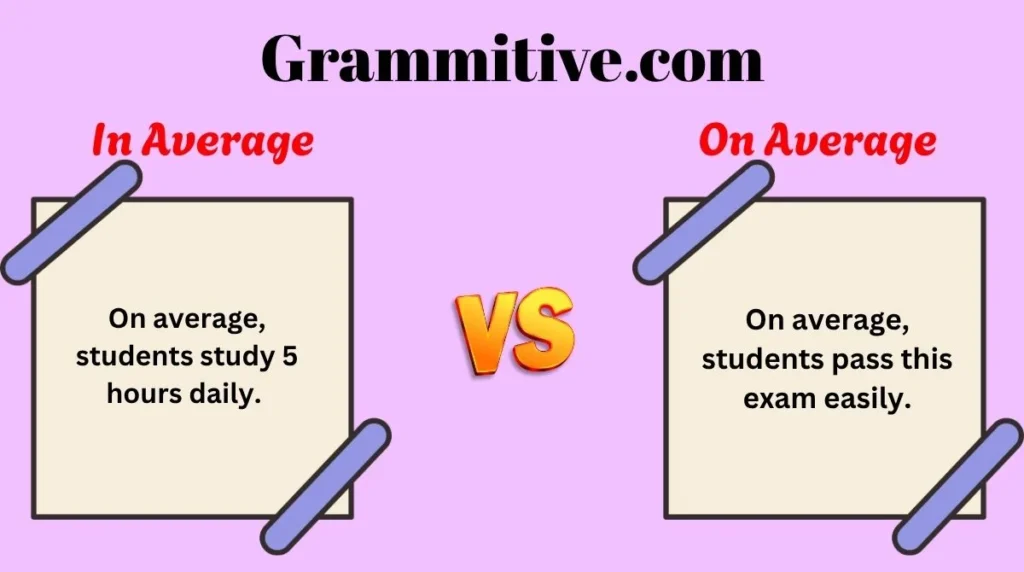
6️⃣ Difference Between “In Average” and “On Average” (Detailed)
Comparison Table
| Feature | In Average | On Average |
|---|---|---|
| Correct Usage | ❌ Incorrect | ✔ Correct |
| Native Use | Not used | Very common |
| Meaning | No standard meaning | General/typical amount |
| Grammar Form | Wrong structure | Fixed phrase |
| Use in Exams | Avoid | Use confidently |
Usage Difference
- “In average” does not follow English grammar rules.
- “On average” is the correct expression used worldwide.
Grammar Logic
English uses specific prepositions with fixed words. “Average” naturally pairs with “on,” not “in.”
Sentence Structure Difference
- Incorrect: In average + subject + verb ❌
- Correct: On average + subject + verb ✔
Meaning Comparison
- “In average” → confusing, unnatural
- “On average” → clear, logical, widely accepted
7️⃣ Grammar Rules You Must Remember
Rule #1
Always use “on average” when talking about general numbers.
✔ On average, people sleep 7 hours.
Rule #2
Never use “in average” in formal or informal English.
❌ In average, he earns 500 dollars.
Rule #3
“On average” can start a sentence or come after a comma.
✔ Students, on average, perform well.
Rule #4
It is mainly used with statistics, habits, and general facts.
✔ On average, cars last 10–15 years.
8️⃣ Common Mistakes Students Make
Why Mistakes Happen
- Influence from native language
- Direct translation from mother tongue
- Lack of exposure to real English
- Confusion with other “in” phrases
Wrong vs Correct Examples
❌ In average, I wake up at 6 AM.
✔ On average, I wake up at 6 AM.
❌ In average, shops open at 9.
✔ On average, shops open at 9.
❌ In average, people are busy.
✔ On average, people are busy.
Easy Fix Tip
Whenever you think of “in average,” immediately replace it with “on average.”
9️⃣ Easy Trick to Remember the Difference
Think like this:
👉 “Average sits ON top of many things.”
Just like a ruler measuring many numbers, the result comes on top of them. That’s why we say on average, not in average.
Another simple idea:
- “On” = general view from above
- “Average” = result of many things
So, the correct picture in your mind is looking on top of data, not inside it.
🔟 Daily Life Examples (Very Important)
- On average, I drink tea three times a day.
- On average, traffic is heavy in the morning.
- On average, my phone battery lasts one day.
- On average, students arrive late in winter.
- On average, I spend 2 hours on social media.
- On average, exams are difficult this year.
- On average, people eat out twice a week.
- On average, I sleep after midnight.
- On average, buses are crowded in cities.
- On average, prices increase every year.
1️⃣1️⃣ Practice Section
Choose the correct sentence:
- ___, students study hard before exams.
A) In average
B) On average - ___, people sleep 7 hours daily.
A) In average
B) On average - He earns ___ 40,000 rupees monthly.
A) in average
B) on average - ___, weather is hot in summer.
A) In average
B) On average - ___, buses come every 20 minutes.
A) In average
B) On average
Answers
- B
- B
- B
- B
- B
1️⃣2️⃣ FAQs
1. What is the difference between “in average” and “on average”?
“In average” is incorrect in modern English. “On average” is the correct and natural expression used in speaking and writing.
2. Can we use “on average” in exams?
Yes, absolutely. It is correct, formal, and safe to use in all types of exams and essays.
3. Is “on average” formal or informal?
It is both. You can use it in casual conversations, school writing, and professional reports.
4. Why is “in average” wrong?
Because English grammar does not support this structure. Native speakers never use it in standard communication.
5. Can “on average” start a sentence?
Yes. It is very common at the beginning of a sentence, especially in reports and explanations.
6. What are similar phrases to “on average”?
You can also say “typically,” “usually,” or “generally,” depending on the context.
1️⃣3️⃣ Final Conclusion
Understanding the difference between “in average” and “on average” is simple once you see real usage.
The main point is that only “on average” is correct in English. It is used everywhere—in conversations, exams, news, and academic writing.
Many learners make mistakes because they try to translate directly from their native language.
But English has its own fixed phrases, and “on average” is one of them.
If you remember the simple rule that average always goes with “on,” you will never get confused again.
Try to use it in your daily speaking and writing. The more you practice, the more natural it will feel.
Keep learning small grammar points like this. They may look simple, but they make a big difference in your English fluency.
With regular practice, your English will become clearer, more natural, and more confident.

I am Lucas Bennett, a digital content creator passionate about social media trends and online growth strategies.
I share practical insights and guides to help users better understand and navigate the digital world.