
Many English learners feel confused when they hear sentences like “you was” and “you were.”
Both sound similar, and sometimes people even use them in casual speech. So naturally, it becomes hard to know which one is correct.
This confusion usually comes from how English verbs change depending on the subject. Words like I, you, he, she, and they all follow different patterns.
For beginners and non-native speakers, remembering these patterns can feel tricky at first.
But here’s the good news: once you understand the simple rule behind “you was” and “you were,” everything becomes much easier.
This topic is very important because it comes up in everyday conversations.
Whether you’re talking about the past, telling a story, or asking a question, you’ll need to use the correct form.
After reading this guide, you will clearly understand:
- Which one is correct: “you was” or “you were”
- When to use each form
- Why one is usually wrong
- How to avoid common mistakes in real life
By the end, you’ll feel confident using the correct grammar in both speaking and writing.
What Does “You Was” Mean?
“You was” is a phrase that some people use, but in standard English grammar, it is incorrect.
Simple Definition
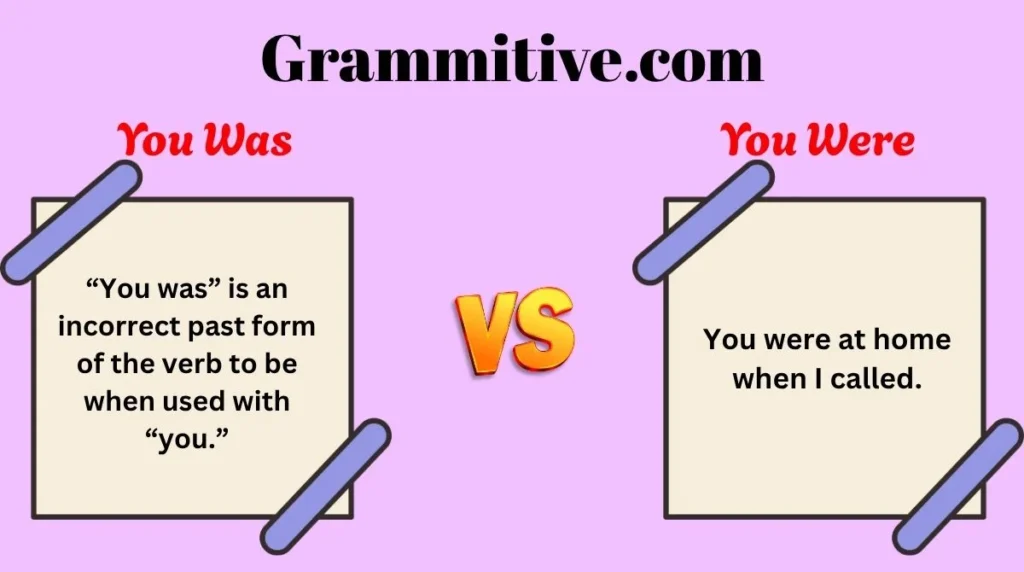
“You was” is an incorrect past form of the verb to be when used with “you.”
Grammar Rule
In past tense:
- Was is used with: I, he, she, it
- Were is used with: you, we, they
So, using “was” with “you” breaks this rule.
When Do People Use “You Was”?
You might hear “you was” in:
- Informal speech
- Certain dialects
- Songs or movies
But it is not correct in formal or standard English.
Example Sentences (Incorrect Usage)
Here are examples of how learners might use it incorrectly:
- ❌ You was late yesterday.
- ❌ You was my best friend.
- ❌ Why you was angry?
- ❌ You was not ready.
- ❌ I thought you was coming.
- ❌ You was at the party, right?
Correct Versions
Now see the correct forms:
- ✅ You were late yesterday.
- ✅ You were my best friend.
- ✅ Why were you angry?
- ✅ You were not ready.
- ✅ I thought you were coming.
- ✅ You were at the party, right?
Common Learner Confusion
Many students think:
- “I was” → so maybe “you was” is also correct
But English does not work that way. Each subject has its own form.
👉 Think of it like this:
- I → was
- You → were
They are different, even though both talk about the past.
What Does “You Were” Mean?
“You were” is the correct past tense form of the verb to be when used with “you.”
Simple Definition
“You were” is used to talk about:
- Past situations
- Past feelings
- Past conditions
Grammar Rule
Use “were” with:
- You (singular and plural)
- We
- They
Example Sentences
Here are correct and natural examples:
- You were very happy yesterday.
- You were my teacher last year.
- You were late to the meeting.
- You were at home when I called.
- You were not ready for the test.
- You were very kind to me.
- You were playing football.
- You were watching TV.
Questions with “You Were”
- Were you at school?
- Were you busy yesterday?
- Were you sleeping?
Negative Form
- You were not (weren’t) tired.
- You were not at the office.
Common Learner Confusion
Some students think “were” is only for plural subjects like “they” or “we.”
But this is not true.
👉 “You” always uses were, whether it means:
- One person → “You were my friend.”
- Many people → “You were all happy.”
Difference Between You Was and You Were (Detailed)
Quick Comparison Table
| Feature | You Was ❌ | You Were ✅ |
|---|---|---|
| Grammar correctness | Incorrect | Correct |
| Usage | Informal/dialect only | Standard English |
| Verb agreement | Wrong | Correct |
| Used in writing | No | Yes |
| Used in exams | No | Yes |
Usage Difference
“You was” is not accepted in standard grammar. It may appear in:
- Slang
- Regional speech
“You were” is used in:
- School writing
- Exams
- Professional communication
- Daily conversations
Grammar Logic
The verb to be in past tense changes like this:
- I → was
- You → were
- He/She/It → was
- We → were
- They → were
So, “you were” follows the correct pattern.
Sentence Structure Difference
Incorrect:
- You was happy.
Correct:
- You were happy.
Incorrect:
- You was at home.
Correct:
- You were at home.
Meaning Comparison
Both phrases try to express the same idea (past state), but only one is grammatically correct.
- “You was happy” → sounds wrong
- “You were happy” → correct and clear
Grammar Rules You Must Remember
Rule #1: Use “Were” with “You”
Always use “were” with “you,” no matter what.
✔ Example:
You were late.
Rule #2: “Was” is Not Used with “You”
Never use “was” with “you” in standard English.
✔ Example:
Incorrect: You was tired
Correct: You were tired
Rule #3: Use “Were” in Questions
When asking questions, “were” comes before “you.”
✔ Example:
Were you at school?
Rule #4: Use “Were” in Negative Sentences
Add “not” after “were.”
✔ Example:
You were not ready.
You weren’t ready.
Common Mistakes Students Make
Why Mistakes Happen
- Direct translation from native language
- Confusion with “I was”
- Hearing incorrect spoken English
Wrong vs Correct Examples
❌ You was my friend
✅ You were my friend
❌ Where you was?
✅ Where were you?
❌ You was sleeping
✅ You were sleeping
Easy Correction Tips
- Always check the subject
- If the subject is “you,” use “were”
- Practice speaking out loud
- Read simple English sentences daily
Easy Trick to Remember the Difference
Here’s a simple trick:
👉 “You always go with were.”
Think of it like a fixed pair:
- You + were ✅
- You + was ❌
Another easy way:
👉 “Was” is only for:
- I
- He
- She
- It
If it’s not one of these, use “were.”
Daily Life Examples (Very Important)
These are natural spoken English sentences:
- You were so funny yesterday.
- You were late again!
- I think you were right.
- You were not listening to me.
- You were at the market, right?
- Why were you upset?
- You were doing great.
- You were my best friend.
- You were very helpful.
- You were busy last night.
These are the kinds of sentences you’ll hear every day.
Practice Section
Choose the correct option:
- You ___ late yesterday.
(was / were) - Why ___ you angry?
(was / were) - You ___ not ready for the test.
(was / were) - ___ you at home?
(Was / Were) - I thought you ___ coming.
(was / were)
Answers
- were
- were
- were
- Were
- were
FAQs
1. What is the difference between “you was” and “you were”?
“You were” is correct in standard English. “You was” is grammatically incorrect but may appear in informal speech or dialects.
2. Can we use “you was” in spoken English?
In some casual or regional speech, people use it. However, it is not correct and should be avoided in proper English.
3. Is “you were” used for one person or many?
Both. “You were” is used for singular and plural. English uses the same form for both.
4. Can we use “were” in questions?
Yes. Example: “Were you at school?” It is very common in questions.
5. Is “you were” formal or informal?
It is used in both formal and informal English. It is the standard correct form.
6. Why do people say “you was” in movies or songs?
Sometimes it is used for style, rhythm, or to show a certain accent or culture. It is not standard grammar.
Final Conclusion
Understanding the difference between “you was” and “you were” is easier than it looks. The main idea is simple:
“you were” is always correct in standard English, and “you was” is not.
This small rule can make a big difference in how you speak and write. Using the correct form helps you sound more natural, confident, and clear.
At first, it might feel strange, especially if you’ve heard “you was” in songs or conversations.
But with practice, your brain will start to recognize the correct pattern automatically.
Try to use “you were” in your daily sentences. Speak it, write it, and notice it when others use it. The more you practice, the more natural it will feel.
Keep learning step by step. English becomes easier when you focus on small rules like this and apply them in real life.

I am Lucas Bennett, a digital content creator passionate about social media trends and online growth strategies.
I share practical insights and guides to help users better understand and navigate the digital world.