

Many English learners feel confused when they hear sentences like “Have anyone seen my bag?” or “Has anyone seen my bag?”
Both sound similar, but only one is correct. This small difference between “have” and “has” can create big confusion, especially when you are learning how to ask questions.
The problem usually comes from understanding subject-verb agreement. Learners often focus on the word “anyone” and think it means “many people,” so they use “have.”
But in English grammar, things are not always what they seem. Some words look plural in meaning but behave as singular in grammar.
This topic is very important in daily English. You will use sentences like this when asking questions, talking about experiences, or checking information. For example:
- Has anyone called me?
- Has anyone finished the work?
After reading this guide, you will clearly understand:
- When to use have and has
- Why “anyone” always takes a certain verb form
- How to avoid common mistakes
- How to use these forms naturally in real life
By the end, you will feel confident using both correctly without thinking too much.
What Does “Have” Mean?
The word “have” is a helping verb (auxiliary verb) and also a main verb in English. It is commonly used with plural subjects like I, you, we, they.
Simple Definition
“Have” is used to show:
- possession (owning something)
- action in present perfect tense
- questions and negative sentences
When to Use It
Use “have” with:
- I → I have finished my work.
- You → You have done a great job.
- We → We have completed the task.
- They → They have arrived.
Grammar Rule
👉 Use “have” with plural subjects and the pronouns I, you, we, they.
Example Sentences
- I have a new phone.
- You have a beautiful house.
- We have finished the project.
- They have seen that movie.
- I have never been to London.
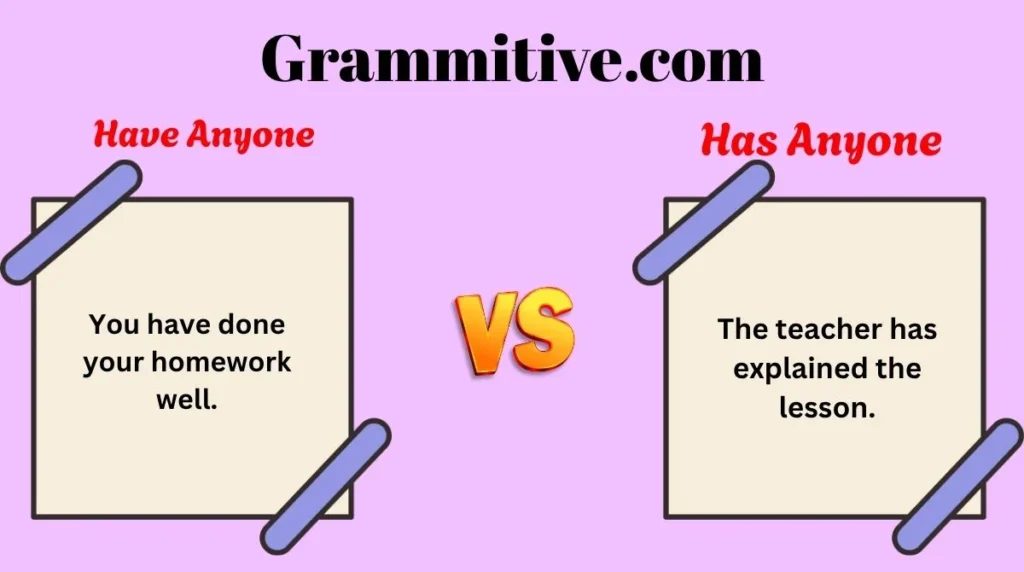
- You have done your homework well.
- We have already eaten dinner.
- They have learned English quickly.
Common Learner Confusion
Many learners think “have” can be used with every subject. But this is not correct.
❌ He have a car
✔️ He has a car
So, “have” is not used with singular third-person subjects like he, she, it.
What Does “Has” Mean?
The word “has” is also a helping verb and the third-person singular form of “have.”
Simple Definition
“Has” is used with singular subjects, especially:
- He
- She
- It
- Singular nouns
When to Use It
Use “has” when the subject is one person or one thing.
Grammar Rule
👉 Use “has” with singular third-person subjects.
Example Sentences
- He has a car.
- She has a beautiful dress.
- It has stopped raining.
- Ali has finished his homework.
- Sara has gone to school.
- The dog has eaten its food.
- My brother has bought a laptop.
- The teacher has explained the lesson.
Common Learner Confusion
Learners often get confused when the subject is not clear. Words like:
- anyone
- someone
- everyone
These look plural but are actually singular, so they use has, not have.
❌ Have anyone called?
✔️ Has anyone called?
Difference Between Have and Has (Detailed)
Understanding the difference becomes easy when you compare them clearly.
Comparison Table
| Feature | Have | Has |
|---|---|---|
| Subject Type | Plural / I, You, We, They | Singular (He, She, It) |
| Usage | General / plural sentences | Third-person singular |
| Example | They have finished work | He has finished work |
| With “Anyone” | ❌ Incorrect | ✔️ Correct |
Usage Difference
- Have → used for multiple people or general subjects
- Has → used for one person or singular subject
Grammar Logic
Even though “anyone” sounds like many people, it is treated as one unknown person.
👉 That is why we say:
✔️ Has anyone seen my keys?
Sentence Structure Difference
- Have + subject (plural)
→ Have they completed the task? - Has + subject (singular)
→ Has he completed the task? - Has + anyone
→ Has anyone completed the task?
Meaning Comparison
There is no difference in meaning between have and has. The difference is only in grammar and subject agreement.
Grammar Rules You Must Remember
Rule #1: Anyone is Always Singular
Even though “anyone” refers to many people, it is grammatically singular.
✔️ Has anyone called me?
Rule #2: Use “Has” with Third-Person Singular
If the subject is he, she, it, or any singular noun, use has.
✔️ She has finished her work.
Rule #3: Use “Have” with I, You, We, They
These pronouns always take “have.”
✔️ They have gone home.
Rule #4: Questions Follow the Same Rule
When forming questions, the rule does not change.
✔️ Has anyone seen my phone?
❌ Have anyone seen my phone?
Common Mistakes Students Make
Why Mistakes Happen
- Learners think “anyone” means many people
- They translate directly from their native language
- They don’t understand singular vs plural grammar rules
Wrong vs Correct Examples
❌ Have anyone finished the work?
✔️ Has anyone finished the work?
❌ Have someone called you?
✔️ Has someone called you?
❌ Have everyone arrived?
✔️ Has everyone arrived?
Easy Correction Tips
- Focus on grammar, not meaning
- Remember: words like anyone, someone, everyone = singular
- Always pair them with has
Easy Trick to Remember the Difference
Here is a very simple trick:
👉 Think of “anyone” as ONE person
Even if you don’t know who the person is, imagine just one unknown person.
So:
- ONE person → use has
- MANY people → use have
Example:
- Has anyone called? → one unknown person
- Have they called? → many known people
This trick works almost every time and helps you avoid confusion quickly.
Daily Life Examples (Very Important)
These are real-life sentences you can use every day:
- Has anyone seen my phone?
- Has anyone called me today?
- Has anyone finished the homework?
- Has anyone opened the door?
- Has anyone tried this restaurant?
- Has anyone taken my pen?
- Has anyone spoken to the teacher?
- Has anyone checked the email?
- Has anyone watched this movie?
- Has anyone heard the news?
These are common spoken English sentences, especially in school, office, or home situations.
Practice Section
Choose the correct option:
- ___ anyone seen my bag? (Have / Has)
- ___ anyone completed the task? (Have / Has)
- ___ they finished the work? (Have / Has)
- ___ she done her homework? (Have / Has)
- ___ anyone called you? (Have / Has)
Answers
- Has
- Has
- Have
- Has
- Has
FAQs
1. What is the difference between have anyone and has anyone?
“Have anyone” is grammatically incorrect. “Has anyone” is correct because “anyone” is singular and needs “has.”
2. Can we use “have anyone” in questions?
No, it is not correct. Always use “has anyone” when asking questions.
3. Is “has anyone” formal or informal?
It is neutral. You can use it in both formal and informal situations.
4. Why is “anyone” singular?
In English grammar, words like anyone, someone, and everyone are treated as singular pronouns.
5. Can I say “have someone” instead of “has someone”?
No, that is incorrect. Always say “has someone.”
6. Is this rule used in spoken English too?
Yes, native speakers always use “has anyone,” even in casual conversation.
Final Conclusion
The difference between have anyone and has anyone may look small, but it is very important in correct English.
The key idea is simple: “anyone” is always singular, so it always takes *“has.”
Many learners make mistakes because they think about meaning instead of grammar.
But once you understand that English follows specific rules for subject-verb agreement, things become much easier.
Remember the simple trick: imagine “anyone” as one unknown person. That will guide you to use “has” every time. Practice with real-life sentences, and soon it will feel natural.
Don’t worry if you make mistakes at first. Every learner goes through this stage. Keep practicing, speak more, and pay attention to how native speakers use these forms.
With time, you will not even think about it—you will just say it correctly.

I am Lucas Bennett, a digital content creator passionate about social media trends and online growth strategies.
I share practical insights and guides to help users better understand and navigate the digital world.