
Many English learners get confused when they see two similar forms: “cannot” and “can not.”
At first glance, they look almost the same, so students often think both are correct in every situation.
But when they try to use them in writing or speaking, they feel unsure. This small confusion can affect grammar marks, job writing, emails, and even daily communication.
The truth is, English is full of small differences like this. One tiny space can change the style, meaning, or emphasis of a sentence.
That is why understanding this topic is very important for anyone learning English.
In daily life, you might write sentences like “I cannot come today” or “I can not only sing but also dance.”
Both look similar, but they are used in different ways. Knowing the correct usage helps you sound more natural and confident.
After reading this guide, you will clearly understand:
- When to use cannot
- When to use can not
- The grammar logic behind both forms
- Easy tricks to never confuse them again
Everything is explained in very simple English with real-life examples so even beginners can follow without difficulty.
By the end, this confusing grammar point will feel very easy and natural.
4️⃣ What Does “Cannot” Mean?
Cannot is the most common and standard way to show inability or impossibility in English. It is a single word formed by joining “can” + “not.”
✔ Simple Definition
We use cannot to say that something is not possible or someone is not able to do something.
✔ When to Use It
- To show inability
- To show impossibility
- In formal and informal writing
- In daily conversation
✔ Grammar Rule
Subject + cannot + base verb
✔ Example Sentences
- I cannot swim.
- She cannot come today.
- They cannot find the keys.
- We cannot open this door.
- He cannot speak French.
- You cannot park here.
- The machine cannot start.
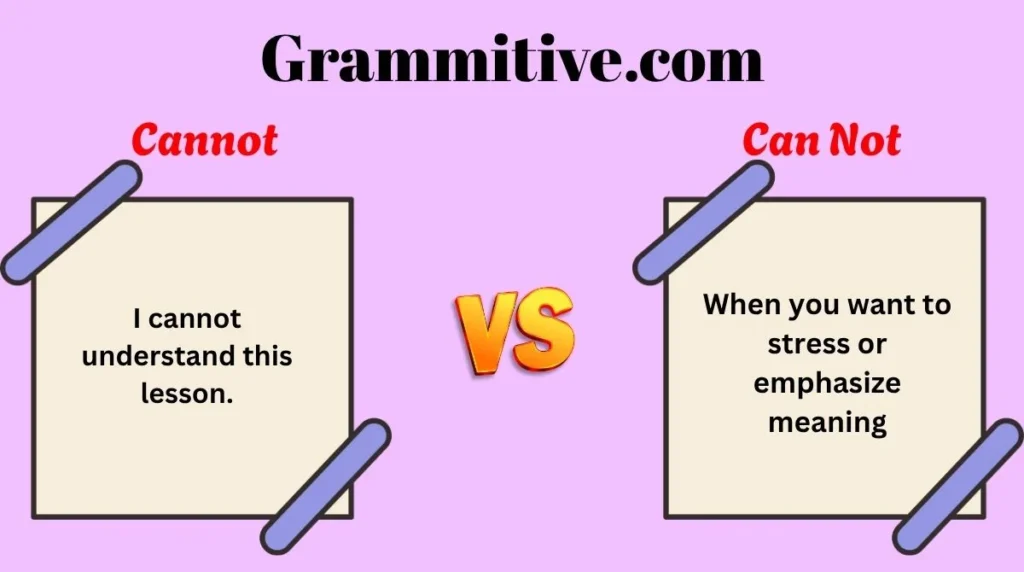
- I cannot understand this lesson.
✔ Common Learner Confusion
Many learners think “cannot” is two words because it comes from “can not.” But in modern English, it is written as one word in most situations. This makes it easier and more natural in writing.
Another confusion is thinking “cannot” is very formal. In reality, it is used in both spoken and written English every day.
5️⃣ What Does “Can Not” Mean?
Can not is also correct in English, but it is used in special situations only. It is not the normal negative form of “can.” Instead, it is used when “not” is connected to a different part of the sentence.
✔ Simple Definition
We use can not when “not” is part of a different idea, not just making “can” negative.
✔ When to Use It
- When you want to stress or emphasize meaning
- When “not” is linked to another phrase
- In formal writing for clarity
- In sentences with “not only… but also”
✔ Grammar Rule
Subject + can + not + (other structure or emphasis)
✔ Example Sentences
- You can not only sing but also dance.
- I can not agree with that idea.
- She can not help but smile.
- They can not always be right.
- He can not deny the truth.
- We can not just wait and do nothing.
- You can not imagine how difficult it is.
- I can not believe this happened.
✔ Common Learner Confusion
Students often think “can not” is just a spelling mistake. But it is not wrong when used for emphasis. The confusion happens because in normal negative sentences, we almost always use “cannot.”
So the key idea is:
👉 “cannot” = normal negative form
👉 “can not” = special emphasis usage
6️⃣ Difference Between Cannot and Can Not (Detailed)
Understanding the difference becomes easy when we compare them side by side.
✔ Comparison Table
| Feature | Cannot | Can Not |
|---|---|---|
| Form | One word | Two words |
| Usage | Normal negative form | Special emphasis |
| Frequency | Very common | Less common |
| Meaning | Inability or impossibility | Emphasis or structure-based |
| Style | Simple, standard English | Formal or expressive |
| Example | I cannot go | I can not only go, but also stay |
✔ Usage Difference
- Cannot is used when you simply say something is not possible.
- Can not is used when “not” belongs to another part of the sentence or when you want to highlight meaning.
✔ Grammar Logic
English prefers shorter forms in negative sentences. That is why “cannot” became the standard. But when sentences become complex, writers sometimes separate “can” and “not” for clarity.
✔ Sentence Structure Difference
- Cannot → direct negative
- Can not → split structure with emphasis or additional meaning
✔ Meaning Comparison
Even though both involve “can” and “not,” their meaning changes based on structure, not just spelling.
7️⃣ Grammar Rules You Must Remember
✔ Rule #1: Use “cannot” for simple negatives
- I cannot drive a car.
✔ Rule #2: Use “can not” for emphasis
- You can not only study but also work part-time.
✔ Rule #3: “Cannot” is more common in daily English
- She cannot attend the meeting.
✔ Rule #4: “Can not” appears in structured or complex sentences
- He can not deny the fact that he was late.
8️⃣ Common Mistakes Students Make
Many learners mix these two forms because they look very similar. Here are common mistakes:
❌ Mistake 1: Using “can not” in normal sentences
Wrong: I can not swim.
✔ Correct: I cannot swim.
❌ Mistake 2: Writing everything as one word
Wrong: I cann ot go.
✔ Correct: I cannot go.
❌ Mistake 3: Thinking both are interchangeable
Students often believe both forms mean exactly the same. But structure changes meaning.
✔ Why mistakes happen
- Lack of practice
- Confusion from similar spelling
- Not understanding sentence structure
✔ Easy fix
Always ask:
👉 Is it a simple negative? Use cannot
👉 Is it showing emphasis or structure? Use can not
9️⃣ Easy Trick to Remember the Difference
Here is a simple trick:
👉 Think of “cannot” = one strong idea
👉 Think of “can not” = two separate ideas
If your sentence is simple, keep it together.
If your sentence is complex or expressive, you can separate it.
Another memory trick:
👉 “Cannot” = normal life
👉 “Can not” = special style writing
This small mental picture helps students remember it easily without memorizing rules.
🔟 Daily Life Examples (Very Important)
Here are natural spoken English examples:
- I cannot come to school today.
- She cannot find her phone.
- We cannot wait any longer.
- You can not only eat here but also relax.
- He cannot drive at night.
- I can not believe what I saw yesterday.
- They cannot solve this problem.
- You cannot enter without permission.
- She can not deny her mistake.
- I cannot hear you clearly.
1️⃣1️⃣ Practice Section
Choose the correct option:
- I ___ swim very well.
a) cannot
b) can not - She ___ come to the party.
a) cannot
b) can not - You ___ only study but also work.
a) cannot
b) can not - He ___ believe this story.
a) cannot
b) can not - They ___ solve this puzzle.
a) cannot
b) can not
✔ Answers:
- cannot
- cannot
- can not
- can not
- cannot
1️⃣2️⃣ FAQs
1. What is the difference between cannot and can not?
“Cannot” is used for simple negative meaning, while “can not” is used for emphasis or special sentence structure.
2. Is cannot one word or two words?
“Cannot” is one word and is the standard form in modern English writing.
3. Can we use can not in writing?
Yes, but only in special cases where you need emphasis or complex structure.
4. Which one is more common?
“Cannot” is much more common in daily English and formal writing.
5. Is cannot formal or informal?
It is neutral. You can use it in both formal and informal situations.
6. Can cannot and can not change meaning?
Yes, structure changes meaning slightly, especially when emphasis is involved.
1️⃣3️⃣ Final Conclusion
The difference between cannot and can not is small in appearance but important in understanding English grammar correctly.
Most of the time, learners should use cannot because it is the standard, natural, and widely accepted form in both speaking and writing.
It clearly shows inability or impossibility in a simple way.
On the other hand, can not is used in special cases where the sentence has extra meaning, emphasis, or a more complex structure.
It is less common, but still correct when used properly.
The main key is understanding structure, not just spelling. Once you learn how sentences are built, this confusion becomes very easy to solve.
Keep practicing with real-life sentences and try noticing how native speakers use these forms.
With time, your understanding will become automatic, and you will use both correctly without thinking too much.
English grammar becomes easy when explained simply and practiced regularly.

I am Lucas Bennett, a digital content creator passionate about social media trends and online growth strategies.
I share practical insights and guides to help users better understand and navigate the digital world.