

Many English learners feel confused when they see the words wholistic and holistic. They look almost the same.
They sound the same too. So naturally, students start asking: Are they different? Is one wrong? Can I use both?
This confusion is very common, especially for non-native speakers. Even some native speakers are unsure.
You might see both words in books, websites, or even health articles. That makes things even more confusing.
Understanding the difference between these two words is important because using the wrong one can make your English look less natural.
In exams, writing tasks, or professional communication, correct word choice matters a lot.
After reading this guide, you will clearly understand:
- What holistic means
- What wholistic means
- Which one is correct in modern English
- When and where to use each word
- Easy tricks to remember the difference
Everything will be explained in very simple English with real-life examples, so you won’t feel lost at any point.
What Does “Wholistic” Mean?
The word wholistic is an alternative spelling of holistic. It comes from the word whole, which means “complete” or “all parts together.”
Simple Definition
Wholistic means looking at something as a whole, not just focusing on one part.
When to Use It
Some people use wholistic when they want to strongly show the idea of “whole.” It is often used in:
- Alternative medicine
- Personal development
- Spiritual topics
However, it is important to know that wholistic is less common and sometimes considered non-standard in modern English.
Grammar Rule
Wholistic is an adjective. It describes a noun.
👉 Structure:
wholistic + noun
Example:
- wholistic approach
- wholistic care
Example Sentences
- She believes in a wholistic approach to health.
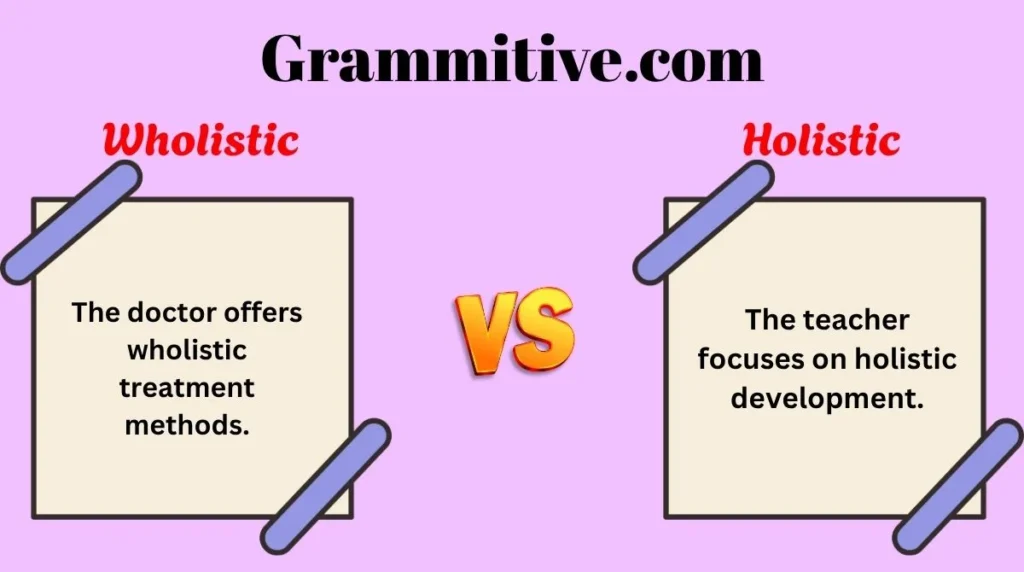
- The doctor offers wholistic treatment methods.
- He focuses on wholistic growth of students.
- The program supports wholistic learning.
- They follow a wholistic lifestyle.
- The teacher uses wholistic methods in class.
- Wholistic healing includes mind and body.
- This book explains wholistic wellness.
Common Learner Confusion
Many learners think wholistic is more correct because it clearly shows the word whole. That seems logical, but English doesn’t always follow logic in spelling.
In reality:
- Wholistic is accepted by some people
- But it is not widely preferred
Most dictionaries and professionals recommend using holistic instead.
What Does “Holistic” Mean?
The word holistic is the standard and widely accepted spelling.
Simple Definition
Holistic means understanding or treating something as a complete system, including all parts.
It focuses on the idea that everything is connected.
When to Use It
Use holistic in:
- Academic writing
- Professional communication
- Health and wellness topics
- Education
- Everyday English
This is the correct and preferred word in modern English.
Grammar Rule
Holistic is also an adjective.
👉 Structure:
holistic + noun
Example:
- holistic approach
- holistic development
Example Sentences
- The school supports holistic education.
- She prefers holistic medicine.
- We need a holistic plan for success.
- The teacher focuses on holistic development.
- This course offers a holistic view of learning.
- Doctors are using holistic methods now.
- The company takes a holistic approach to training.
- Holistic care improves both mind and body.
Common Learner Confusion
Students often ask:
“Why is it holistic and not wholistic?”
The answer is simple:
- The word comes from holism, not whole
- That is why the correct spelling is holistic
Even though both sound similar, only one is commonly accepted.
Difference Between Wholistic and Holistic (Detailed)
Here is a clear comparison to remove all confusion:
| Feature | Wholistic | Holistic |
|---|---|---|
| Spelling | Less common | Standard and correct |
| Usage | Rare, informal, alternative | Widely used in all contexts |
| Acceptance | Limited | Fully accepted globally |
| Origin clarity | Based on “whole” idea | Comes from “holism” |
| Recommended use | Not recommended | Strongly recommended |
Usage Difference
- Holistic is used in schools, books, and professional writing
- Wholistic is sometimes used in informal or niche areas
👉 Example:
- Correct: The doctor uses a holistic approach.
- Less preferred: The doctor uses a wholistic approach.
Grammar Logic
Both words follow the same grammar rules:
- Both are adjectives
- Both describe nouns
But the difference is in standard usage, not grammar.
Sentence Structure Difference
There is no structural difference:
- Holistic care
- Wholistic care
Both follow the same pattern, but only one is widely accepted.
Meaning Comparison
Both words mean the same thing:
- Seeing the “big picture”
- Considering all parts together
But only holistic is considered correct in modern English.
Grammar Rules You Must Remember
Rule #1: Use “Holistic” in Formal Writing
Always use holistic in essays, emails, and exams.
✔ Example:
She gave a holistic explanation of the topic.
Rule #2: Avoid “Wholistic” in Academic English
It may look correct, but it is not standard.
✔ Example:
Correct: holistic development
Incorrect: wholistic development
Rule #3: Both Are Adjectives
They describe nouns, not actions.
✔ Example:
The teacher uses a holistic method.
Rule #4: Follow the Origin Word
Remember:
- holistic → from holism
- not from whole
✔ Example:
Holistic thinking improves problem-solving.
Common Mistakes Students Make
1. Choosing Based on Spelling Logic
Many learners think:
“Whole → wholistic must be correct”
❌ Wrong:
She believes in wholistic health care.
✔ Correct:
She believes in holistic health care.
2. Mixing Both Words
Students sometimes use both in the same text.
❌ Wrong:
The course offers holistic and wholistic learning.
✔ Correct:
The course offers holistic learning.
3. Using Wholistic in Exams
This can reduce marks in formal writing.
✔ Tip:
Always choose holistic in tests.
Easy Correction Tips
- Always remember: Holistic = safe choice
- If unsure, never use wholistic
- Think of “holistic health” (common phrase)
Easy Trick to Remember the Difference
Here’s a simple memory trick:
👉 “Holistic is whole enough.”
Even without “w”, the word already means complete.
Another trick:
👉 Think of “holistic health”
This phrase is very common. You rarely see “wholistic health.”
So your brain will remember:
- Holistic = natural, common, correct
- Wholistic = unusual, avoid it
Daily Life Examples (Very Important)
These are simple sentences you may hear in real conversations:
- I like a holistic way of living.
- This school focuses on holistic education.
- We need a holistic plan for this project.
- She believes in holistic healing.
- The doctor suggested a holistic treatment.
- Try a holistic approach to your problems.
- He follows a holistic lifestyle.
- This app helps with holistic wellness.
- Teachers should support holistic growth.
- Holistic thinking helps in real life.
These examples are very natural and used in daily English.
Practice Section
Choose the correct word: holistic or wholistic
- The teacher supports ______ learning.
- She prefers ______ medicine.
- We need a ______ approach.
- This course offers ______ development.
- He believes in ______ health care.
Answers
- holistic
- holistic
- holistic
- holistic
- holistic
👉 Notice something?
All answers use holistic.
FAQs
1. What is the difference between wholistic and holistic?
Both words have the same meaning, but holistic is the correct and widely used spelling. Wholistic is less common and not recommended in formal English.
2. Can we use wholistic in English?
Yes, it is not completely wrong, but it is rare. Most teachers and dictionaries suggest using holistic instead.
3. Is holistic formal or informal?
Holistic can be used in both formal and informal English. It is commonly used in academic, medical, and professional writing.
4. Why do some people use wholistic?
Some people use it to show the connection with the word whole. But this is based on personal preference, not standard grammar.
5. Which word should I use in exams?
Always use holistic. It is the correct and accepted form.
6. Is wholistic outdated?
It is not exactly outdated, but it is uncommon. It is better to avoid it in modern English.
Final Conclusion
The confusion between wholistic and holistic is very understandable.
Both words sound the same and share the same meaning, which makes learners unsure about which one to use.
The good news is that the answer is simple. Holistic is the correct, standard, and widely accepted word.
It is used in education, health, business, and everyday English. On the other hand, wholistic is rare and not preferred in formal writing.
The best way to avoid mistakes is to always choose holistic. It is safe, correct, and natural. With regular practice and exposure, this choice will become automatic.
Keep using the word in sentences, notice it in real-life situations, and your confidence will grow quickly.
English becomes easier when you focus on small but important details like this.

I am Lucas Bennett, a digital content creator passionate about social media trends and online growth strategies.
I share practical insights and guides to help users better understand and navigate the digital world.