
Many English learners get confused when they see sentences like “The audience is clapping” or “The audience are leaving”.
Why do some people use is and others use are? Which one is correct?
This question is tricky because it depends on how we see the word audience—as one group or as individual people.
Even native speakers sometimes pause before choosing the right verb.
Understanding when to use is or are is more than just a grammar detail. It affects your clarity in speaking and writing.
Imagine giving a presentation and saying, “The audience are happy”. Some listeners may think you are talking about each person separately rather than the group as a whole.
Small mistakes like this can make your English sound slightly awkward.
By the end of this guide, you will clearly understand the meaning of is and are when connected to audience.
You will know exactly when to treat audience as singular or plural. You will also learn simple tricks to remember the difference and practice with real-life examples.
After reading, your confidence in using sentences like “The audience is listening carefully” will increase, and you will stop doubting yourself when speaking or writing.
What Does “Is” Mean?
The word is is a singular verb, used when the subject is one person, thing, or group considered as a whole. In grammar, we say it is the third-person singular form of “to be”.
When to Use “Is”
- When talking about one person:
- She is my friend.
- When talking about one object:
- The book is on the table.
- When talking about a group as a single unit:
- The audience is excited.
Grammar Rule
- Singular subject → use is.
- The group acts together as one entity.
Examples
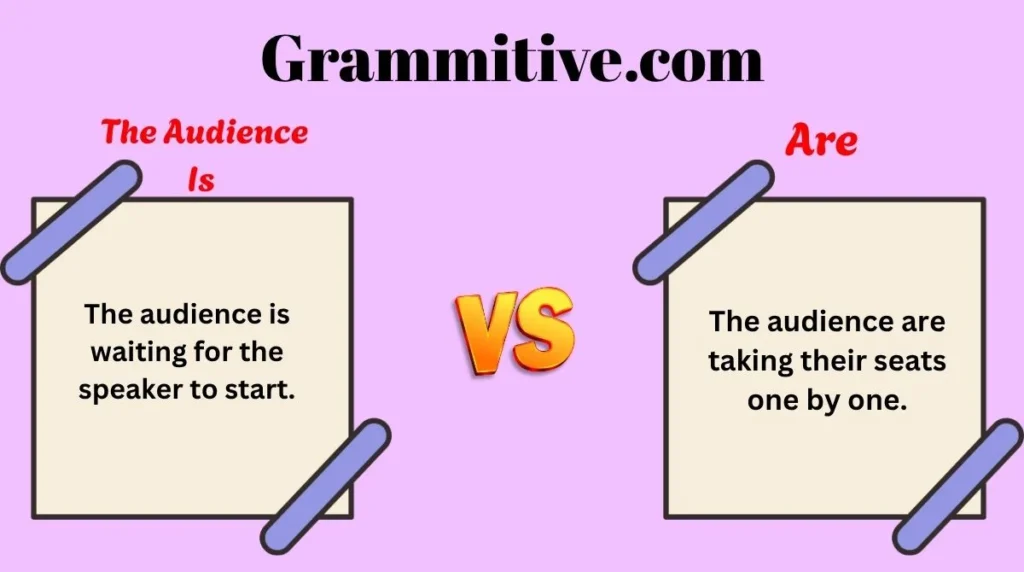
- The audience is waiting for the speaker to start.
- The audience is full of enthusiastic fans.
- The committee is meeting at 10 a.m.
- The team is ready for the match.
- The family is going on vacation.
- The class is learning new grammar rules.
- The audience is clapping after the performance.
- The group is making a decision together.
Common Learner Confusion
Many learners assume that because audience includes many people, it should take are. But in English, some collective nouns are singular in meaning, so they pair with is. Remember: it’s about the group as a whole, not each person individually.
What Does “Are” Mean?
The word are is a plural verb, used when the subject is more than one person or thing. It is the second-person singular/plural and first/third-person plural form of “to be”.
When to Use “Are”
- When talking about multiple people:
- They are my friends.
- When talking about multiple objects:
- The books are on the table.
- When talking about a group as individuals:
- The audience are arguing among themselves.
Grammar Rule
- Plural subject → use are.
- The group acts as individuals, not as a single entity.
Examples
- The audience are taking their seats one by one.
- The students are submitting their homework.
- The children are playing outside.
- The employees are checking their emails.
- The fans are cheering loudly.
- The audience are giving different opinions about the movie.
- The guests are arriving at the party.
- The participants are voting individually.
Common Learner Confusion
Learners often hesitate because audience sounds singular, but if we focus on the people inside the group, then are is correct. The key is whether you are thinking about the group as one unit or as separate individuals.
Difference Between “Is” and “Are” with “Audience”
| Feature | Audience is | Audience are |
|---|---|---|
| Meaning | The audience as a single group | The audience as individual people |
| Verb type | Singular | Plural |
| Grammar rule | Collective noun + singular verb | Collective noun + plural verb |
| Example sentence | The audience is enjoying the show. | The audience are taking their seats. |
| Focus | Unity, togetherness | Individuals, separate actions |
| Use in daily English | Formal speech, reporting | Informal, when describing individual actions |
Grammar Logic
- English treats some collective nouns as singular (team, audience, family, committee) when they act as a unit.
- If the emphasis is on individuals, we use plural verb.
Sentence Structure Difference
- Singular: Subject + is + adjective/verb
- The audience is happy.
- Plural: Subject + are + adjective/verb
- The audience are happy with their seats.
Meaning Comparison
- Is → the audience as one group feels happy.
- Are → each person in the audience feels happy, possibly differently.
Grammar Rules You Must Remember
Rule #1: Collective nouns with singular meaning use is
- Example: The audience is clapping after the speech.
Rule #2: Collective nouns with plural meaning use are
- Example: The audience are taking photos with their phones.
Rule #3: Look at the context
- If the sentence talks about the group as a whole, use is.
- If the sentence talks about individuals within the group, use are.
Rule #4: In American vs British English
- American English usually prefers is for collective nouns.
- British English often uses are, especially when focusing on members individually.
- Example:
- AmE: The audience is listening carefully.
- BrE: The audience are listening carefully.
Common Mistakes Students Make
Mistake #1: Always using is
- Wrong: The audience is taking their seats. (If referring to individual people)
- Correct: The audience are taking their seats.
Mistake #2: Always using are
- Wrong: The audience are clapping loudly. (If thinking of the group as one)
- Correct: The audience is clapping loudly.
Mistake #3: Confusing with other collective nouns
- Wrong: The team are winning the match. (AmE, thinking of team as one)
- Correct: The team is winning the match.
Easy Correction Tip: Always ask yourself: “Am I talking about the group as a unit or individuals?”
Easy Trick to Remember the Difference
Think of the audience as a single TV screen vs individual people:
- If you see one screen showing a show → is.
- The audience is amazed by the performance.
- If you see people moving separately → are.
- The audience are leaving through different doors.
This trick works in real life and makes grammar intuitive for learners.
Daily Life Examples
Here are 10 simple sentences you might hear every day:
- The audience is applauding the speaker.
- The audience are taking their seats before the show starts.
- The audience is focused on the movie screen.
- The audience are answering the survey individually.
- The audience is enjoying the performance together.
- The audience are leaving one by one after the concert.
- The audience is silent during the play.
- The audience are discussing their favorite scenes.
- The audience is cheering for the winner.
- The audience are holding up their tickets for inspection.
These examples show clearly how context decides the verb.
Practice Section
Choose the correct verb (is or are) for each sentence:
- The audience ___ ready to watch the movie.
- The audience ___ giving their feedback.
- The audience ___ laughing at the joke.
- The audience ___ entering the hall slowly.
- The audience ___ impressed by the singer.
Answers:
- is
- are
- is
- are
- is
FAQs
1. What is the difference between “the audience is” and “the audience are”?
- Is treats the audience as one group; are treats them as individuals.
2. Can we use “are” in questions?
- Yes, when focusing on individual members: Are the audience taking notes?
3. Is “the audience is” formal or informal?
- Mostly formal, especially in American English.
4. Can British English use “are” more often?
- Yes, British English often uses are for collective nouns.
5. Why do learners confuse “audience is” and “audience are”?
- Because audience looks singular but includes many people.
6. Is there a quick trick to decide which verb to use?
- Think: group as a whole → is, individuals → are.
Final Conclusion
Knowing whether to use the audience is or the audience are may seem small, but it makes your English much clearer and more natural.
The key is understanding whether you are talking about the group as one unit or as separate people.
Using the right verb shows confidence in speaking and writing.
Practice daily with real-life sentences. Pay attention when watching TV shows, speeches, or movies, and notice how native speakers treat collective nouns.
Soon, choosing is or are will become automatic. English is full of small rules like this, and mastering them makes your communication precise and fluent.
Keep practicing, and don’t be afraid to make mistakes—they are part of learning.

I am Lucas Bennett, a digital content creator passionate about social media trends and online growth strategies.
I share practical insights and guides to help users better understand and navigate the digital world.