

English grammar can feel confusing, especially when words look plural but behave like singular.
One of the most common doubts students ask is about “everyone is vs everyone are.”
At first sight, many learners think “everyone” means many people, so it should take a plural verb like “are.”
This is a natural mistake. In everyday life, we see groups of people, and our brain automatically connects “more than one” with plural grammar.
That is why sentences like “everyone are here” often appear in speech or writing from learners.
But English does not always follow this simple logic. Some words look plural but act as singular in grammar rules. “Everyone” is one of them.
In this lesson, you will clearly understand:
- What “everyone” really means in grammar
- Why it always takes a singular verb
- Why “everyone are” is usually incorrect
- How to use it correctly in real-life English
- Easy tricks to never forget the rule again
By the end, you will speak and write more confidently. You will stop guessing and start using correct grammar naturally, like a fluent English speaker.
4️⃣ What Does “Everyone” Mean?
“Everyone” is a singular indefinite pronoun in English grammar. It refers to all people in a group, but it treats them as one whole unit.
Even though it talks about many people, grammar rules see it as a single idea, not individual people.
✔️ Simple Definition:
“Everyone” means all people in a group together, but it behaves like one person in grammar.
✔️ Grammar Rule:
- “Everyone” always takes a singular verb
- We use is, has, was, does, not are, have, were, do
✔️ When to Use “Everyone”:
We use it when we talk about:
- All people in a group
- General statements about people
- Situations where individuals are not named
✔️ Example Sentences:
- Everyone is ready for the trip.
- Everyone is happy today.
- Everyone has finished their work.
- Everyone was late to class yesterday.
- Everyone is invited to the party.
- Everyone wants a good life.
- Everyone is talking about the news.
- Everyone knows the answer.
✔️ Common Learner Confusion:
Many students think:
“Everyone = many people = plural = are”
But English grammar does not always match meaning. “Everyone” is treated like a single group unit, so it needs singular verbs.
A simple way to understand it:
👉 Think of “everyone” as one box containing many people.
5️⃣ What Does “Everyone Are” Mean?
The phrase “everyone are” is usually considered incorrect in standard English grammar.
However, learners still use it because they are influenced by spoken English or their native language structure.
✔️ Simple Explanation:
“Everyone are” is a grammar mistake in formal English because “everyone” is singular, not plural.
✔️ Grammar Rule:
- “Everyone” must always pair with singular verbs
- “Are” is a plural verb, so it does not match
✔️ Correct vs Incorrect:
❌ Everyone are happy.
✔️ Everyone is happy.
❌ Everyone are coming.
✔️ Everyone is coming.
❌ Everyone are ready.
✔️ Everyone is ready.
✔️ When People Still Say It:
You may hear “everyone are” in:
- Casual speech
- Fast conversations
- Non-native English speaking environments
But remember:
👉 It is not correct in formal writing or exams.
✔️ Why Learners Make This Mistake:
- “Everyone” feels plural in meaning
- Native language influence
- Lack of grammar rule awareness
- Listening to incorrect spoken English
✔️ Easy Correction Tip:
Always replace:
everyone + are ❌
with
everyone + is ✔️
This small change fixes most mistakes instantly.
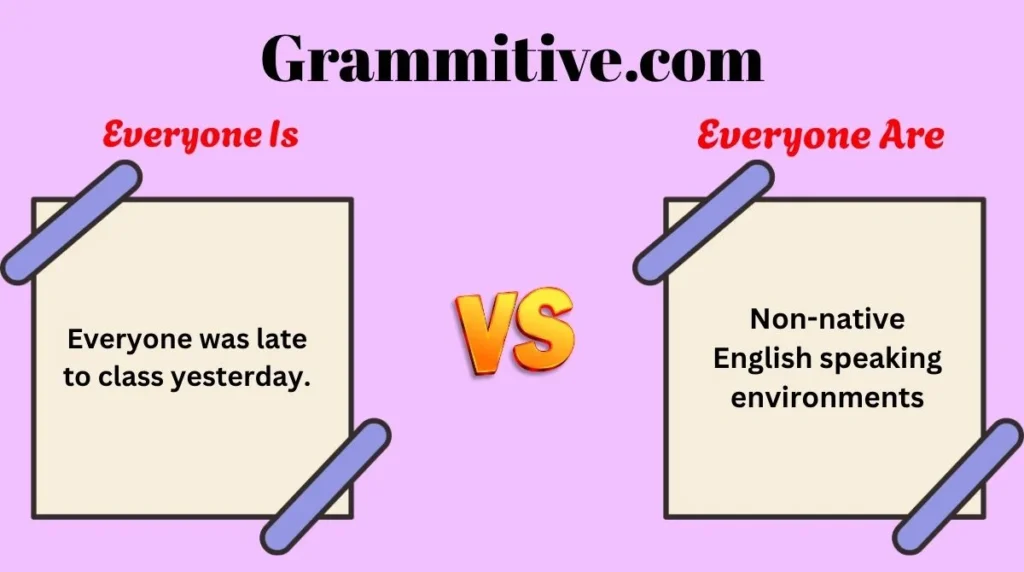
6️⃣ Difference Between Everyone Is and Everyone Are (Detailed)
Let’s understand the real difference clearly.
✔️ Comparison Table:
| Feature | Everyone is | Everyone are |
|---|---|---|
| Grammar correctness | Correct | Incorrect |
| Verb used | Singular (is/has/was) | Plural (are/have/were) |
| Meaning | All people as one group | Wrong structure |
| Usage | Formal + informal | Not standard English |
| Example | Everyone is here | Everyone are here ❌ |
✔️ Usage Difference:
- “Everyone is” follows English grammar rules
- “Everyone are” breaks subject-verb agreement rules
Even though meaning feels plural, grammar treats “everyone” as singular.
✔️ Grammar Logic:
English grammar focuses on structure, not meaning only.
So:
- Everyone = singular pronoun
- Therefore → must use singular verb
✔️ Sentence Structure Difference:
Correct:
Everyone + singular verb + object
Example:
- Everyone is ready.
Incorrect:
Everyone + plural verb + object
Example:
- Everyone are ready ❌
✔️ Meaning Comparison:
Both sentences try to show the same idea:
- A group of people doing something together
But only one follows grammar rules correctly.
7️⃣ Grammar Rules You Must Remember
✔️ Rule #1: Everyone is always singular
Example: Everyone is excited about the match.
✔️ Rule #2: Use singular verbs with everyone
(is, was, has, does)
Example: Everyone has completed the test.
✔️ Rule #3: Never use plural verbs with everyone
❌ Everyone are coming
✔️ Everyone is coming
✔️ Rule #4: Treat everyone as one unit, not individuals
Example: Everyone is responsible for their actions.
8️⃣ Common Mistakes Students Make
Many learners make the same mistakes again and again.
✔️ Mistake 1: Thinking “everyone = plural”
❌ Everyone are happy
✔️ Everyone is happy
👉 Why it happens: meaning confusion
✔️ Mistake 2: Mixing subject-verb agreement
❌ Everyone have finished work
✔️ Everyone has finished work
✔️ Mistake 3: Following spoken English
People hear wrong usage in casual speech and copy it.
✔️ Mistake 4: Translating from native language
Some languages do not change verbs for singular subjects.
✔️ Easy Fix Tips:
- Always check the subject first
- Ask: Is it singular or plural in grammar?
- Remember: everyone = singular
9️⃣ Easy Trick to Remember the Difference
Here is a simple trick used by teachers:
👉 “Everyone = Every ONE = ONE person”
Even though it refers to many people, grammar sees it as ONE group.
So:
- ONE → use IS
- MANY → but still ONE group → IS
✔️ Real-life logic:
Think of a class photo:
- You see 30 students
- But you say: “Everyone is in the photo”
Not:
Everyone are in the photo ❌

🔟 Daily Life Examples (Very Natural English)
Here are real spoken English sentences:
- Everyone is waiting outside.
- Everyone is busy today.
- Everyone is talking about the exam.
- Everyone has a mobile phone now.
- Everyone is watching the match.
- Everyone is tired after work.
- Everyone is asking the same question.
- Everyone is ready to leave.
- Everyone is invited to dinner.
- Everyone is learning English online.
1️⃣1️⃣ Practice Section
Choose the correct sentence:
- Everyone (is / are) happy today.
- Everyone (is / are) coming to school.
- Everyone (has / have) finished homework.
- Everyone (is / are) ready for lunch.
- Everyone (was / were) late yesterday.
✔️ Answers:
- is
- is
- has
- is
- was
1️⃣2️⃣ FAQs
❓ 1. What is the difference between everyone is and everyone are?
“Everyone is” is correct because “everyone” is singular. “Everyone are” is incorrect in standard English.
❓ 2. Why do we say everyone is not everyone are?
Because grammar treats “everyone” as one single unit, not many individuals.
❓ 3. Can we ever use everyone are?
No, in standard English it is not correct. It may appear in casual speech but should be avoided.
❓ 4. Is everyone singular or plural?
“Everyone” is singular in grammar even though it refers to many people.
❓ 5. What verb goes with everyone?
Singular verbs like is, has, was, does.
❓ 6. Is everyone formal or informal?
“Everyone” is neutral. It is used in both formal and informal English.
1️⃣3️⃣ Final Conclusion (Simple Summary for Students)
The confusion between “everyone is” and “everyone are” is very common among English learners.
At first, it feels logical to use “are” because “everyone” talks about many people. But English grammar works differently.
“Everyone” is always treated as a singular pronoun. That means it needs singular verbs like “is,” “has,” and “was.”
The phrase “everyone are” is not correct in standard English and should be avoided in writing, exams, and professional communication.
Once you understand the idea that “everyone = one group,” the rule becomes very easy. You don’t need to memorize complicated grammar rules—just remember that it behaves like one single unit.
With regular practice and attention, you will naturally start using “everyone is” correctly in your daily English.
Keep practicing with real sentences, and soon this rule will feel completely natural in your speech and writing.

I am Lucas Bennett, a digital content creator passionate about social media trends and online growth strategies.
I share practical insights and guides to help users better understand and navigate the digital world.