

Many English learners feel confused when they see phrases like “draw on” and “draw from.”
At first look, they seem almost the same. Both talk about using something, like experience, knowledge, or ideas.
Because of this similarity, students often mix them up in speaking and writing.
But in real English, these two phrases are not exactly the same. Native speakers choose them carefully depending on the situation.
Sometimes they talk about using skills, and sometimes they talk about the source of something.
If you use the wrong one, your sentence may sound a little strange or unclear.
This topic is very important for daily English because both expressions are used in school, workplace, exams, and even casual conversations.
You will hear them in books, movies, interviews, and speeches.
After reading this guide, you will clearly understand:
- What each phrase really means in simple English
- When to use “draw on” correctly
- When to use “draw from” correctly
- The key difference between them
- Easy tricks to remember them forever
By the end, you will feel more confident using both phrases naturally like a native speaker. Let’s break it down step by step in a very simple way.
4️⃣ What Does “Draw On” Mean?
The phrase “draw on” means to use something that you already have inside you or something available to you, especially knowledge, experience, or skills.
Think of it like this: you are “pulling” from your mind, memory, or abilities when you need them.
📌 Simple definition:
To use your personal experience, knowledge, or resources when needed.
📌 When to use it:
Use “draw on” when you talk about:
- Experience
- Skills
- Knowledge
- Strength
- Imagination
It often sounds more personal and active.
📌 Grammar rule:
draw on + something (experience/knowledge/skills/resources)
📌 Example sentences:
- She draws on her teaching experience in every class.
- The writer draws on real-life stories.
- I draw on my memory to solve this problem.
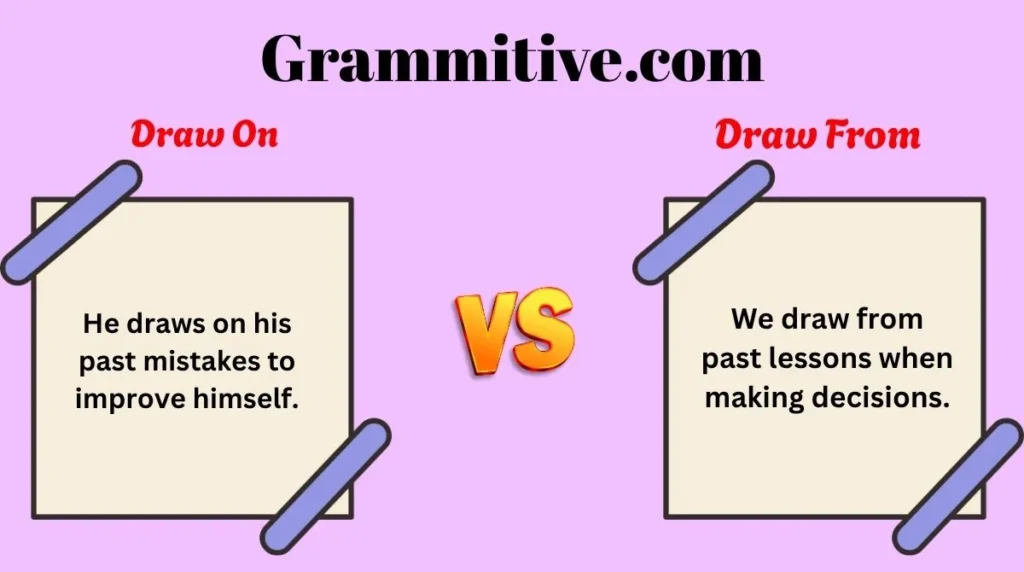
- He draws on his past mistakes to improve himself.
- The actor draws on deep emotions for the role.
- We draw on our teamwork skills during projects.
- She draws on her creativity to design clothes.
- The speaker draws on personal experience in his speech.
📌 Common learner confusion:
Many students think it means “taking something from outside,” but actually it is more about using what is already inside you or available as support.
So, “draw on” is more about using resources actively.
5️⃣ What Does “Draw From” Mean?
The phrase “draw from” means to take something from a source, origin, or supply.
It is more about where something comes from, not just using skills.
📌 Simple definition:
To take ideas, energy, inspiration, or materials from a source.
📌 When to use it:
Use “draw from” when talking about:
- Sources of information
- Inspiration
- Experience (as a source)
- Collections or data
- Natural resources
📌 Grammar rule:
draw from + source (experience, book, history, nature, data, etc.)
📌 Example sentences:
- The story draws from real events.
- Scientists draw from research data.
- She draws from nature for her paintings.
- The teacher draws from different books.
- The movie draws from historical events.
- We draw from past lessons when making decisions.
- The design draws from traditional art.
- The report draws from multiple sources.
📌 Common learner confusion:
Students often mix it with “draw on,” but here the focus is on the origin or source, not the personal ability.
So, “draw from” is more about where something comes from.
6️⃣ Difference Between “Draw On” and “Draw From” (Detailed)
Even though both phrases look similar, their meaning and usage are different.
📊 Comparison Table
| Feature | Draw On | Draw From |
|---|---|---|
| Meaning | Use something you already have | Take something from a source |
| Focus | Personal ability or resource | Origin or source |
| Usage | Skills, experience, memory | Inspiration, data, nature, books |
| Action type | Active use | Extraction or origin |
| Example | draw on experience | draw from experience |
📌 Usage Difference
- Draw on → You are actively using your own knowledge or skills
- Draw from → You are taking something from a source outside or general pool
📌 Grammar Logic
- Draw on feels like “using stored power inside you”
- Draw from feels like “taking something out of a source”
📌 Sentence Structure Difference
- She draws on her experience. (She uses her own skill)
- She draws from her experience. (Her experience is the source)
Both can be correct, but meaning changes slightly.
📌 Meaning Comparison
- “Draw on” = use what you already control
- “Draw from” = take from where it exists
This small difference is very important in writing and speaking.
7️⃣ Grammar Rules You Must Remember
✔ Rule #1:
Use draw on with personal skills or abilities
- He draws on his leadership skills.
✔ Rule #2:
Use draw from with sources of information or inspiration
- The book draws from real history.
✔ Rule #3:
Both can sometimes be used with “experience,” but meaning changes
- draw on experience = use experience
- draw from experience = experience is the source
✔ Rule #4:
Do not use them without an object
❌ He draws on.
✔ He draws on his memory.
8️⃣ Common Mistakes Students Make
❌ Mistake 1:
Using both phrases randomly
Wrong: She draws from her skills in teaching.
Correct: She draws on her skills in teaching.
👉 Skills are something you use, not a source.
❌ Mistake 2:
Confusing “experience” usage
Wrong: He draws on history for his story.
Correct: He draws from history for his story.
👉 History is a source, so “draw from” is better.
❌ Mistake 3:
Leaving sentences incomplete
Wrong: I draw on.
Correct: I draw on my knowledge.
📌 Why these mistakes happen:
- Both phrases look similar
- Students translate directly from native language
- Lack of exposure to real English usage
📌 Easy correction tip:
Always ask:
- Am I USING something? → draw on
- Am I TAKING FROM a source? → draw from
9️⃣ Easy Trick to Remember the Difference
Here is a very simple trick:
👉 “ON = inside you”
👉 “FROM = outside source”
Think like this:
- You draw on your brain (inside use)
- You draw from a book or history (outside source)
This small mental picture makes it very easy to remember.
🔟 Daily Life Examples (Very Important)
Here are real spoken English examples you might hear every day:
- I draw on my notes before exams.
- She draws from her childhood memories.
- The teacher draws on real-life examples.
- We draw from online resources for homework.
- He draws on his work experience.
- The artist draws from nature.
- I draw on my past mistakes to improve.
- This speech draws from personal experience.
- They draw on teamwork skills during projects.
- The book draws from real events.
1️⃣1️⃣ Practice Section
Choose the correct option:
- She ___ her experience in teaching.
A) draws on
B) draws from - The movie ___ history.
A) draws on
B) draws from - I ___ my memory to solve problems.
A) draw from
B) draw on - The story ___ real events.
A) draws on
B) draws from - He ___ his creativity in design work.
A) draws from
B) draws on
✔ Answers:
1-A, 2-B, 3-B, 4-B, 5-B
1️⃣2️⃣ FAQs
❓ What is the main difference between draw on and draw from?
“Draw on” means using your own skills or experience. “Draw from” means taking from a source or origin. The focus changes in each phrase.
❓ Can we use draw on in formal English?
Yes, “draw on” is common in formal writing, speeches, and academic English. It is widely used in professional contexts.
❓ Is draw from more formal or informal?
“Draw from” is neutral. It is used in both formal and informal English depending on context, especially in writing and reports.
❓ Can both phrases be used with “experience”?
Yes, but meaning changes slightly. “Draw on experience” means using experience. “Draw from experience” means experience is the source.
❓ Which one is more common in daily English?
Both are common, but “draw on” is often used when talking about personal skills, while “draw from” is common in writing and storytelling.
❓ What is the easiest way to remember them?
Remember: ON = use your own skills, FROM = take from a source. This simple trick helps avoid confusion.
1️⃣3️⃣ Final Conclusion
Understanding the difference between “draw on” and “draw from” makes your English sound more natural and clear.
At first, both phrases look almost the same, but their meaning changes based on usage.
“Draw on” focuses on using your own skills, experience, or knowledge. It feels personal and active.
On the other hand, “draw from” focuses on the source of something, like history, books, nature, or data.
Once you understand this small difference, your writing and speaking will improve a lot.
These phrases are very common in exams, essays, and real conversations, so learning them properly is very useful.
Keep practicing with real sentences from your daily life. Try to notice them in books, movies, or articles.
The more you see them, the easier they become. Slowly, you will start using them naturally without thinking.

