

English is full of words that sound similar but have completely different meanings.
One pair that often confuses learners is “input” and “imput”.
Many students hear these words in conversations, online, or in school, and they are unsure which one is correct.
Sometimes, a small spelling mistake can completely change the meaning of a sentence, making it sound strange or even wrong.
Knowing the difference between input and imput is not just about spelling.
It’s about understanding which word belongs in formal writing, casual conversations, or even in computer and technology contexts.
For example, a student might write “I gave my imput” in an essay, but that looks incorrect to an English teacher.
By reading this guide, you will clearly understand what each word means, how to use it correctly, and why learners often make mistakes.
You will also get practical tricks and real-life examples to remember the difference easily.
By the end, you will feel confident using these words naturally in daily English, conversations, and writing.
What Does “Input” Mean?
Input is a common English word that you will see in daily life, school, and work. It is both a noun and a verb, and it is spelled I-N-P-U-T.
Definition
- As a noun, input means information, advice, ideas, or energy that you give to a task, process, or conversation.
- As a verb, it means to put information into a system, device, or process.
When to Use “Input”
- When talking about giving ideas: “I want your input on this project.”
- When talking about computers: “Please input your password.”
- When referring to energy or effort: “The team’s input helped finish the task quickly.”
Grammar Rules
- As a noun, input is uncountable. We usually do not say “an input” in casual conversation, though in technical contexts, it is acceptable.
- As a verb, it usually follows the object: “She input the data into the computer.”
Examples of “Input”
- I need your input before I make a decision.
- Please input your name and email address.
- The teacher appreciated the students’ input during the discussion.
- My father’s input helped me solve the problem.
- Inputting data correctly is very important for accuracy.
- The team gave valuable input on the new design.
- You can input numbers using the keypad.
- His input was ignored, but it was still helpful.
Common Learner Confusions
- Some learners write “imput” instead of “input”, thinking it is a different form.
- Others confuse input as a verb with the noun impute, which is completely different in meaning.
What Does “Imput” Mean?
Here’s the tricky part: “imput” is not a standard English word. Most of the time, if you see “imput,” it is a spelling mistake.
Correct Word: Impute
Sometimes, people mean “impute” instead of “imput.”
- Impute (I-M-P-U-T-E) is a formal verb. It means to assign a reason, responsibility, or blame to someone.
- It is often used in academic, legal, or formal writing.
When to Use “Impute”
- When explaining responsibility: “The teacher imputed the mistake to lack of practice.”
- When referring to cause or blame: “The court imputed the error to negligence.”
Grammar Rules
- Impute is always a verb, never a noun.
- It usually takes a direct object: “They imputed the failure to poor planning.”
Examples of “Impute”
- We should not impute bad intentions without proof.
- The manager imputed the project delay to the supplier.
- Scholars impute the discovery to several scientists.
- He was careful not to impute blame unfairly.
- Critics often impute political motives to writers.
- The mistake was imputed to human error.
- One should not impute meaning where there is none.
- The report imputes the success to teamwork.
Common Learner Confusions
- Learners often write “imput” when they actually mean “input”.
- Some confuse impute with input, even though the meanings are very different.
- Beginners may also try to use “imput” in casual conversation, which is incorrect.
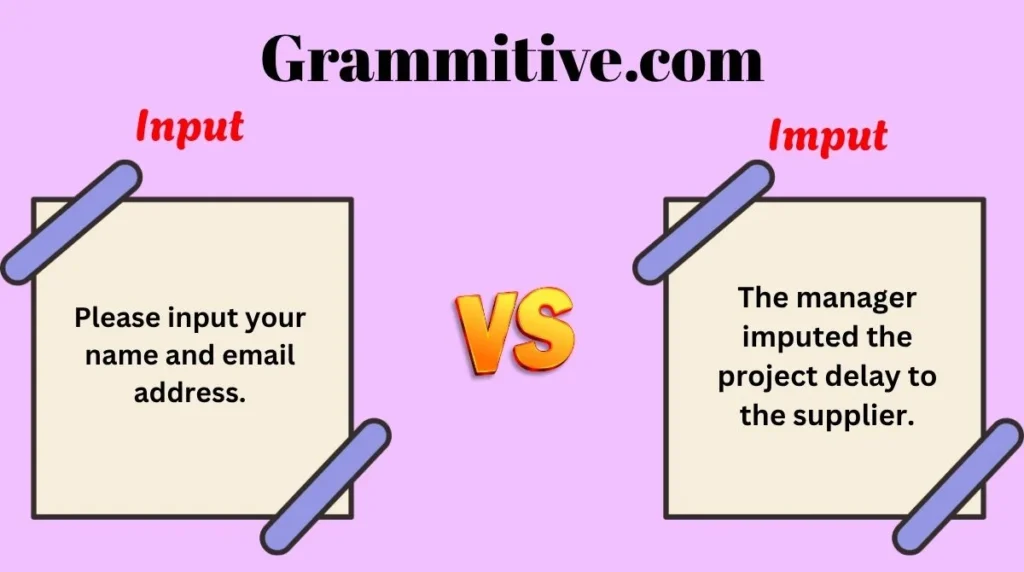
Difference Between Input and Impute
It’s easy to see why learners get confused. The words sound similar, but they are completely different in meaning and usage.
| Feature | Input | Impute |
|---|---|---|
| Part of Speech | Noun / Verb | Verb |
| Meaning | Information, advice, effort | Assign blame, responsibility, or cause |
| Use in Sentences | Everyday English, computers, discussions | Formal writing, legal, academic contexts |
| Common Error | Spelling “imput” | Using in casual speech incorrectly |
| Example Sentence | Please input your data. | Do not impute motives unfairly. |
Usage Difference
- Input is about giving or entering information.
- Impute is about assigning responsibility or cause.
Sentence Structure
- Input as verb: “Input the password.”
- Input as noun: “Her input was valuable.”
- Impute: “They imputed the failure to poor planning.”
Meaning Comparison
- Input = help, ideas, or data. Positive or neutral.
- Impute = blame, responsibility, or cause. Often formal and sometimes negative.
Grammar Rules You Must Remember
Rule #1: Noun vs Verb
- Input can be both noun and verb.
- Impute is only a verb.
- Example:
- Noun: Your input is helpful.
- Verb (input): Please input the answers.
- Verb (impute): Do not impute mistakes to others unfairly.
Rule #2: Spelling
- Always spell input as I-N-P-U-T.
- Never spell input as “imput.”
- Correct: I will input the data.
- Wrong: I will imput the data.
Rule #3: Formal vs Informal
- Input can be informal or formal.
- Impute is formal and mostly used in writing, not in daily conversation.
Rule #4: Object Usage
- Input as a verb takes a direct object (data, information, name).
- Impute also takes a direct object (blame, cause, responsibility).
- Example:
- Input: Input your answer in the box.
- Impute: Do not impute failure to lack of effort.
Common Mistakes Students Make
Many learners mix these words, especially in writing.
- Spelling Mistake
- Wrong: I gave my imput.
- Correct: I gave my input.
- Meaning Confusion
- Wrong: I will imput the data.
- Correct: I will input the data.
- Formality Mistake
- Using impute in casual chat:
- Wrong: Can you impute your ideas?
- Correct: Can you give your input?
- Using impute in casual chat:
Easy Correction Tips:
- Ask yourself: Am I giving ideas or assigning blame?
- If it’s ideas, use input.
- If it’s blame, use impute.
- Check spelling carefully.
Easy Trick to Remember the Difference
Here’s a simple way to remember:
- Input = “put in” ideas or information. Think of typing on a computer.
- Impute = “assign” blame or reason. Think of a teacher assigning responsibility.
Memory Tip:
- Input = Input = Enter → everyday use.
- Impute = Impute → Academic/Blame → formal.
This logic makes it easier to choose the correct word in writing and speaking.

Daily Life Examples
Here are 10 examples that you can use in real-life conversations:
- Can you give your input on my essay?
- I input the scores into the system yesterday.
- Her input really helped me understand the topic.
- We need to input the correct numbers.
- His input on the project was very valuable.
- The manager imputed the delay to supplier issues.
- Don’t impute bad intentions to someone without proof.
- Scholars impute this invention to multiple scientists.
- I input all my ideas into the brainstorming session.
- The teacher imputed the error to careless reading.
Practice Section
Choose the correct word to complete the sentences:
- I need your _______ to finish this plan. (input / imput)
- Don’t _______ blame to someone without evidence. (input / impute)
- Please _______ the data carefully. (input / impute)
- The teacher _______ the mistake to misunderstanding instructions. (input / impute)
- Your _______ was very helpful in the meeting. (input / imput)
Answers:
- input
- impute
- input
- impute
- input
FAQs
1. What is the difference between input and impute?
- Input is ideas or data; impute is assigning blame or cause. One is for daily use, the other is formal.
2. Can we use input in questions?
- Yes, for example: Can you give your input on this issue?
3. Is impute formal or informal?
- Impute is formal. You usually see it in writing, legal, or academic contexts.
4. Can “input” be a verb?
- Yes, you can say: Input the numbers into the computer.
5. Is “imput” correct?
- No, “imput” is a misspelling. The correct word is either input or impute depending on meaning.
6. How do I remember input vs impute?
- Input = put in ideas/info. Impute = assign blame/responsibility. Simple logic helps you choose.
Final Conclusion
Understanding input and impute is simple once you know the meaning, spelling, and context.
Input is about giving ideas, data, or effort, while impute is about assigning blame or cause in formal contexts.
Many learners confuse these words because they sound similar, but remembering the rules, grammar, and simple tricks can make it easy.
Practice using input in daily conversations and impute in formal writing examples. Soon, you will naturally choose the correct word without thinking twice.
Keep reading, practicing, and using these words in sentences. English gets easier when you spot the differences and apply them in real life.

I am Lucas Bennett, a digital content creator passionate about social media trends and online growth strategies.
I share practical insights and guides to help users better understand and navigate the digital world.