
Many English learners feel confused when they see the words forgo and forego. These two words look almost the same.
Only one extra letter “e” makes the difference. Because of this, students often mix them up in writing and speaking.
Another reason for confusion is that both words are not used very often in daily conversation.
So when learners finally see them in books, articles, or exams, they hesitate. They think, “Are these two different spellings of the same word?” or “Do they mean the same thing?”
The truth is a little tricky but very simple once you understand it clearly.
In real English, forgo and forego are NOT the same word. They have different meanings and different uses.
One is common in modern English, and the other is more formal and sometimes old-fashioned.
After reading this guide, you will clearly understand:
- What each word means in simple English
- When to use forgo correctly
- When forego is used (and why it is less common today)
- The key difference between them in real sentences
- Easy tricks to never confuse them again
By the end, you will feel confident using both words in writing, exams, and reading comprehension. Let’s break it down step by step in a very simple way.
4️⃣ What Does “Forgo” Mean?
Simple Definition
Forgo means to give up something willingly or to do without something.
It is used when someone decides not to take or use something they could have had.
When to Use “Forgo”
Use forgo when:
- You choose not to enjoy something
- You decide to skip something
- You give up a benefit, habit, or pleasure
Grammar Rule
- It is a verb
- Base form: forgo
- Past tense: forgone
- Present participle: forgoing
Example Sentences
- I will forgo dessert today.
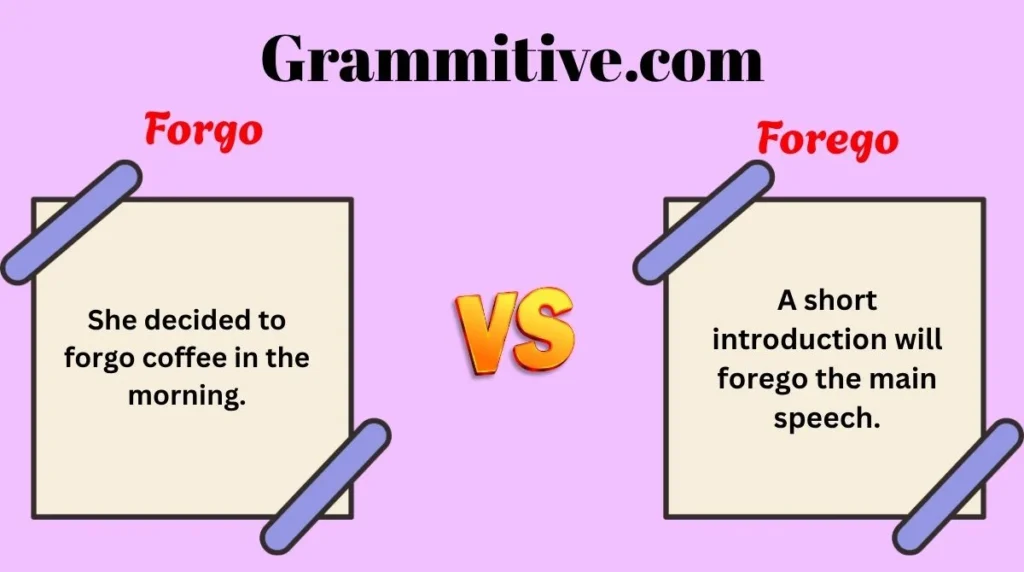
- She decided to forgo coffee in the morning.
- He forgave lunch to save time.
- They forgo luxury to save money.
- We will forgo the meeting this week.
- She is forgoing social media for exams.
- He has forgone his weekend plans.
- I forgo extra snacks for health reasons.
Common Learner Confusion
Many learners think forgo means “forget,” but that is wrong. It does NOT mean forgetting something. It means choosing not to take something.
Another confusion is spelling. People often write “forego” instead of “forgo” because it looks more natural. But meaning matters more than spelling here.
5️⃣ What Does “Forego” Mean?
Simple Definition
Forego means to go before something in time or place.
It is less common in modern English and is often used in formal or old writing.
When to Use “Forego”
Use forego when:
- Talking about something that comes earlier in time
- Referring to something that happens before another event
- In formal or literary English
Grammar Rule
- It is also a verb
- Base form: forego
- Past tense: forewent
- Past participle: foregone
Example Sentences
- A short introduction will forego the main speech.
- The meeting will forego dinner.
- His speech forewent the ceremony.
- The warning foregoes the final decision.
- The chapter foregoes the main story.
- She forewent the explanation and started quickly.
- The introduction foregoes the details.
- The announcement forewent the event.
Common Learner Confusion
Most students never use forego in speaking. That’s because modern English prefers simpler words like “come before” or “earlier than.”
Also, many people think forego is just a spelling mistake of forgo. That is not true. It is a real word, but its meaning is different.
6️⃣ Difference Between Forgo and Forego (Detailed)
These two words are confusing because they look similar, but their meanings are completely different.
Comparison Table
| Feature | Forgo | Forego |
|---|---|---|
| Meaning | To give up something | To come before something |
| Usage | Modern, common | Formal, less common |
| Time reference | No time meaning | Time or sequence meaning |
| Example | I forgo sweets | Intro foregoes speech |
| Frequency | Very common | Rare |
Usage Difference
- Forgo is about choice
- Forego is about order in time
Grammar Logic
Think of it like this:
- Forgo = “I don’t want it”
- Forego = “It happens earlier”
Sentence Structure Difference
- Forgo: Subject + forgo + object
→ I forgo tea. - Forego: Subject + forego + object/event
→ The introduction foregoes the main topic.
Meaning Comparison
One is emotional or personal choice (forgo), while the other is structural or time-based (forego).
7️⃣ Grammar Rules You Must Remember
Rule #1
Forgo always shows a choice.
Example:
I forgo fast food to stay healthy.
Rule #2
Forego shows time order.
Example:
The summary foregoes the full explanation.
Rule #3
Forgo is more common in daily English.
Example:
She forgoes sugar in tea.
Rule #4
Forego is formal and often replaced with simpler phrases.
Example:
Instead of forego, people say “come before” in normal speech.
8️⃣ Common Mistakes Students Make
Mistake 1: Mixing spellings
Wrong: I will forego chocolate.
Correct: I will forgo chocolate.
👉 Why it happens: The words look similar.
Mistake 2: Using forego for giving up
Wrong: He forewent lunch.
Correct: He forgone lunch.
👉 Why it happens: Learners confuse meanings.
Mistake 3: Using forgo for time order
Wrong: The intro forgoes the story.
Correct: The intro foregoes the story.
Easy Correction Tip
Always ask:
- Am I talking about “giving up”? → use FORGO
- Am I talking about “before”? → use FOREGO
9️⃣ Easy Trick to Remember the Difference
Here is a simple memory trick:
- FORGO = FORGET to take something (choice)
- FOREGO = BEFORE something happens (time)
Another way:
- “O” in forgo → “Option” (you choose)
- “E” in forego → “Earlier” (time comes first)
This small trick helps students remember forever without confusion.
🔟 Daily Life Examples (Very Important)
- I forgo sweets during exams.
- She forgoes makeup for school.
- We forgo expensive food to save money.
- He foregoes the introduction and starts speaking.
- The announcement foregoes the meeting.
- I forgo social media for peace of mind.
- The teacher foregoes the story and explains rules first.
- They forgo weekend trips this month.
- The summary foregoes the full details.
- She forgoes coffee every morning.
1️⃣1️⃣ Practice Section
Choose the correct word (forgo or forego):
- I will ___ dessert today.
- The introduction ___ the main topic.
- She decided to ___ sugar.
- The chapter ___ the story details.
- He will ___ luxury for savings.
Answers:
- forgo
- forego
- forgo
- forego
- forgo
1️⃣2️⃣ FAQs
1. What is the main difference between forgo and forego?
Forgo means to give up something by choice. Forego means to come before something in time or order. Both are different in meaning and use.
2. Is forgo more common than forego?
Yes, forgo is used more in modern English. It is common in daily writing and speech. Forego is rarely used.
3. Can I use forego in speaking English?
You can, but it sounds formal and uncommon. Most people prefer simpler phrases like “come before.”
4. Is forgo formal or informal?
Forgo is neutral. It can be used in both formal writing and everyday English.
5. Why do people confuse forgo and forego?
Because they look very similar in spelling. Only one letter “e” changes the meaning completely.
6. Are forgo and forego interchangeable?
No, they are NOT interchangeable. They have different meanings and cannot replace each other.
1️⃣3️⃣ Final Conclusion
The words forgo and forego may look almost the same, but their meanings are very different. One talks about choice, and the other talks about time or order.
This small difference often confuses English learners, but once understood, it becomes very easy to use correctly.
Forgo is the word you will see most often in daily English. It simply means giving up something by choice, like skipping dessert or avoiding sugar.
On the other hand, forego is used in formal writing to show that something comes earlier in time or order.
The key to mastering these words is practice and awareness. Always ask yourself: “Am I talking about choice or time?”
That simple question will guide you to the correct word every time.
Keep practicing the examples and exercises. Over time, using these words correctly will become natural and effortless in your English communication.

I am Lucas Bennett, a digital content creator passionate about social media trends and online growth strategies.
I share practical insights and guides to help users better understand and navigate the digital world.