

English learners often get confused between “where are you” and “where you are.” These two phrases may seem similar at first, but they are used in very different ways.
Understanding the difference is essential because using the wrong form can change the meaning of a sentence or make it sound unnatural.
Many beginners struggle with this topic because it involves question formation and sentence structure.
In English, the word order in a question is different from the word order in a statement.
This can make learners overthink, leading to mistakes like saying “where you are” in a question or “where are you” in a statement.
Getting this right is important in daily conversations. For example, when you ask a friend about their location, you need to use the correct question form.
Or, when you report someone else’s location in a sentence, you need the statement form. Misusing these can confuse the listener or make your English sound less natural.
By the end of this guide, you will clearly understand when to use “where are you” and when to use “where you are.”
You will also learn grammar rules, common mistakes, easy tricks, and real-life examples that make this topic simple.
Even beginners can master this with practice, making your spoken and written English much more confident and accurate.
What Does “Where Are You” Mean?
“Where are you” is a direct question. It is used when you want to ask someone about their current location. It is a very common phrase in daily English.
When to Use “Where Are You”
- To ask someone’s location
- To find someone in real-time
- In informal and formal settings
Grammar Rule
“Where are you” follows the subject-verb inversion rule in English questions:
- Subject (you) + Verb (are) → Verb comes before the subject in questions.
- Structure: Where + auxiliary verb + subject?
Example Sentences
- Where are you right now?
- Where are you going this afternoon?
- Where are you staying during your trip?
- Where are you hiding?
- Where are you from?
- Where are you living these days?
- Where are you at the moment?
- Where are you planning to meet us?
Common Learner Confusion
Many learners make mistakes like:
- Wrong: Where you are?
- Correct: Where are you?
The confusion happens because in some languages, the word order does not change in questions. English always requires the auxiliary verb to come before the subject in questions.
What Does “Where You Are” Mean?
“Where you are” is used inside statements, not direct questions. It tells about someone’s location in a sentence.
When to Use “Where You Are”
- To describe someone’s location
- In reported speech
- Inside relative clauses
- Often part of longer sentences
Grammar Rule
“Where you are” is used as a clause:
- Subject (you) + Verb (are) → Standard word order for statements.
- Structure: … + where + subject + verb + …
Example Sentences
- I don’t know where you are.
- She asked me where you are.
- Please tell me where you are staying.
- He explained where you are in the building.
- We need to find out where you are.
- Do you remember where you are in the map?
- I can see where you are from here.
- Can you show me where you are on the diagram?
Common Learner Confusion
Mistakes like:
- Wrong: I don’t know where are you.
- Correct: I don’t know where you are.
This happens because learners try to use question word order in statements. Remember, inside a statement, English does not invert the subject and verb.
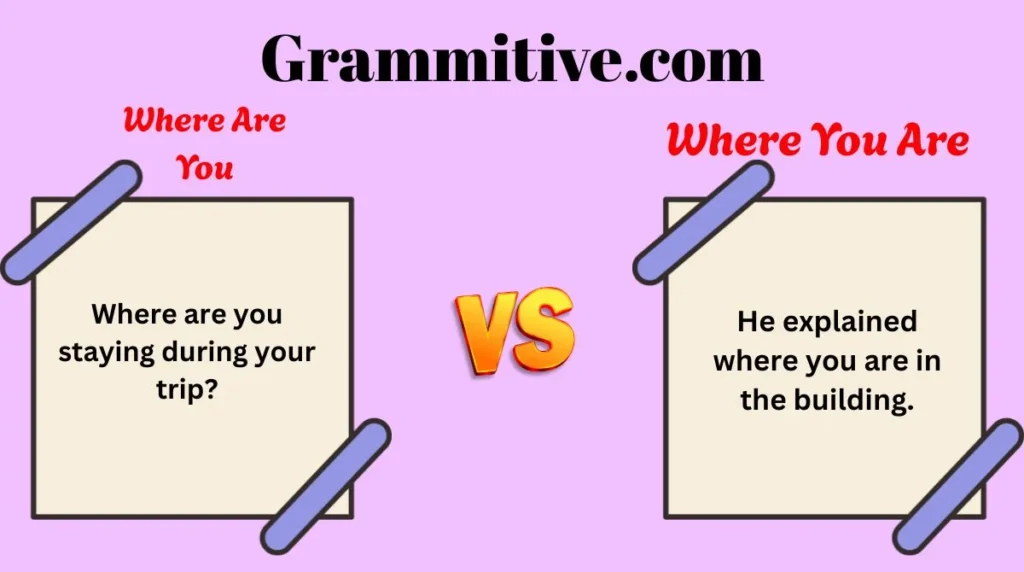
Difference Between “Where Are You” and “Where You Are”
| Feature | Where Are You | Where You Are |
|---|---|---|
| Type | Direct question | Statement clause / indirect question |
| Word Order | Verb + Subject | Subject + Verb |
| Usage | Asking someone directly | Reporting or embedding location information |
| Example | Where are you now? | I don’t know where you are. |
| Question Form | Yes | No |
| Grammar Logic | Subject-verb inversion for questions | Standard word order for statements |
Usage Difference Explained
- Where are you? → You are asking directly. Simple, clear, immediate.
- Where you are → Part of another sentence, often indirect. You are explaining or reporting.
Sentence Structure Difference
- Question: Where + auxiliary verb + subject? → Where are you?
- Statement clause: … + where + subject + verb → I know where you are.
Meaning Comparison
- Where are you? asks location.
- Where you are tells location.
Grammar Rules You Must Remember
Rule #1: Direct Questions Require Inversion
- Example: Are you ready? → Where are you?
- Incorrect: You are ready?
Rule #2: Clauses Use Standard Word Order
- Example: I wonder where you are.
- Incorrect: I wonder where are you.
Rule #3: Use “Where Are You” for Real-Time Questions
- Example: Where are you right now?
- Think: This is a live question, not a statement.
Rule #4: Use “Where You Are” Inside Statements or Reports
- Example: He knows where you are.
- Think: This is not a question; it is information.
Common Mistakes Students Make
Mistake 1: Using question word order inside statements
- Wrong: I don’t know where are you.
- Correct: I don’t know where you are.
- Tip: Remember, statements do not invert the verb and subject.
Mistake 2: Using statement form in questions
- Wrong: Where you are?
- Correct: Where are you?
- Tip: Always invert subject and verb in direct questions.
Mistake 3: Forgetting context
- Wrong: Tell me where are you.
- Correct: Tell me where you are.
- Tip: “Tell me” introduces a statement clause, not a direct question.
Mistake 4: Mixing both forms
- Wrong: I don’t know where are you going.
- Correct: I don’t know where you are going.
- Tip: Indirect questions always use statement word order.
Easy Trick to Remember the Difference
- Question = invert → Are you hungry? Where are you?
- Statement = normal order → I know where you are.
- Memory Trick: If you are asking, flip. If you are telling, keep normal.
- Real-life logic: You ask for information = question form. You share information = statement form.

Daily Life Examples
- Phone call: “Where are you? I’m waiting at the café.”
- Friend texting: “I can’t find you. Where are you now?”
- Parent checking: “Where are you? It’s time for dinner.”
- Reporting: “I don’t know where you are, but I’ll find out.”
- Directions: “Can you show me where you are on the map?”
- Classroom: “The teacher asked where you are sitting.”
- Emergency: “Call me immediately! Where are you?”
- Travel: “I’ll meet you where you are staying.”
- Office: “Please send a message to let me know where you are.”
- Friends chat: “Hey, where are you hanging out today?”
Practice Section
Choose the correct option:
- _____ (Where are you / Where you are) going tonight?
- I don’t know _____ (where are you / where you are) now.
- Can you tell me _____ (where are you / where you are) on the map?
- _____ (Where are you / Where you are) from?
- She asked me _____ (where are you / where you are) living these days.
Answers:
- Where are you
- where you are
- where you are
- Where are you
- where you are
FAQs
Q1: What is the difference between “where are you” and “where you are”? A1: “Where are you” is a direct question. “Where you are” is used inside statements or reported speech. The main difference is word order.
Q2: Can we use “where you are” in questions? A2: No, “where you are” is not used in direct questions. Use “where are you” instead.
Q3: Is “where are you” formal or informal? A3: It can be both. It’s polite and acceptable in formal and informal situations.
Q4: Can “where you are” be used in writing? A4: Yes, it is common in both spoken and written English for indirect questions or clauses.
Q5: Why do learners confuse these phrases? A5: Many languages don’t change word order in questions. English does, which leads to mistakes.
Q6: How can I remember which to use? A6: Ask = invert (Where are you?), Tell/report = normal order (where you are). Simple and effective.
Final Conclusion
Understanding the difference between “where are you” and “where you are” makes English much easier for daily communication.
Remember the simple rule: questions invert the subject and verb, while statements keep normal word order.
Use the memory trick, practice with real-life sentences, and check your grammar when writing or speaking.
With regular practice, these phrases will become second nature, and your English will sound natural and confident.
Keep using them in your daily conversations, messages, and reports. Soon, distinguishing between these two will feel effortless, and you’ll never hesitate to ask or explain someone’s location correctly.

I am Lucas Bennett, a digital content creator passionate about social media trends and online growth strategies.
I share practical insights and guides to help users better understand and navigate the digital world.