
Many English learners struggle with words that sound similar but mean different things. One pair of words that often confuses students is invaluable vs valuable.
At first glance, these two words look almost the same. They even share a root word — value.
Yet, their meanings are not just slightly different… they can be opposite in how they feel or work in a sentence.
Why does this matter? In daily English, native speakers use these words all the time — in school, work, emails, and conversations.
If you use them incorrectly, your meaning might change. Imagine giving someone a gift and saying it is “invaluable” when you mean it’s cheap! That mistake can lead to confusion.
By the end of this article, you will:
- Know the exact meaning of invaluable and valuable
- Understand how to use them correctly
- Learn simple tricks to easily tell them apart
- See lots of examples you can copy and practice
Let’s make sure you never mix these two up again. You’ll feel more confident, clearer in your speaking, and more accurate in your writing.
What Does “Invaluable” Mean?
Simple Definition
Invaluable means so useful or precious that it is impossible to put a value on it.
In other words, something is too important to measure in money or simple worth.
When to Use It
Use invaluable when something is:
- Extremely useful
- Very precious or significant
- Hard to replace
- Beyond a simple price tag
This word is usually positive. It shows great respect or appreciation.
Grammar Rule
- Invaluable is an adjective.
- It comes before nouns: invaluable help, invaluable advice.
- It does not mean “not valuable”. Instead, it means so valuable that you cannot measure how valuable it is.
Many learners think “invaluable” means “not valuable” because of the prefix in-. But here, in- does not mean “not”. It intensifies the value instead.
Example Sentences
- Her advice was invaluable to my success.
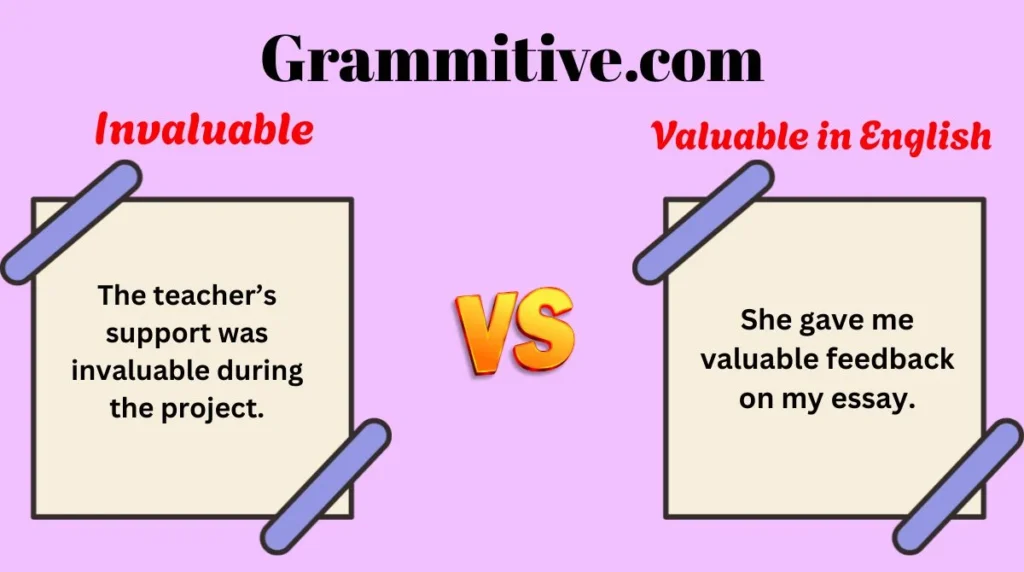
- The teacher’s support was invaluable during the project.
- This ancient map is invaluable to historians.
- Your help today was truly invaluable.
- The experience I gained was invaluable.
- Their friendship is invaluable to me.
- The doctor’s guidance was invaluable after the surgery.
- The notes from class are invaluable for the exam.
Common Learner Confusion
Learners sometimes think invaluable means “not valuable”. This mistake comes from seeing in- as a negative prefix. But here, invaluable means more than valuable.
Remember: invaluable = extremely valuable.
What Does “Valuable” Mean?
Simple Definition
Valuable means having a high value, importance, or worth.
It often refers to things that are worth a lot of money, respect, or usefulness.
When to Use It
Use valuable when something:
- Has a clear value
- Can be measured by money or importance
- Is useful or helpful
This word is also positive, but more straightforward.
Grammar Rule
- Valuable is an adjective.
- It comes before nouns: valuable lesson, valuable experience.
- It can describe things, experiences, advice, and people’s skills.
Example Sentences
- This ring is very valuable.
- She gave me valuable feedback on my essay.
- A university degree is a valuable asset.
- The information in the report is valuable.
- You have valuable skills for this job.
- That painting is extremely valuable.
- We received valuable tips from the coach.
- The lesson I learned was very valuable.
Common Learner Confusion
Learners sometimes use valuable when they mean invaluable. For example, they might say, “Your help was valuable” when they want to show deep gratitude beyond measurement.
Although valuable is correct in many cases, it’s not as strong as invaluable.
Difference Between Invaluable and Valuable (Detailed)
Comparison Table
| Feature | Invaluable | Valuable |
|---|---|---|
| Meaning | Too valuable to measure | Has high value or worth |
| Strength | Very strong importance | Strong importance but measurable |
| Money? | Not about price | Often about price or worth |
| Use with feelings | Yes | Yes |
| Use with objects | Yes | Yes |
| Prefix confusion | Yes – learners misunderstand | No confusion |
| Tone | Emotional, deep appreciation | Practical, clear value |
Usage Difference
- Invaluable means something is so important or useful that we cannot count its worth.
- Example: His support was invaluable during tough times.
- Valuable means something has good value or worth that can be measured.
- Example: These coins are valuable; they are rare.
Grammar Logic
Both words are adjectives and go before nouns. The difference is their degree of value:
- Valuable = valuable in a measurable way
- Invaluable = valuable in a way beyond measurement
Sentence Structure Difference
- Valuable → describes clear importance: a valuable book
- Invaluable → describes extreme importance: invaluable experience
Meaning Comparison
- Valuable = good, worth money or respect
- Invaluable = extremely good, beyond simple worth
Grammar Rules You Must Remember
Rule #1: Both Are Adjectives
🔹 They describe nouns.
- Valuable help
- Invaluable advice
Example:
- Her feedback was valuable.
- His support was invaluable.
Rule #2: “Invaluable” Doesn’t Mean “Not Valuable”
- In this case, in- means too much value, not no value.
Example:
- The teacher’s guidance was invaluable → means super useful, not useless.
Rule #3: Use “Invaluable” When Value Cannot Be Measured
If you cannot put a price or limit on something’s worth, choose invaluable.
Example:
- Her kindness is invaluable → you cannot measure how important it is.
Rule #4: Use “Valuable” for Clear Worth
If something has a clear price, measurement, or known importance, use valuable.
Example:
- This watch is very valuable → it has a measurable price.
Common Mistakes Students Make
Mistake #1: Mixing Meanings
Some learners think:
- “invaluable = not valuable”
- “valuable = very strong value only”
This is wrong.
Invaluable = extremely valuable.
Wrong:
- Your help was not important; it was invaluable.
Correct:
- Your help was invaluable.
(meaning: very important)
Mistake #2: Using Valuable for Deep Appreciation
Sometimes learners say:
- Your support was valuable.
This is not wrong — it is acceptable.
But if you want to show very strong appreciation and importance, invaluable is better.
Mistake #3: Not Understanding Prefix “in-”
Learners see in- and think “negative”.
But here it means beyond measure, not “no value”.
Mistake #4: Not Matching Tone and Context
Choose the word based on how strong you want your meaning to be.
Easy Trick to Remember the Difference
Memory Trick: Think of “IN-BEYOND”
- Invaluable = IN → beyond → too valuable to count.
- So in doesn’t mean “not” here. It means beyond limits.
Picture it like this:
- Valuable = like money in your pocket
- Invaluable = like the love of a parent
The love of a parent cannot be measured — so it is invaluable.
Remember this simple idea:
- Valuable = you can count value
- Invaluable = value too big to count
This makes the difference very clear!
Daily Life Examples
- Your advice was absolutely invaluable during the interview.
- This passport is a valuable document.
- The lessons from that trip were invaluable to me.
- These old coins are valuable collectors’ items.
- His encouragement was invaluable when I was nervous.
- A good education is valuable for your future.
- The teamwork we learned was invaluable.
- That diamond ring is very valuable.
- My grandmother’s stories are invaluable memories.
- The repairman’s tools are valuable but replaceable.
Practice in Real Life
- When talking about feelings or help: use invaluable
- When talking about money or useful things: use valuable
This pattern will make your English sound natural.
Practice Section
Choose the correct word:
- Her support was _________ during my project.
a) valuable
b) invaluable - These antiques are very _________.
a) invaluable
b) valuable - Your experience is _________ to this team.
a) valuable
b) invaluable - The lesson was _________ — I learned a lot.
a) valuable
b) invaluable - This data is _________ for our research.
a) invaluable
b) valuable
Practice Answers
- b) invaluable
- b) valuable
- a) valuable (Both words work, but “valuable” fits common use.)
- a) valuable
- a) invaluable
FAQs
1. What is the difference between invaluable and valuable?
Valuable means something has real worth or usefulness. Invaluable means something is so important or useful that its value cannot be measured.
2. Can we use invaluable in questions?
Yes! You can ask: Was their help invaluable to your success?
3. Is valuable formal or informal?
Valuable is neutral. You can use it in everyday speech or professional writing.
4. Is invaluable formal or informal?
Invaluable is slightly more formal but still used in spoken English.
5. Can I replace invaluable with very valuable?
Not always. Very valuable shows high worth, but invaluable shows worth beyond measurement.
6. Do native speakers mix these words?
Sometimes. But careful speakers choose invaluable for deep appreciation and valuable for measurable worth.
Conclusion
Now you can confidently use invaluable and valuable in English. Remember:
✔ Valuable — something with clear worth, often measurable.
✔ Invaluable — something so precious you can’t measure its value.
Don’t let prefixes confuse you. Instead, picture the meaning in real life. Think of valuable as money in your wallet and invaluable as love, help, or life lessons — priceless and deeply meaningful.
Practicing with real sentences will help you remember these differences. Try using the words in your next email, conversation, or journal entry.
Your English will sound clearer, stronger, and more natural each time you choose the right word!

I am Lucas Bennett, a digital content creator passionate about social media trends and online growth strategies.
I share practical insights and guides to help users better understand and navigate the digital world.