

English learners often stumble over small prepositions like “to” and “into.” A common confusion is whether to say “transition to” or “transition into”.
At first glance, both phrases seem correct, and many students use them interchangeably.
But if you want to sound natural and fluent, understanding the subtle difference is essential.
Prepositions in English can be tricky because they often carry hidden meanings about direction, change, or focus.
Choosing the wrong one can make your sentence sound awkward or unclear.
This is especially important in everyday English, in school writing, emails, or even casual conversation.
For example, you might hear someone say, “She transitioned to a new job” or “He transitioned into adulthood.” Both seem okay, but they are used in slightly different ways.
After reading this guide, you will clearly understand:
- When to use transition to
- When to use transition into
- How their meanings differ
- How to avoid common mistakes
By learning these small details, you will improve your English significantly.
Not only will your sentences be grammatically correct, but they will also sound natural to native speakers.
The goal is to help you feel confident using these phrases in daily life, writing, and professional communication.
What Does “Transition to” Mean?
Simple Definition
Transition to is used when talking about moving from one state, situation, or place to another. The focus is on the change itself, often highlighting the destination rather than the process.
Think of it as pointing towards the next step or goal.
When to Use It
Use transition to:
- When describing a change in role, job, or situation
- When emphasizing the new state you are moving toward
- In professional, formal, or neutral contexts
Grammar Rule
- Transition is usually followed by “to” + noun (the thing you are moving toward).
- Example structure: Subject + transition + to + noun
Example Sentences
- After college, she transitioned to a career in marketing.
- The company is transitioning to a remote work model.
- He transitioned to a healthier lifestyle last year.
- The student transitioned to high school smoothly.
- Our software is transitioning to a new version this month.
- She wants to transition to part-time work after having a baby.
- Many people transition to retirement slowly.
- The city is transitioning to greener energy sources.
Common Learner Confusion
Many learners mistakenly use into in these sentences. For example:
❌ She transitioned into a career in marketing.
This sounds awkward because the focus is on the destination, not the transformation. Using to keeps the sentence clear and natural.
What Does “Transition into” Mean?
Simple Definition
Transition into is used when the focus is on the process of changing or becoming something new. It emphasizes the transformation rather than just the destination.
Think of it as entering a new phase or slowly becoming something else.
When to Use It
Use transition into:
- When talking about personal growth, transformation, or development
- When highlighting the process of change
- Often used in emotional, educational, or lifestyle contexts
Grammar Rule
- Transition is usually followed by “into” + noun (the new state you are becoming).
- Example structure: Subject + transition + into + noun
Example Sentences
- She transitioned into adulthood with confidence.
- The caterpillar transitioned into a butterfly.
- He transitioned into a leadership role after years of training.
- The actor transitioned into directing successfully.
- The student transitioned into a more confident speaker.
- The country is transitioning into a democratic system.
- Many introverts transition into public speakers with practice.
- The project transitioned into a long-term program.
Common Learner Confusion
Learners often say to instead of into here. For example:
❌ He transitioned to adulthood quickly.
While understandable, it loses the sense of personal growth or transformation, which is the key meaning of into.
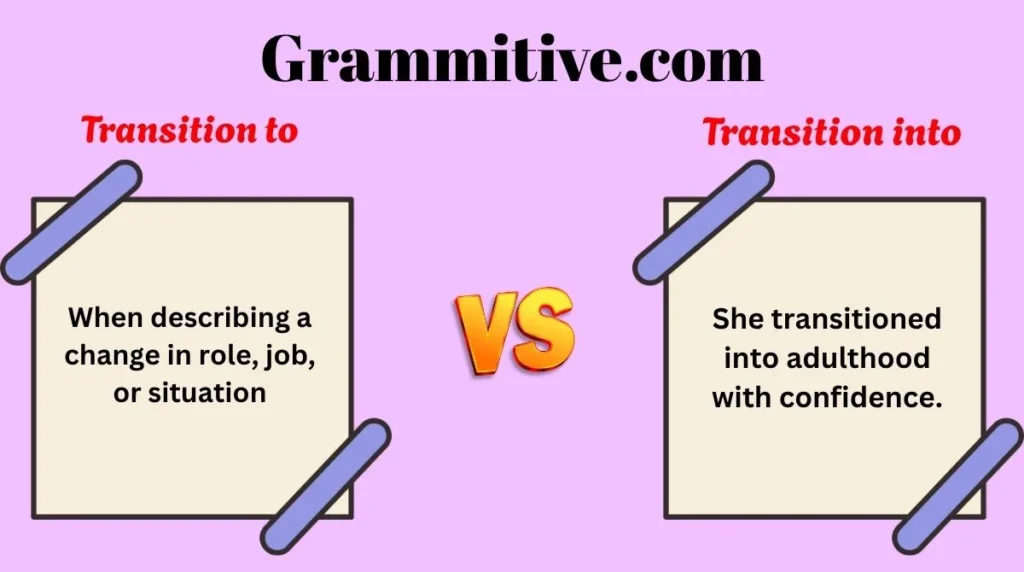
Difference Between Transition to and Transition into
It is easier to see the difference with a comparison table:
| Feature | Transition to | Transition into |
|---|---|---|
| Focus | Destination / next stage | Transformation / process |
| Emphasis | Where you are going | Becoming something new |
| Common Usage | Jobs, roles, situations | Personal growth, change, phases |
| Structure | transition + to + noun | transition + into + noun |
| Example | She transitioned to a managerial role. | She transitioned into a confident leader. |
| Feel | Neutral, factual | Active, developmental |
Usage Difference
- To → highlights the end point.
- Into → highlights the journey or change.
Sentence Structure Difference
- Transition to: The focus is on the object after ‘to’. Example: The city transitioned to a digital payment system.
- Transition into: The focus is on the subject’s change. Example: The student transitioned into a more disciplined person.
Meaning Comparison
- To = moving toward a target
- Into = changing into something different
This distinction might feel subtle but changes how natural your sentence sounds.
Grammar Rules You Must Remember
Rule #1: Use “to” for destination or goal
✅ Correct: She transitioned to a new role.
❌ Incorrect: She transitioned into a new role.
Rule #2: Use “into” for transformation or change
✅ Correct: He transitioned into a confident speaker.
❌ Incorrect: He transitioned to a confident speaker.
Rule #3: Preposition follows the noun, not the verb directly
✅ Correct: The company transitioned to online services.
❌ Incorrect: The company transitioned online services.
Rule #4: Avoid unnecessary prepositions
Do not say: transitioned “towards” or transitioned “inside of”. Stick to to or into.
✅ Correct: She transitioned to a remote role.
✅ Correct: He transitioned into adulthood.
Common Mistakes Students Make
Mistake #1: Using “to” instead of “into”
❌ He transitioned to adulthood.
✅ He transitioned into adulthood.
Mistake #2: Using “into” instead of “to”
❌ She transitioned into a new job.
✅ She transitioned to a new job.
Mistake #3: Adding extra words
❌ He transitioned to into leadership.
✅ He transitioned into leadership.
Why Mistakes Happen
- “To” and “into” look similar
- Learners translate directly from their native language
- Confusion about whether the focus is destination or change
Easy Correction Tips
- Ask: Am I talking about destination or change?
- Destination → use to
- Change → use into
Easy Trick to Remember the Difference
Think of a doorway:
- Transition to → stepping toward the door (destination)
- Transition into → stepping through the door and becoming part of the new room (change)
This visual trick helps you remember which preposition shows destination vs transformation.

Daily Life Examples
Here are real-life examples you can use in conversation:
- I am transitioning to a new diet plan next week.
- She transitioned into a teacher after working as a nurse.
- Our office is transitioning to a digital filing system.
- He transitioned into a more responsible adult during college.
- The country is transitioning to solar energy slowly.
- I transitioned into running every morning last year.
- My brother transitioned to a remote job successfully.
- The caterpillar transitioned into a butterfly beautifully.
- She transitioned to a managerial position after five years.
- He transitioned into a confident speaker after taking a course.
These sentences show natural, everyday use in both spoken and written English.
Practice Section
Choose the correct option:
- She transitioned ___ a leadership role.
a) to
b) into - He transitioned ___ a healthier lifestyle.
a) to
b) into - Our company is transitioning ___ online services.
a) to
b) into - The student transitioned ___ a confident speaker.
a) to
b) into - I transitioned ___ a part-time job last month.
a) to
b) into
Answers: 1-a, 2-b, 3-a, 4-b, 5-a
FAQs
Q1: What is the difference between transition to and transition into?
A1: Transition to focuses on moving toward a destination or goal, while transition into emphasizes changing or becoming something new.
Q2: Can we use transition into for jobs?
A2: Yes, if you want to show personal growth or transformation. For just moving to a new job, use transition to.
Q3: Is transition to formal or informal?
A3: It is neutral and works well in both formal and informal contexts.
Q4: Can transition into be used for things, not people?
A4: Yes. Example: The project transitioned into a long-term program.
Q5: Can I say transitioned to adulthood?
A5: This is understandable but less natural. Use transitioned into adulthood to emphasize growth.
Q6: Do both phrases work in emails and reports?
A6: Yes, but transition to is more common in professional writing, while transition into suits descriptions of change or transformation.
Final Conclusion
Mastering transition to and transition into may seem tricky, but the key is to focus on whether you are highlighting a destination or a transformation.
Once you understand this subtle difference, your sentences will sound natural and confident.
Practice with daily life examples, and remember the doorway trick: stepping toward → to, stepping through → into.
Using these phrases correctly will make your English sound polished, professional, and clear.
Take a few minutes every day to try forming sentences with both expressions.
Over time, choosing the right preposition will become second nature, making your English more fluent and precise.
You are now ready to confidently use transition to and transition into in conversations, writing, and presentations. Keep practicing, and soon it will feel effortless.

I am Lucas Bennett, a digital content creator passionate about social media trends and online growth strategies.
I share practical insights and guides to help users better understand and navigate the digital world.