
English learners often stumble over words that look similar but carry slightly different meanings.
One of the most confusing pairs is “content” and “contented.” Both relate to happiness and satisfaction, but they are not interchangeable.
Misusing them can make sentences sound awkward or even change the intended meaning.
For example, saying “I am contented with my life” is technically correct, but many native speakers would simply say “I am content.”
On the other hand, “contented” can be used to emphasize a deeper, long-lasting satisfaction, which can slightly shift the tone.
Understanding this difference is essential because these words appear often in conversations, books, and even emails.
Using them correctly can make your English sound natural and fluent.
Whether you are writing an essay, chatting with friends, or posting on social media, knowing the subtle distinctions will make your speech smoother and more precise.
By the end of this lesson, you will clearly know:
- When to use content versus contented
- How native speakers naturally use these words
- How grammar rules change depending on your choice
- Simple tricks to remember the difference
With a little practice, you can stop hesitating and confidently say “I am content” or “He looked contented.”
This guide will give you all the tools you need to master these tricky words.
What Does “Content” Mean?
The word content (pronounced /kənˈtɛnt/) is an adjective that describes a state of happiness or satisfaction. When someone is content, they feel that what they have is enough. It does not always mean extreme joy, but rather a calm acceptance or peaceful satisfaction.
When to Use “Content”
- To describe current satisfaction or a temporary feeling of happiness.
- When someone doesn’t want more than what they have at the moment.
- Often used in modern English conversations and informal writing.
Grammar Rule
Content is usually followed by “with” when you describe what satisfies someone:
- Structure: subject + to be + content + with + noun/pronoun
Examples
- I am content with my meal.
- She seems content with her new job.
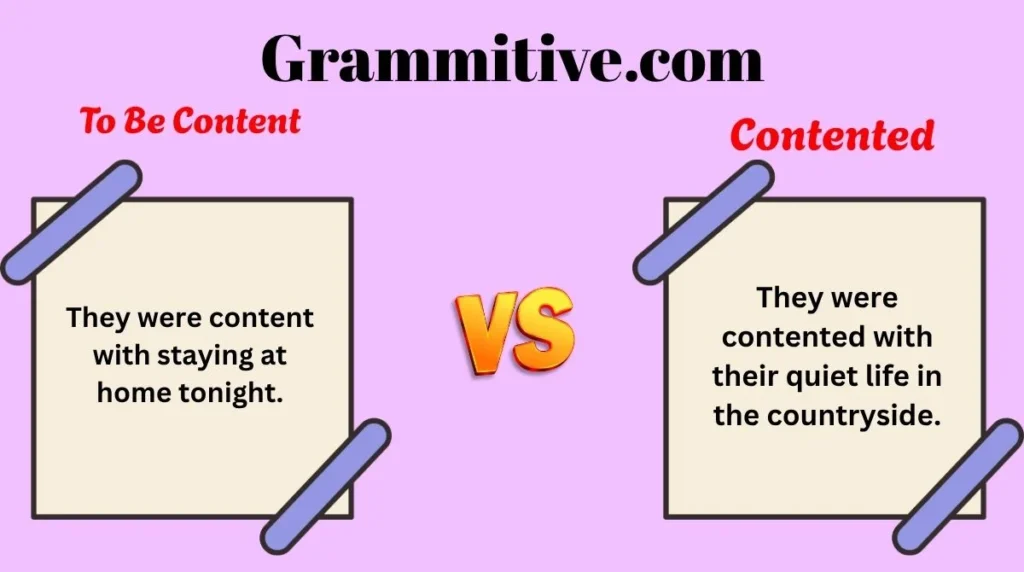
- They were content with staying at home tonight.
- He is content with his small collection of books.
- I feel content with my life right now.
- Are you content with the results?
- The baby is content with his toys.
- She looked content as she watched the sunset.
Common Learner Confusion
Many learners confuse content with contented because they both describe satisfaction. The main difference is that content often refers to a present, simple feeling, not necessarily long-lasting. Beginners also sometimes forget to use “with”: “I am content my life” is incorrect; it must be “I am content with my life.”
What Does “Contented” Mean?
The word contented (pronounced /kənˈtɛntɪd/) is also an adjective describing satisfaction or happiness. However, it carries a slightly stronger sense of deep, lasting happiness. It suggests a more complete, comfortable, and peaceful state of mind.
When to Use “Contented”
- To describe long-term satisfaction or a calm, fulfilled feeling.
- Often appears in literary or formal English.
- Can describe someone’s personality or general state, not just temporary happiness.
Grammar Rule
Contented can also be followed by “with”, but it is more flexible and can sometimes stand alone:
- Structure: subject + to be + contented (+ with + noun/pronoun)
Examples
- She felt contented after finishing her work.
- He looked contented sitting by the fire.
- They were contented with their quiet life in the countryside.
- I am contented with what I have achieved.
- The dog appeared contented after its meal.
- She led a contented life surrounded by family.
- He smiled, feeling contented inside.
- They seemed genuinely contented with their decision.
Common Learner Confusion
Some learners think contented is more formal and avoid it entirely, using content instead. While this is partly correct, using contented can give your English a gentle, refined tone, especially in writing. Another confusion is mixing verb forms: “I contented with life” is wrong; you always need to be: “I am contented with life.”
Difference Between Content and Contented
Although content and contented are close in meaning, there are subtle differences in usage, tone, and grammar.
| Feature | Content | Contented |
|---|---|---|
| Meaning | Simple, present satisfaction | Deep, long-lasting satisfaction |
| Tone | Neutral, casual | Gentle, literary, sometimes formal |
| Usage Frequency | More common in spoken English | Less common, often in writing |
| Typical Context | Temporary happiness | Ongoing happiness or lifestyle |
| Grammar Structure | content + with + noun/pronoun | contented (+ with + noun/pronoun) |
| Example Sentence | I am content with my lunch. | I am contented with my life. |
Key Logic:
- Content = temporary or immediate satisfaction
- Contented = enduring or deeper satisfaction
Sentence Structure Difference:
- Content: “I am content with the results.”
- Contented: “She is contented; she has everything she needs.”
Meaning Comparison:
- Saying “I am content” suggests you are happy right now.
- Saying “I am contented” suggests a peaceful, long-term state of happiness.
Grammar Rules You Must Remember
Rule #1: Always use “to be” with adjectives
You cannot say “I content” or “I contented”. Always use:
- I am content.
- She is contented.
Rule #2: Use “with” to explain the source of satisfaction
- Correct: I am content with my work.
- Incorrect: I am content my work.
- Correct: He is contented with his family life.
- Incorrect: He is contented his family life.
Rule #3: Present tense for temporary satisfaction
- Content is usually used for feelings in the moment.
- Example: She is content with her coffee.
Rule #4: Contented often shows long-term satisfaction
- Use contented for lifestyle, personality, or ongoing feelings.
- Example: They lived a contented life in the countryside.
Common Mistakes Students Make
Mistake #1: Using the wrong form
- Wrong: I contented with my job.
- Correct: I am content with my job.
Mistake #2: Forgetting “with”
- Wrong: She is content her life.
- Correct: She is content with her life.
Mistake #3: Overusing “contented” in casual speech
- Wrong (in conversation): I am contented with my sandwich.
- Correct: I am content with my sandwich.
Mistake #4: Confusing temporary and long-term feelings
- Wrong: I am contented just for today.
- Correct: I am content just for today.
Tip: Think about time and intensity—content = now, contented = deep/long-term.
Easy Trick to Remember the Difference
Memory Trick:
- Content = current contentment → short word = short-term feeling.
- Contented = deeply satisfied → longer word = deeper happiness.
Real-Life Logic:
- If you ate a good meal → content
- If your life is peaceful → contented
Student-Friendly Explanation:
- Think of content as a snap photo of happiness.
- Think of contented as a long movie showing your happiness over time.
Daily Life Examples
Here are real-life sentences you can hear in everyday English:
- I am content with my breakfast; it’s exactly what I wanted.
- She looked contented sitting on the porch, reading her book.
- He is content with his new phone and doesn’t want another one.
- They were contented living in a small village far from the city.
- I feel content after finishing my homework early.
- The cat seemed contented as it curled up on the sofa.
- Are you content with your progress in English?
- After the family dinner, everyone was content and happy.
- She’s contented with her life and doesn’t feel the need to rush.
- I am content to spend the evening quietly at home.
Practice Section
Choose the correct word: content or contented
- I am ______ with my new shoes.
- He looked ______ after completing the marathon.
- Are you ______ with the service at the restaurant?
- She lived a ______ life in the mountains.
- I feel ______ now that my exam is over.
Answers:
- content
- contented
- content
- contented
- content
FAQs
1. What is the difference between content and contented?
Content refers to temporary happiness, while contented indicates deep, long-lasting satisfaction.
2. Can we use content in questions?
Yes. Example: Are you content with your results?
3. Is contented formal or informal?
Contented is more formal or literary, often used in writing rather than casual speech.
4. Can we say “I contented with life”?
No. You must use “to be”: I am contented with life.
5. Which one is more common in daily conversation?
Content is more common in everyday spoken English.
6. Can contented describe animals?
Yes. Example: The dog looked contented after eating.
Final Conclusion
Understanding the difference between content and contented makes your English sound more natural and fluent.
Remember that content is for short-term, immediate satisfaction, while contented is for long-term, deeper happiness.
Pay attention to grammar rules like always using “to be” and adding “with” when explaining what brings satisfaction.
Practice with daily examples, and soon choosing between these two words will feel effortless.
By using them correctly, you not only avoid mistakes but also sound more confident and polished in both speaking and writing.
Keep observing how native speakers use these words, and try them in your own sentences.
With consistent practice, this small but important difference will become second nature.

I am Lucas Bennett, a digital content creator passionate about social media trends and online growth strategies.
I share practical insights and guides to help users better understand and navigate the digital world.