

English learners often face a tricky question: should you say “replace with” or “replace by”?
It seems small, but using the wrong one can make your sentence sound awkward or even incorrect.
Many students confuse these two because both involve changing something, yet the grammar rules are different.
This confusion is common in daily English, especially in writing, speaking, and formal communication.
Imagine you are writing an email to your teacher or boss: using the wrong phrase might make your English seem unnatural.
Even experienced learners sometimes mix them up because the meanings seem very close.
Understanding the difference is important not only for grammar exams but also for clear communication.
Once you know the rules, you will never hesitate when choosing the right phrase.
You will also sound more confident in English conversations, whether you are talking about replacing a part in a machine, a word in a sentence, or even a person in a team.
By the end of this guide, you will clearly understand what “replace with” and “replace by” mean, when to use each, and how to avoid common mistakes.
You will also get tricks, practice examples, and daily-life sentences so you can use these phrases naturally.
What Does “Replace With” Mean?
Simple Definition
“Replace with” is used when you are putting one thing in place of another. It shows the new thing that will take the place of the old thing.
In other words, the focus is on what you are using instead.
When to Use It
- When you swap one thing for another.
- When describing action where something changes physically or conceptually.
- Always followed by the thing that comes instead, not the person doing the replacement.
Grammar Rule
Structure:
replace + [old thing] + with + [new thing]
- The old thing is the object being replaced.
- The new thing is introduced after “with.”
Example Sentences
- I need to replace the battery with a new one.
- She replaced the sugar with honey in her recipe.
- They replaced the old chairs with comfortable sofas.
- Please replace the broken bulb with a new LED bulb.
- He replaced his old phone with a more advanced model.
- We replaced the black curtains with white ones.
- You should replace unhealthy snacks with fruits and nuts.
- The teacher replaced the word “happy” with “joyful” in the sentence.
Common Learner Confusion
Many students mistakenly say:
- ❌ Replace the battery by a new one
- ❌ Replace sugar by honey
This is incorrect because “by” is not used to show the new object. Remember: “with” = the thing you use instead.
What Does “Replace By” Mean?
Simple Definition
“Replace by” is used when the focus is on the person or thing doing the replacement. Often, it appears in passive voice sentences.
In other words, it tells who or what performed the action of replacement.
When to Use It
- Mainly in formal or written English, especially reports, instructions, or passive constructions.
- Shows the agent of the action, not the replacement object.
- Often seen in technical, academic, or business contexts.
Grammar Rule
Structure in passive voice:
[old thing] + is/was/will be + replaced + by + [person or agent]
- The old thing is the subject.
- The person or agent comes after “by.”
Example Sentences
- The old chair was replaced by a comfortable sofa.
- The broken window has been replaced by the maintenance team.
- The outdated software will be replaced by a newer version next week.
- The CEO was replaced by a more experienced manager.
- This word can be replaced by another synonym.
- The faulty parts were replaced by the technicians yesterday.
- The damaged tiles were replaced by professionals.
- The manager was replaced by his assistant for the meeting.
Common Learner Confusion
Many beginners say:
- ❌ The chair was replaced with a comfortable sofa (less formal but not entirely wrong in spoken English)
- ❌ She replaced the window by a new one
Remember: “by” focuses on the agent, not the replacement object.
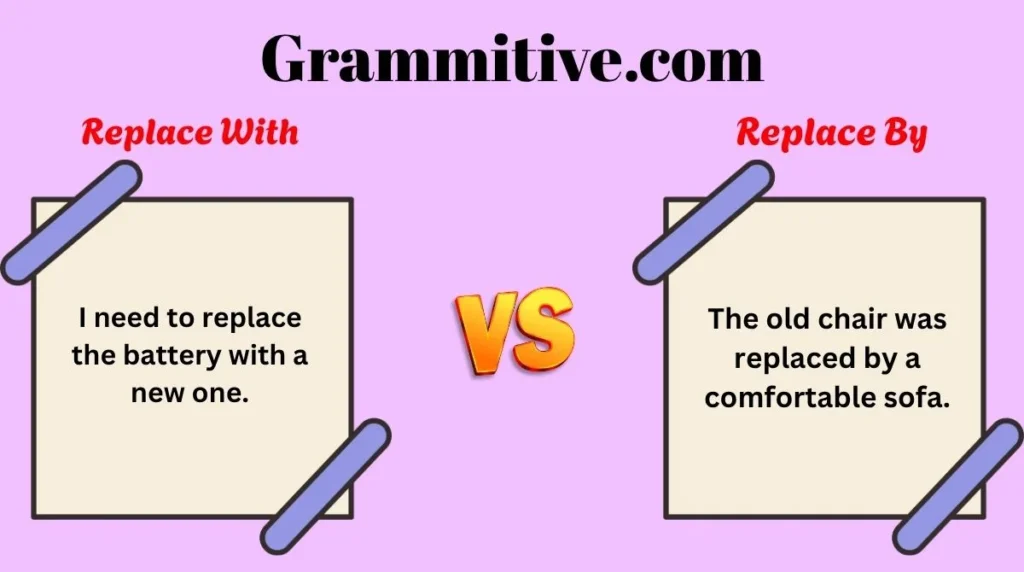
Difference Between Replace With and Replace By (Detailed)
The main difference is focus:
| Feature | Replace With | Replace By |
|---|---|---|
| Focus | What is used instead | Who or what does the replacement |
| Common Structure | replace + [old thing] + with + [new thing] | [old thing] + is/was/will be + replaced + by + [agent/person] |
| Voice | Active voice | Passive voice |
| Example | I replaced sugar with honey. | Sugar was replaced by honey. |
| Usage | Everyday spoken English | Formal writing, reports, passive constructions |
| Meaning | Focus on replacement object | Focus on the agent of replacement |
Grammar Logic
- Replace with = active sentence, emphasizes what is new.
- Replace by = passive sentence, emphasizes who/what performed the action.
Sentence Structure Difference
- Active: Subject + replace + old thing + with + new thing
- Passive: Old thing + is/was replaced + by + agent
For example:
- Active: She replaced the tires with new ones.
- Passive: The tires were replaced by her.
Meaning Comparison
- “With” → emphasizes the new item or thing
- “By” → emphasizes the person or agent
Grammar Rules You Must Remember
Rule #1: Always use “with” for the replacement object
Example:
- ❌ She replaced the sugar by honey.
- ✅ She replaced the sugar with honey.
Rule #2: Use “by” only in passive sentences
Example:
- ❌ She replaced by her assistant.
- ✅ The manager was replaced by her assistant.
Rule #3: Active vs Passive voice changes the phrase
- Active: replace + with → I replaced the chair with a new one.
- Passive: replaced + by → The chair was replaced by the staff.
Rule #4: Spoken vs Written English
- In casual spoken English, “with” is more common even in passive constructions.
- In formal writing, “by” is correct when indicating the agent.
Common Mistakes Students Make
Why Mistakes Happen
- Confusion between object vs agent.
- Translating from native language literally.
- Misunderstanding passive vs active voice.
Wrong vs Correct Examples
- ❌ The broken laptop was replaced with John.
- ✅ The broken laptop was replaced by John.
- ❌ I replaced by sugar honey.
- ✅ I replaced sugar with honey.
Easy Correction Tips
- Ask yourself: Are you showing what is used instead or who did it?
- If it’s the new thing, use with.
- If it’s the person or agent, use by.
Easy Trick to Remember the Difference
Think of “with” as the tool or replacement item and “by” as the doer.
- “With” = what is used → like holding a hammer with your hand.
- “By” = who does it → like the hammer was swung by your hand.
Real-life logic:
- You replace sugar with honey → honey is doing the job.
- The sugar was replaced by the chef → chef is doing the job.
This small trick works every time and makes remembering easy for beginners.

Daily Life Examples
Here are some spoken English examples you can use:
- I replaced my old shoes with new ones yesterday.
- The broken phone was replaced by the shop staff.
- We replaced the water bottle with a bigger one.
- The outdated software will be replaced by the IT team soon.
- Mom replaced sugar with honey in the cake.
- The tired chair was replaced by a comfy one.
- The old manager was replaced by a younger leader.
- I replaced my notebook with a digital tablet.
- The missing page was replaced by a photocopy from the library.
- She replaced her winter coat with a lighter jacket.
Practice Section
Choose the correct option:
- I replaced the old lamp ___ a new LED lamp.
- a) with
- b) by
- The CEO was replaced ___ a more experienced manager.
- a) with
- b) by
- She replaced sugar ___ honey in the tea.
- a) by
- b) with
- The broken window was replaced ___ the repair team.
- a) with
- b) by
- He replaced his old notebook ___ a new one.
- a) with
- b) by
Answers: 1-a, 2-b, 3-b, 4-b, 5-a
FAQs
1. What is the difference between replace with and replace by?
- Replace with shows the new item. Replace by shows the agent who does the replacement.
2. Can we use replace by in questions?
- Yes, in formal English: Who was the manager replaced by?
3. Is replace with formal or informal?
- Replace with is neutral and common in daily English.
4. Can replace by be used in spoken English?
- Yes, but mostly in formal or technical contexts.
5. Can I say “replace X with Y” in passive voice?
- It’s possible in casual English: The chair was replaced with a new one, but “by” is more formal.
6. Why do learners confuse replace with and replace by?
- Because both involve change, and the difference between agent vs object is subtle.
Final Conclusion
Understanding replace with and replace by makes your English clearer and more natural. Remember:
with = the replacement object; by = the person or agent. These phrases are everywhere—from school, work, emails, to casual conversations.
Practicing real-life sentences will help you internalize the rules, avoid mistakes, and gain confidence.
Start noticing these phrases in books, TV shows, or daily conversations, and try using the memory trick:
“with = what; by = who.” With enough practice, choosing the right phrase will become automatic, and your English will sound fluent and correct every time.

I am Lucas Bennett, a digital content creator passionate about social media trends and online growth strategies.
I share practical insights and guides to help users better understand and navigate the digital world.