

English learners often stumble upon phrases that sound similar but have very different meanings.
Two such phrases are “piece of mine” and “peace of mind.” They look almost alike, but using them incorrectly can confuse your listener or even change the meaning of your sentence entirely.
Understanding these expressions is not just about memorizing words—it’s about knowing the context, emotion, and grammar behind them.
Using them correctly can make your English sound natural, confident, and fluent.
For beginners and non-native speakers, mixing up these phrases is extremely common, especially because they sound similar in spoken English.
By the end of this lesson, you will clearly understand what each phrase means, when to use it, and how to avoid mistakes.
You will also get practical examples, grammar rules, memory tricks, and real-life conversations where these phrases appear.
After this, you won’t have to pause or think twice while choosing the right expression—you’ll know exactly which one fits.
English is full of such tricky phrases, and mastering them step by step will make your speaking and writing smoother.
You’ll also notice that knowing small differences can make a big impact on your confidence and clarity.
So, let’s explore these two expressions carefully, understand their meanings, and make them part of your everyday English.
What Does “Piece of Mine” Mean?
Definition:
A “piece of mine” literally refers to a portion or part of something that belongs to you. It is about ownership and usually refers to a tangible or countable object.
When to Use It:
Use this phrase when you are talking about something that is yours, either physical or sometimes metaphorical (like a share of something).
Grammar Rule:
- “Piece” is a noun.
- “Of mine” is a possessive phrase.
- Together, “piece of mine” = “a part that belongs to me.”
Example Sentences:
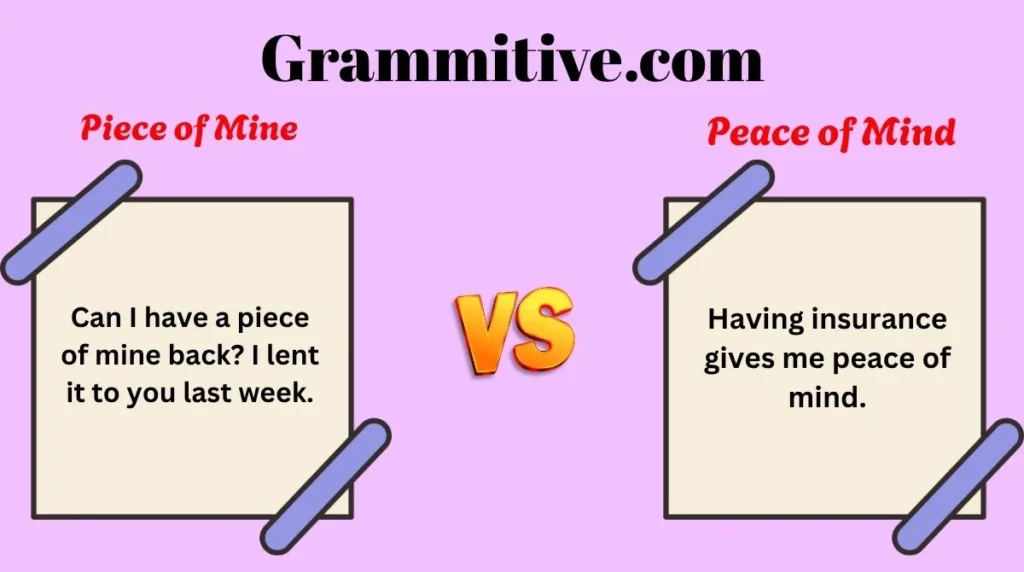
- Can I have a piece of mine back? I lent it to you last week.
- This chocolate bar is a piece of mine; don’t eat it.
- She took a piece of mine without asking.
- The painting on the wall is a piece of mine from my collection.
- I want a piece of mine to keep for later.
- Every piece of mine has a special story behind it.
- That book is a piece of mine; it means a lot to me.
- Please return the piece of mine that you borrowed yesterday.
Common Learner Confusion:
- Beginners often say “peace of mine” instead of “piece of mine.” This mistake happens because the words sound similar, but one is about ownership and the other is about calmness.
- Remember: “piece” = part of something, “peace” = calm or no stress.
What Does “Peace of Mind” Mean?
Definition:
“Peace of mind” refers to a feeling of calm, safety, or freedom from worry. It is about emotions, not objects.
When to Use It:
Use this expression when talking about mental calmness, relaxation, or security.
Grammar Rule:
- “Peace” is a noun.
- “Of mind” describes the type of peace.
- Together, “peace of mind” = a mental state of calm or comfort.
Example Sentences:
- Having insurance gives me peace of mind.
- I locked the door twice to ensure peace of mind.
- Knowing she is safe brings me peace of mind.
- A good night’s sleep provides peace of mind.
- Meditation can give you peace of mind.
- Paying off my debts finally gave me peace of mind.
- He bought a security system for peace of mind.
- Traveling with a guide ensures peace of mind for beginners.
Common Learner Confusion:
- Many learners confuse “piece of mind” with “peace of mind.”
- Saying “piece of mind” instead of “peace of mind” can make your sentence sound wrong or even funny, because it would suggest you are giving a part of yourself instead of feeling calm.
Difference Between Piece of Mine and Peace of Mind
Understanding the difference is simple if we focus on ownership vs. emotional state. Here’s a detailed comparison:
| Feature | Piece of Mine | Peace of Mind |
|---|---|---|
| Meaning | A part or portion that belongs to you | A calm, relaxed, worry-free state |
| Focus | Physical or tangible object | Mental or emotional state |
| Grammar Structure | Noun + “of mine” | Noun + “of mind” |
| Common Use | Talking about belongings or shares | Talking about security, calmness, comfort |
| Example | “This pen is a piece of mine.” | “Having backup files gives me peace of mind.” |
| Confusion Point | Often confused with “peace of mind” | Often mistakenly written as “piece of mind” |
Usage Difference in Sentences:
- Piece of mine: “That cookie is a piece of mine, don’t eat it!”
- Peace of mind: “Locking the windows at night gives me peace of mind.”
Grammar Logic:
- “Piece of mine” is possessive → it talks about ownership.
- “Peace of mind” is descriptive → it talks about a mental condition.
Sentence Structure Difference:
- “Piece of mine” often comes after the object: a piece of mine, a part of mine.
- “Peace of mind” often follows verbs that indicate feeling or giving: gives me peace of mind, brings peace of mind.
Grammar Rules You Must Remember
Rule #1: “Piece” for physical ownership
- Use “piece” when you are talking about something tangible.
- Example: “This necklace is a piece of mine.”
Rule #2: “Peace” for mental calmness
- Use “peace” when you are talking about emotions or state of mind.
- Example: “Completing my homework early gives me peace of mind.”
Rule #3: “Of mine” vs “of mind”
- “Of mine” = possessive → belongs to me
- “Of mind” = emotional/mental → belonging to the mind
- Example: “That car is a piece of mine.” vs “Knowing my car is safe gives me peace of mind.”
Rule #4: Don’t mix sounds with meaning
- Sound is similar, but meaning is different. Always think: physical vs mental.
- Example of mistake: “Eating chocolate gives me a piece of mind.” ❌
- Correct: “Eating chocolate gives me peace of mind.” ✅
Common Mistakes Students Make
Why mistakes happen:
- Pronunciation is similar: “piece” and “peace”
- Written English often confuses learners
- Translating directly from another language
Wrong vs Correct Examples:
- Wrong: “I need a peace of mine for my book.”
Correct: “I need a piece of mine for my book.” - Wrong: “Meditation gives me a piece of mind.”
Correct: “Meditation gives me peace of mind.” - Wrong: “Can I borrow a peace of mine?”
Correct: “Can I borrow a piece of mine?”
Easy Correction Tips:
- Ask yourself: Is it something I own? → piece
- Ask yourself: Is it about feeling calm? → peace
Easy Trick to Remember the Difference
Memory Trick:
- Piece = part of a physical thing → imagine holding a piece of chocolate or paper.
- Peace = calm in your mind → imagine relaxing in a quiet park.
Real-Life Logic:
- You own a piece but you feel peace.
- Think: “I own a piece of cake” vs “I feel peace after studying.”
Student-Friendly Explanation:
- Every time you write or say it, check the context: Are you talking about an object or a feeling?
- If it’s an object → piece of mine
- If it’s a feeling → peace of mind
Daily Life Examples
- “I can’t give you a piece of mine; I need it for my project.”
- “Sleeping early always brings me peace of mind.”
- “The toy is a piece of mine, please don’t break it.”
- “Buying insurance provides peace of mind to many parents.”
- “This painting is a piece of mine, part of my private collection.”
- “A clean house gives me peace of mind after a long day.”
- “I accidentally ate a piece of mine from the fridge.”
- “Knowing my phone is backed up gives me peace of mind.”
- “That pen is a piece of mine, please return it.”
- “Meditating in the morning helps me start the day with peace of mind.”
Practice Section
Choose the correct option:
- Can I borrow a ___ of mine?
a) peace
b) piece ✅ - Knowing my family is safe gives me ___ of mind.
a) peace ✅
b) piece - That chocolate bar is a ___ of mine.
a) piece ✅
b) peace - Paying bills on time gives me ___ of mind.
a) peace ✅
b) piece - I want a ___ of mine back from you.
a) piece ✅
b) peace
Answers: 1b, 2a, 3a, 4a, 5a
FAQs
1. What is the difference between piece of mine and peace of mind?
- “Piece of mine” is about ownership, while “peace of mind” is about feeling calm.
2. Can we use “peace of mind” in questions?
- Yes. Example: “Does having a guard dog give you peace of mind?”
3. Is “piece of mine” formal or informal?
- It is neutral and can be used in both formal and informal contexts.
4. Can “peace of mind” be used in business English?
- Absolutely. It often appears in insurance, finance, and customer service contexts.
5. Why do learners confuse these two phrases?
- They sound alike but mean very different things. Focusing on context solves this.
6. Can we use “piece of mind” instead of “peace of mind”?
- No, that’s incorrect. “Piece of mind” literally means giving a part of your mind, which doesn’t make sense in most contexts.
Final Conclusion
Confusing piece of mine and peace of mind is a common problem, but with a little attention, it’s easy to master.
Remember: piece = ownership, peace = calm. By practicing these expressions in daily conversations, you can speak English more confidently and clearly.
Real-life examples, memory tricks, and grammar rules make it easier to remember which one to use.
Start by noticing when you are talking about things versus feelings, and the correct phrase will naturally come to mind.
Over time, you’ll find that your English sounds smooth, accurate, and natural. Every small step, like understanding these two phrases, brings you closer to fluency.
Keep practicing, and don’t worry about making mistakes—mistakes are part of learning.
Soon, “piece of mine” and “peace of mind” will feel as easy as your favorite words in English.

I am Lucas Bennett, a digital content creator passionate about social media trends and online growth strategies.
I share practical insights and guides to help users better understand and navigate the digital world.