
Many English learners feel confused when they see phrases like “from which” and “from where.” At first, both seem to mean the same thing.
They both talk about a place or source. So, it’s normal to wonder: Are they interchangeable? Which one is correct?
This confusion happens because English has both formal grammar rules and casual spoken usage.
Sometimes, what sounds natural in daily conversation is not always correct in formal writing. That’s exactly where “from which” and “from where” create problems.
Understanding the difference is important because you will see these phrases in questions, sentences, exams, emails, and even job interviews.
Using the wrong one can make your English sound unnatural or incorrect.
After reading this guide, you will clearly understand:
- What “from which” means and how to use it
- What “from where” means and when it is correct
- The exact difference between them
- Simple rules that you can remember easily
- Real-life examples you can use every day
By the end, you won’t feel confused anymore. You’ll feel confident using both correctly in your own English.
What Does “From Which” Mean?
Simple Definition
“From which” is a formal English phrase used to talk about a specific place, thing, or source.
It is often used in formal writing, such as:
- Essays
- Reports
- Academic English
- Professional emails
When to Use It
Use “from which” when:
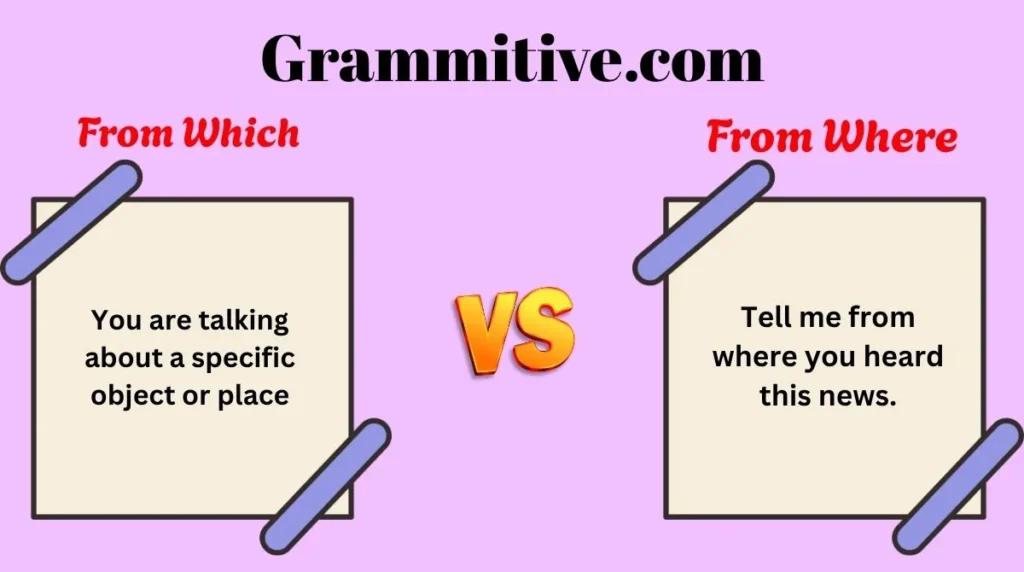
- You are talking about a specific object or place
- You already mentioned the thing before
- You want to sound formal and correct
Grammar Rule
“From which” = Preposition (from) + Relative pronoun (which)
It is commonly used in relative clauses, like:
- The house from which he came
- The city from which she moved
Example Sentences
- This is the village from which he came.
- The school from which she graduated is very famous.
- I found the box from which the sound was coming.
- The country from which they imported goods is far away.
- That is the river from which we get water.
- The company from which I received the email is hiring.
- This is the place from which the journey started.
- The website from which I downloaded the file is safe.
Common Learner Confusion
Many learners think “from which” sounds too difficult or old-fashioned. So they avoid it.
But in reality:
- It is still correct and widely used
- It is important in formal English
- It often replaces “from where” in correct grammar
What Does “From Where” Mean?
Simple Definition
“From where” is used to talk about the starting point of a place.
It is more common in spoken English and informal situations.
When to Use It
Use “from where” when:
- You are asking questions
- You are speaking casually
- You want simple and natural English
Grammar Rule
“From where” = Preposition (from) + question word (where)
It is mainly used in:
- Questions
- Informal sentences
Example Sentences
- From where are you coming?
- From where did you buy this phone?
- I don’t know from where he got the money.
- From where can I learn English?
- Tell me from where you heard this news.
- From where does this train start?
- She asked from where I got the idea.
- From where should we begin the trip?
Common Learner Confusion
Here is the important point:
In formal grammar, many of these sentences should actually use:
- “Where … from?” instead of “From where…”
For example:
❌ From where are you coming?
✅ Where are you coming from?
So, even though “from where” is used, it is often not the best or most natural choice.
Difference Between “From Which” and “From Where” (Detailed)
Comparison Table
| Feature | From Which | From Where |
|---|---|---|
| Type | Formal | Informal |
| Usage | Writing, academic English | Speaking, casual conversation |
| Structure | Relative clause | Question phrase |
| Focus | Specific object/place | General place |
| Correctness | Grammatically precise | Sometimes less preferred |
Usage Difference
- “From which” is used when you talk about something specific and already known.
- “From where” is used more in everyday speaking, especially in questions.
Grammar Logic
“From which” follows strict grammar rules. It connects two ideas in a sentence.
Example:
- The house from which he came is old.
“From where” is simpler but less formal. It often appears in spoken English.
Sentence Structure Difference
From which:
- The place from which he arrived
From where:
- From where did he arrive?
Meaning Comparison
Both phrases can talk about the same idea (origin or starting point), but:
- “From which” sounds clear and formal
- “From where” sounds casual and conversational
Grammar Rules You Must Remember
Rule #1: Use “from which” in formal sentences
Example:
The office from which I got the letter is closed.
Rule #2: Avoid “from where” in formal writing
Example:
❌ The city from where he came
✅ The city from which he came
Rule #3: In questions, prefer “where…from”
Example:
❌ From where are you coming?
✅ Where are you coming from?
Rule #4: Use “from which” for objects, not people
Example:
The company from which I bought this laptop is reliable.
(Not used for people — use “whom” instead.)
Common Mistakes Students Make
Why Mistakes Happen
- Direct translation from native language
- Confusion between formal and informal English
- Lack of grammar practice
Wrong vs Correct Examples
❌ The place from where I live
✅ The place from which I live
❌ From where you got this?
✅ Where did you get this from?
❌ The shop from where I bought it
✅ The shop from which I bought it
Easy Correction Tips
- Replace “from where” with “from which” in formal sentences
- In questions, switch to “where…from”
- Practice speaking simple sentences
Easy Trick to Remember the Difference
Here’s a simple trick:
👉 If the sentence is formal or written, use “from which”
👉 If the sentence is spoken or a question, use “where…from”
Think like this:
- “Which” = specific + formal
- “Where” = general + casual
This small idea helps a lot.
Daily Life Examples (Very Important)
Here are real-life sentences you can use:
- Where are you coming from?
- This is the shop from which I bought my shoes.
- Where did you get this idea from?
- The village from which he belongs is beautiful.
- Where are they traveling from?
- The website from which I learned English is helpful.
- Where did you hear this news from?
- The company from which she resigned is famous.
- Where are you calling from?
- The place from which the sound came was dark.
Practice Section
Choose the correct option:
- The city ___ he came is large.
(from where / from which) - ___ are you coming?
(From where / Where) - The shop ___ I bought this is closed.
(from where / from which) - ___ did you hear this news?
(From where / Where) - The school ___ she studied is famous.
(from where / from which)
Answers
- from which
- Where
- from which
- Where
- from which
FAQs
What is the difference between “from which” and “from where”?
“From which” is formal and used in structured sentences. “From where” is more informal and common in speech, but often replaced by “where…from.”
Can we use “from where” in questions?
Yes, but it is better to say “Where are you from?” instead of “From where are you?”
Is “from which” formal or informal?
“From which” is formal and commonly used in writing, especially in academic or professional English.
Is “from where” grammatically correct?
It is not always incorrect, but it is often less natural. Native speakers usually prefer “where…from.”
Can I use “from which” in speaking?
Yes, but it may sound formal. It is more common in writing than in everyday conversation.
Which one should beginners use?
Beginners should use:
- “where…from” in speaking
- “from which” in writing
This keeps your English simple and correct.
Final Conclusion
“From which” and “from where” may look similar, but they belong to different styles of English. One is formal and structured, while the other is more casual and flexible.
The key idea is simple: use “from which” when you want your English to be clear, correct, and formal.
Use “where…from” when speaking in daily life. Try to avoid “from where” in most cases, especially in writing.
Learning small grammar differences like this makes a big impact. It helps your English sound more natural and confident.
At first, it may feel a little tricky, but with practice, it becomes easy.
Keep practicing with real sentences. Listen to how native speakers talk. And don’t worry about making mistakes — that’s part of learning.
Step by step, your English will improve.

I am Lucas Bennett, a digital content creator passionate about social media trends and online growth strategies.
I share practical insights and guides to help users better understand and navigate the digital world.