

Small grammar differences can feel very big when you are learning English.
Sometimes just one tiny word can make you stop and think, “Is this correct… or not?”
One very common confusion happens with these two phrases:
a couple of times
and
a couple times
Many students ask:
- Which one is correct?
- Do we need “of” or not?
- Is one more formal?
- Do native speakers really use both?
If you watch movies, talk to friends, or read books, you may notice both forms. That makes it even more confusing. Some teachers say only one is right. Others say both are fine.
So what’s the truth?
This topic is important because we use these phrases all the time in daily English. You might say:
- “I called you a couple of times.”
- “I met her a couple times.”
- “I’ve tried that recipe a couple of times.”
These are very normal, everyday sentences.
By the end, you will clearly understand:
- the meaning of each phrase
- the grammar rules
- which one is formal or informal
- when to use each
- and how native speakers actually talk
After that, you won’t hesitate anymore. You’ll simply choose the right one naturally.
What Does “A Couple of Times” Mean?
Simple meaning
A couple of times means:
👉 two times or a few times
Most often, it means two, but sometimes it can mean two or three or a small number. It is not exact.
When to use it
Use this phrase when you want to say something happened more than once, but not many times.
It is very common in:
- normal conversation
- writing
- school essays
- formal English
It sounds natural everywhere.
Grammar rule
Here is the structure:
a couple + of + plural noun
So:
- a couple of days
- a couple of friends
- a couple of minutes
- a couple of times
The word times is a plural noun. That is why we use of.
This pattern is very common in English grammar.
Example sentences
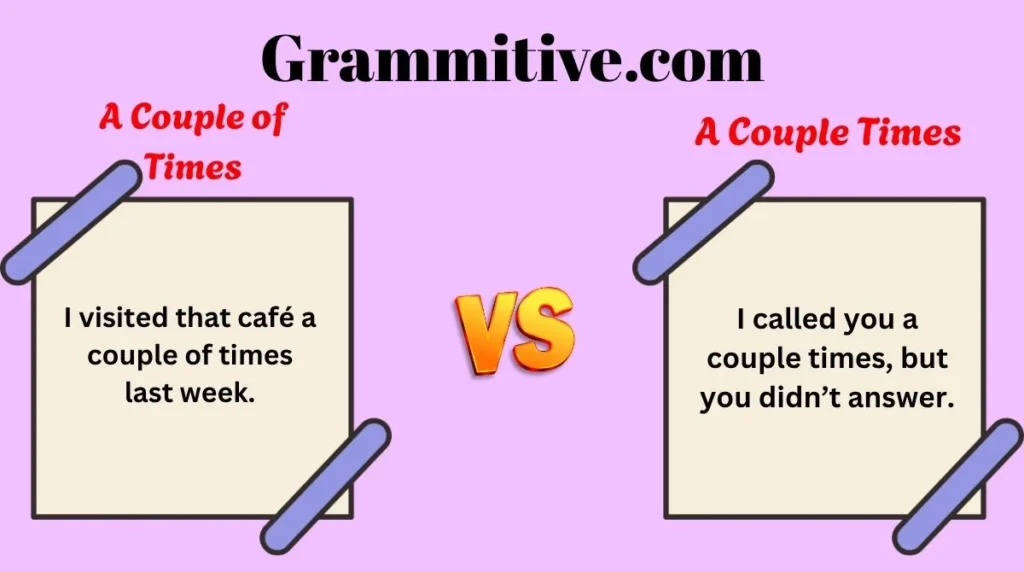
- I visited that café a couple of times last week.
- She called me a couple of times, but I missed it.
- We watched the movie a couple of times already.
- I’ve tried to fix my phone a couple of times.
- He explained the rule a couple of times.
- I met her parents a couple of times before the wedding.
- The dog barked a couple of times at night.
- I read that book a couple of times in school.
Common learner confusion
Many students think:
❌ “Couple means two, so why add ‘of’?”
The answer is simple. In English grammar, couple needs ‘of’ when it comes before a noun.
Without “of,” it sounds incomplete in standard grammar.
So traditionally, a couple of times is the safer and more correct form.
What Does “A Couple Times” Mean?
Simple meaning
A couple times means exactly the same thing:
👉 two or a few times
The meaning does not change.
When to use it
This form is common in:
- casual speech
- American English
- texting
- informal conversation
It sounds relaxed and natural in everyday talk.
But it may sound too casual in formal writing.
Grammar rule
Structure:
a couple + noun (without “of”)
This is actually a shortened form. Many native speakers drop “of” when speaking quickly.
It is similar to how we shorten other phrases in spoken English.
So grammatically, it is more informal, but still widely accepted in conversation.
Example sentences
- I called you a couple times, but you didn’t answer.
- We met a couple times at the gym.
- I tried that game a couple times.
- She visited us a couple times last year.
- I’ve seen him a couple times around town.
- The computer crashed a couple times today.
- He knocked a couple times on the door.
- I asked her a couple times, but she forgot.
Common learner confusion
Students often ask:
❌ “Is this wrong grammar?”
Not exactly.
It’s informal grammar, not wrong grammar.
Think of it like:
- gonna
- wanna
- kinda
These are fine in speech but not great in formal writing.
Difference Between “A Couple of Times” and “A Couple Times” (Detailed)
Both phrases mean almost the same thing. The real difference is style and formality, not meaning.
Here is a simple comparison.
Comparison Table
| Feature | A Couple of Times | A Couple Times |
|---|---|---|
| Meaning | two or a few | two or a few |
| Grammar | standard form | shortened form |
| Formality | neutral/formal | informal |
| Common in writing | yes | less common |
| Common in speech | yes | very common |
| Safe for exams | yes | not always |
Usage difference
If you are:
- writing an essay → use a couple of times
- speaking with friends → both are fine
- taking an exam → use a couple of times
- texting → either is okay
Grammar logic
Traditional grammar rule:
couple + of + noun
But spoken English often removes small words.
So native speakers say:
- a couple minutes
- a couple days
- a couple times
It’s faster and easier to say.
Sentence structure difference
Formal:
👉 I visited the museum a couple of times.
Informal:
👉 I visited the museum a couple times.
Meaning comparison
No difference in meaning.
Only difference in tone.
One sounds slightly more proper. The other sounds relaxed.
Grammar Rules You Must Remember
Rule #1 – Use “of” in formal writing
Correct:
✔ I called her a couple of times.
Wrong for essays:
❌ I called her a couple times.
Rule #2 – “Times” must be plural
Correct:
✔ a couple of times
Wrong:
❌ a couple of time
Because couple means more than one.
Rule #3 – Don’t use numbers with couple
Wrong:
❌ two couple of times
Correct:
✔ a couple of times
“Couple” already means two.
Rule #4 – Use it for small numbers only
Correct:
✔ I visited twice or three times → a couple of times
Wrong:
❌ I visited 20 times → a couple of times
Couple means a small number, not many.
Common Mistakes Students Make
Why mistakes happen
Students get confused because:
- they translate from their own language
- they hear different forms in movies
- they learn strict grammar rules
- spoken English breaks rules sometimes
Wrong vs correct examples
❌ I went there couple times
✔ I went there a couple times
❌ I went there a couple time
✔ I went there a couple times
❌ I went there two couple of times
✔ I went there a couple of times
Easy correction tips
Remember:
- add a
- make times plural
- use of for safe grammar
Easy Trick to Remember the Difference
Here’s a simple memory trick.
Think:
👉 Formal = full form
Full form = a couple of times
Short form = a couple times
So:
- school, exams, writing → full form
- talking, chatting → short form
Just like wearing formal clothes vs casual clothes.
Same meaning. Different style.

Daily Life Examples (Very Important)
These sound very natural in real conversations.
- I’ve been there a couple of times, it’s nice.
- I tried calling you a couple times yesterday.
- She visited us a couple of times last month.
- We watched that show a couple times already.
- I explained it a couple of times, but he still forgot.
- My internet stopped working a couple times today.
- I met him a couple of times at work.
- The baby woke up a couple times at night.
- I practiced driving a couple of times before the test.
- We ordered from that restaurant a couple times.
These are exactly how native speakers talk.
Practice Section
Choose the correct option.
Questions
- I called her ___ yesterday.
a) a couple of times
b) a couple time - We met ___ at the café.
a) a couple times
b) couple of times - He visited us ___ last year.
a) a couple of times
b) two couple times - I tried the recipe ___ already.
a) a couple times
b) couple times - For an exam, which is safer?
a) a couple of times
b) a couple times
Answers
1 → a
2 → a
3 → a
4 → a
5 → a
FAQs
What is the difference between a couple of times and a couple times?
Both mean two or a few times. The first is standard and more formal. The second is informal and common in speech.
Can we use a couple times in questions?
Yes, in casual speech. For example, “Did you try calling him a couple times?” But in formal writing, use “a couple of times.”
Is a couple of times formal or informal?
It is neutral and works in both formal and informal situations. It’s the safest choice.
Which one do native speakers use more?
In speech, many native speakers say “a couple times.” In writing, “a couple of times” is more common.
Can couple mean more than two?
Yes. Sometimes it means two or three or a small number. It’s not always exactly two.
Should students use the short form in exams?
No. It’s better to use “a couple of times” in exams or academic writing.
Final Conclusion
Tiny grammar points like this can feel tricky at first. One small word — of — creates a lot of doubt. But once you understand the logic, everything becomes simple.
Both phrases mean the same thing. The only real difference is style. The longer form sounds standard and works everywhere. The shorter form sounds casual and friendly.
So if you ever feel unsure, just choose a couple of times. It’s always safe.
With practice, you’ll start hearing both forms in daily English. Soon, you won’t even think about it. You’ll speak naturally, just like native speakers.
Keep reading, keep listening, and keep using these phrases in real life. Small details like this slowly build strong, confident English.

I am Lucas Bennett, a digital content creator passionate about social media trends and online growth strategies.
I share practical insights and guides to help users better understand and navigate the digital world.