
Many English learners feel confused when they see words that look almost the same but mean very different things.
One classic example is “yourself” and “your self.” At first glance, they seem identical. The only difference is a small space. But that tiny space changes everything.
Students often ask questions like:
- Is “yourself” one word or two?
- Can I say “your self” in normal sentences?
- Why does one sound correct and the other strange?
These doubts are normal. English spelling can be tricky. Sometimes one small change completely changes grammar and meaning. That is exactly what happens here.
This topic matters more than you think. You use “yourself” every day in spoken English:
- “Take care of yourself.”
- “Do it yourself.”
- “Be yourself.”
But “your self” is rare and used in special situations only. Using the wrong one can make your sentence sound unnatural or incorrect.
After reading this guide, you will clearly understand:
- what each form means
- when to use each one
- grammar rules
- common mistakes
- easy memory tricks
- and real-life examples
By the end, you’ll feel confident using the correct form without stopping to think.
What Does “Yourself” Mean?
Simple definition
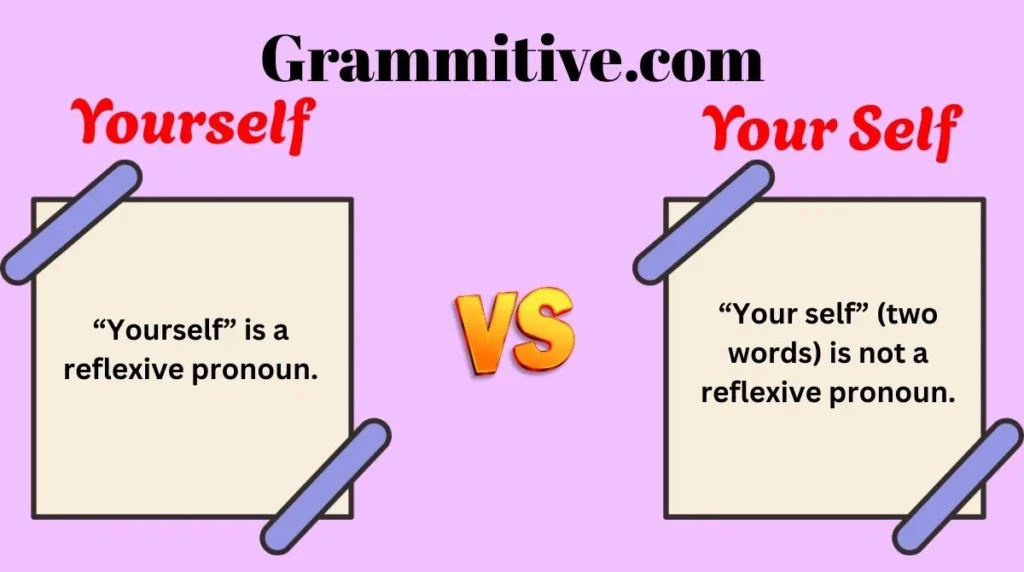
“Yourself” is a reflexive pronoun.
It refers back to you.
It means:
👉 you personally or you alone
When to use it
You use “yourself” when:
- you do something to your own body
- you do something alone
- you want to emphasize “you”
- the action comes back to you
Grammar rule
“Yourself” = you + self → one word → reflexive pronoun
It works like:
- myself
- yourself
- himself
- herself
- ourselves
All of these are one word, never two.
Example sentences
Here are some simple examples:
- Look at yourself in the mirror.
- Did you hurt yourself?
- You should trust yourself.
- Make yourself comfortable.
- Please introduce yourself.
- You cooked this meal yourself? Amazing!
- Take care of yourself.
- You must believe in yourself.
Notice something important:
The action goes back to the same person — you.
Common learner confusion
Many learners think:
❌ “your self” because they see “your” and “self” separately
But English doesn’t work that way here. It is always joined together when it’s a pronoun.
Think of it as one solid unit, just like “myself.”
If you separate it, the meaning changes completely.
What Does “Your Self” Mean?
Simple definition
“Your self” (two words) is not a reflexive pronoun.
It simply means:
👉 your inner personality or identity
Here, self is a noun, not part of a pronoun.
When to use it
You use “your self” when:
- talking about psychology
- discussing personality
- speaking about identity or the inner mind
- using “self” as a normal noun
This usage is much less common in daily conversation.
Grammar rule
“Your self” = possessive adjective + noun
Structure:
your (possessive adjective) + self (noun)
Just like:
- your car
- your house
- your idea
- your life
- your self
So grammatically, it is correct, but only in special contexts.
Example sentences
Here are some natural examples:
- You must understand your self before helping others.
- Meditation helps you know your self better.
- Your self is shaped by your experiences.
- Your self grows stronger with challenges.
- Love your self and respect others.
- Your self is not your job or your money.
- Protect your self from negative thoughts.
Notice something:
These sentences talk about identity or the inner mind, not physical actions.
Common learner confusion
Students sometimes write:
❌ Take care of your self.
But that sounds strange.
Why?
Because this sentence needs a reflexive pronoun, not a noun.
Correct:
✅ Take care of yourself.
The two-word form feels unnatural in everyday speech.
Difference Between Yourself and Your Self (Detailed)
Understanding the difference becomes easier when you compare them side by side.
Comparison Table
| Feature | Yourself | Your self |
|---|---|---|
| Type | Reflexive pronoun | Possessive + noun |
| Words | One word | Two words |
| Usage | Everyday English | Psychological/philosophical |
| Meaning | You personally | Your identity/inner being |
| Common? | Very common | Rare |
| Example | Help yourself | Understand your self |
Usage difference
Yourself
Used for actions that return to you.
Your self
Used when talking about identity or personality.
Grammar logic
Reflexive pronouns are fixed forms.
They never split.
So:
- myself ✅
- yourself ✅
- your self ❌ (as pronoun)
But when “self” is a normal noun, splitting is okay.
Sentence structure difference
Reflexive:
You + verb + yourself
Example: You hurt yourself.
Noun form:
Your + self + verb
Example: Your self changes over time.
Meaning comparison
- “Believe in yourself” → trust YOU
- “Understand your self” → understand your identity
The meanings are different.
Grammar Rules You Must Remember
Rule #1 — Reflexive pronouns are always one word
✅ myself
✅ yourself
❌ your self
Example:
Correct: Enjoy yourself.
Wrong: Enjoy your self.
Rule #2 — Use “yourself” when the action returns to you
Example:
You taught yourself English.
The action comes back to you.
Rule #3 — Use “your self” only when “self” is a noun
Example:
Your self develops through experience.
Here “self” behaves like “mind” or “personality.”
Rule #4 — If unsure, choose “yourself” in daily conversation
In normal English, “yourself” is correct 99% of the time.
Common Mistakes Students Make
Why mistakes happen
The problem usually comes from:
- translating from native language
- overthinking grammar
- seeing “your” + “self” separately
- typing errors
Wrong vs Correct examples
❌ Wash your self.
✅ Wash yourself.
❌ Trust your self.
✅ Trust yourself.
❌ Be your self.
✅ Be yourself.
❌ Protect yourself identity.
✅ Protect your self identity. (noun use)
Easy correction tips
Ask yourself:
👉 Is this about an action to me? → use yourself
👉 Is this about identity or personality? → maybe your self
Simple.
Easy Trick to Remember the Difference
Here’s a small trick many students love.
Think:
“Action = together”
“Identity = separate”
If it’s an action you do → yourself (stick together)
If it’s about your inner identity → your self (separate idea)
Also remember:
Nobody says “my self” in normal speech.
We say myself.
Same logic.
Daily Life Examples (Very Important)
These are natural spoken sentences you’ll hear every day:
- Please help yourself to some food.
- Did you make this cake yourself?
- Take care of yourself.
- Don’t blame yourself too much.
- You should be proud of yourself.
- Relax and enjoy yourself.
- Introduce yourself to the teacher.
- Trust yourself more.
- You handled that problem yourself.
- Be yourself. Don’t pretend.
Notice how all of them use yourself, not “your self.”
That’s why it’s so common.
Practice Section
Choose the correct option:
- Believe in (yourself / your self).
- You must know (yourself / your self) better.
- She told me to relax and enjoy (yourself / your self).
- Your experiences shape (yourself / your self).
- Did you hurt (yourself / your self)?
Answers
- yourself
- your self
- yourself
- your self
- yourself
FAQs
What is the difference between yourself and your self?
“Yourself” is a reflexive pronoun used in everyday actions. “Your self” refers to your identity or inner personality and is much less common.
Can we use yourself in questions?
Yes. It’s very common.
Example: “Did you hurt yourself?”
Works in both statements and questions.
Is “your self” wrong?
Not wrong, but rare. It’s only correct when “self” is a noun about identity or psychology.
Which one is more common in daily English?
“Yourself” is used almost all the time. Most conversations use it many times a day.
Can I say “be your self”?
In normal speech, no.
Say “Be yourself.”
The two-word version sounds unnatural.
Why is yourself one word?
Because it’s a fixed reflexive pronoun, just like “myself” and “himself.” English spelling combines them.
Final Conclusion
Small spelling differences can cause big confusion in English. “Yourself” and “your self” look nearly the same, but their jobs in a sentence are very different.
Most of the time, you will use yourself. It works for daily actions, feelings, and personal situations. It’s natural, common, and safe in almost every conversation.
The two-word form appears mostly in deeper topics like psychology or philosophy, when talking about identity. Regular conversations rarely need it.
So when you speak or write, don’t stress too much. If the action comes back to you, choose yourself. That simple rule will keep you correct almost every time.
Keep practicing with real sentences. Notice how native speakers use it. Soon, it will feel automatic.
Trust yourself — you’ve got this.

I am Lucas Bennett, a digital content creator passionate about social media trends and online growth strategies.
I share practical insights and guides to help users better understand and navigate the digital world.