

English looks simple at first. But when you start speaking it every day, small phrases can cause big confusion.
One common example is “you all” and “all of you.”
Both seem to mean the same thing. Both talk about a group of people. So many learners think they are always interchangeable. But that is not completely true.
Sometimes one sounds natural. Sometimes the other sounds better. And in some situations, using the wrong one can make your sentence feel strange or too formal.
You might hear a teacher say, “You all did great today,” but a parent might say, “I’m proud of all of you.”
Why the difference? Why not use just one form all the time?
These small choices matter. They help your English sound more natural, friendly, and native-like.
After reading this guide, you will clearly understand:
- what each phrase means
- when to use each one
- grammar rules behind them
- common mistakes to avoid
- how native speakers use them in real life
By the end, you won’t guess anymore. You’ll simply know which one feels right.
What Does “You All” Mean?
Simple definition
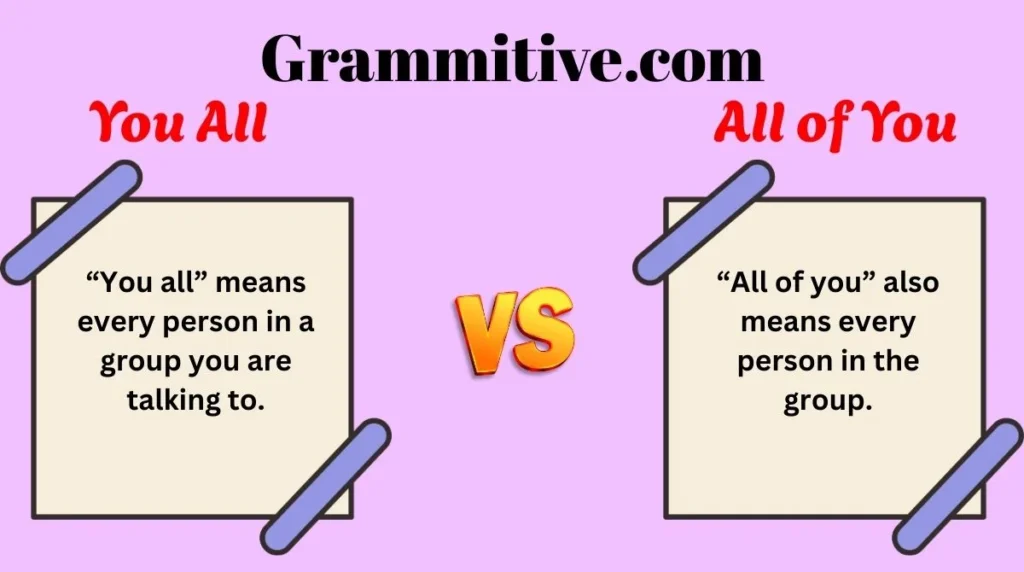
“You all” means every person in a group you are talking to.
It is simply the plural form of “you.”
English has only one word — you — for both singular and plural. This can be confusing. So speakers sometimes add all to show they mean more than one person.
When to use it
“You all” is often used:
- when speaking to a group directly
- in conversations
- in casual or friendly speech
- in American English (especially the South: “y’all”)
It feels warm, direct, and natural.
Grammar rule
Structure:
You all + verb
It acts as the subject of the sentence.
Examples:
- You all are late.
- You all need to listen.
“You all” = subject pronoun phrase.
Example sentences (6–8)
- You all did a great job today.
- Are you all ready to leave?
- I hope you all understand the lesson.
- You all look tired after the trip.
- Thank you all for coming.
- You all should try this cake.
- Did you all finish your homework?
- I miss you all.
Common learner confusion
Many students think “you all” is wrong grammar. It is not.
It’s perfectly correct. It’s just more conversational.
Another confusion: some learners think it sounds too informal. But native speakers use it every day, even teachers and bosses.
If you want friendly, spoken English, “you all” works beautifully.
What Does “All of You” Mean?
Simple definition
“All of you” also means every person in a group.
The meaning is almost the same as “you all.”
But the feeling and structure are slightly different.
When to use it
“All of you” is often used:
- when you want to emphasize everyone
- in more formal situations
- in careful or written English
- when showing strong emotion (love, anger, pride)
It sounds a bit more complete and deliberate.
Grammar rule
Structure:
All of + pronoun
“All of you” is a quantifier phrase.
It can be:
- subject
- object
- after a preposition
Examples:
- All of you are here. (subject)
- I invited all of you. (object)
- I spoke to all of you. (after preposition)
Example sentences (6–8)
- All of you must wear uniforms.
- I invited all of you to my party.
- I’m proud of all of you.
- All of you are welcome here.
- I talked to all of you yesterday.
- The teacher thanked all of you.
- I trust all of you completely.
- All of you need to be careful.
Common learner confusion
Some learners use “all you” without “of.”
❌ All you are late.
✅ All of you are late.
Remember: when using this structure with pronouns, “of” is necessary.
Difference Between “You All” and “All of You” (Detailed)
Both phrases talk about the whole group. But they are not used in exactly the same way.
Here’s a clear comparison.
Comparison Table
| Feature | You all | All of you |
|---|---|---|
| Type | Subject phrase | Quantifier phrase |
| Tone | Casual, friendly | Neutral to slightly formal |
| Position | Usually subject | Subject or object |
| Common in speech | Very common | Common |
| Emphasis | Light | Stronger |
| Sounds | Conversational | More careful/complete |
Usage difference
“You all” feels like you’re talking directly to people in front of you.
“All of you” feels like you are counting or emphasizing every single person.
Example:
- You all did well. (friendly)
- All of you did well. (strong praise, more emphasis)
Grammar logic
“You all” behaves like one subject.
“All of you” contains:
- all = quantity
- of = connector
- you = pronoun
So it’s slightly heavier grammatically.
Sentence structure difference
“You all” → mostly subject
“All of you” → subject OR object
Examples:
✅ You all arrived early.
❌ I invited you all of.
But:
✅ I invited all of you.
Meaning comparison
The basic meaning is the same: everyone in the group.
But “all of you” often adds emotional weight:
- I love you all. (sweet)
- I love all of you. (stronger, deeper feeling)
Small difference, but noticeable.
Grammar Rules You Must Remember
Rule #1: “You all” usually comes before the verb
✅ You all are welcome.
❌ Are welcome you all.
Keep it in subject position.
Rule #2: Use “of” with “all of you”
Never remove “of.”
✅ All of you passed.
❌ All you passed.
Rule #3: Use “all of you” after prepositions
After words like to, for, with, about, use this form.
✅ I spoke to all of you.
❌ I spoke to you all (possible but less common and less natural in careful English).
Rule #4: For casual talk, “you all” sounds more natural
In daily speech:
“You all” often sounds warmer.
Example:
Teacher: You all did great today!
It feels friendly and encouraging.
Common Mistakes Students Make
Why mistakes happen
The problem comes from:
- one pronoun “you” for both singular and plural
- direct translation from other languages
- not knowing formal vs casual tone
Let’s fix the common errors.
Mistake 1
❌ All you are late.
✅ All of you are late.
Tip: Always add “of.”
Mistake 2
❌ I spoke you all.
✅ I spoke to all of you.
Tip: After prepositions, use “all of you.”
Mistake 3
❌ You all of need to sit.
✅ You all need to sit.
Tip: Never mix both structures.
Mistake 4
❌ You all is ready.
✅ You all are ready.
Tip: Plural subject → plural verb.
Easy Trick to Remember the Difference
Here’s a simple classroom trick students love.
Think like this:
- You all = talking directly
- All of you = counting everyone
Imagine pointing your finger at a group:
👉 “You all, come here!”
Now imagine checking a list:
📋 “All of you are present.”
Talking → you all
Counting/emphasis → all of you
This mental picture helps a lot.

Daily Life Examples (Very Important)
These are the kinds of sentences you hear every day.
- You all ready to order food?
- Thank you all for helping me move.
- I sent emails to all of you.
- I believe in all of you.
- You all look amazing tonight.
- I bought gifts for all of you.
- You all need to listen carefully.
- I’m proud of all of you kids.
- Are you all coming tomorrow?
- I trust all of you completely.
Say them out loud. Notice the rhythm. One sounds lighter, the other more serious.
Practice Section
Choose the correct option.
1
___ did a fantastic job.
A) You all
B) All you
2
I spoke to ___ yesterday.
A) you all
B) all of you
3
___ are invited to dinner.
A) All of you
B) All you
4
___ look tired today.
A) You all
B) You all of
5
I’m proud of ___.
A) you all
B) all of you
Answers
1 → A
2 → B
3 → A
4 → A
5 → B
FAQs
What is the difference between “you all” and “all of you”?
Both mean everyone in the group. “You all” sounds casual and conversational. “All of you” sounds slightly more formal and emphasizes every person.
Can we use “you all” in questions?
Yes. It’s very common in speech.
Example: Are you all ready?
Is “all of you” formal or informal?
It is neutral. It works in both formal and informal English. It just sounds a bit more careful or complete.
Can both be used as objects?
“You all” is mostly used as a subject.
“All of you” works better as an object.
Example: I invited all of you.
Is “y’all” correct English?
Yes. It’s a contraction of “you all.” Very common in American English, especially in the South. It’s informal but correct.
Which one should learners use more?
Use both.
For friendly speech → “you all.”
For clear grammar or writing → “all of you.”
Final Conclusion
Small grammar points like this can make a big difference in how natural your English sounds. Even though “you all” and “all of you” share almost the same meaning, their tone and structure are not exactly the same.
“You all” feels warm, direct, and perfect for everyday conversation. It’s the kind of phrase teachers, friends, and coworkers use naturally.
“All of you” sounds slightly more formal and is great when you want to emphasize everyone or when grammar structure matters, like after prepositions.
The key is not memorizing rules like a robot. Instead, listen to real speech. Notice how people talk. Practice saying these phrases out loud. The more you use them, the more natural they will feel.
Soon, you won’t stop to think. Your brain will simply choose the right one automatically.
Keep practicing, and your English will sound smoother every day.

I am Lucas Bennett, a digital content creator passionate about social media trends and online growth strategies.
I share practical insights and guides to help users better understand and navigate the digital world.