
Understanding English can be tricky, especially when small words change the meaning of a sentence.
One of the common confusions for learners is the difference between “would be appreciated” and “will be appreciated.”
Both are polite ways of asking for help or expressing gratitude, but they are used in different situations.
Knowing the difference can make your English sound polite, professional, and natural.
Many learners mix these two phrases because they seem similar. You might read an email that says, “Your help would be appreciated,” and wonder if it is the same as “Your help will be appreciated.”
While both show appreciation, the timing, tone, and context are different. Using them correctly can make your requests more polite, your emails more professional, and your conversations smoother.
After reading this guide, you will understand:
- The exact meaning of would be appreciated and will be appreciated.
- How to use them correctly in spoken and written English.
- Common mistakes learners make and how to avoid them.
- Easy tricks to remember which one to use.
By the end, you will be confident using these phrases in emails, letters, requests, and daily conversations without hesitation.
What Does “Would Be Appreciated” Mean?
“Would be appreciated” is a polite way to ask for something or express gratitude for help that is not guaranteed. It is often used to sound soft, indirect, or courteous. It is a conditional expression, which means it usually depends on someone agreeing or taking action.
Simple Definition
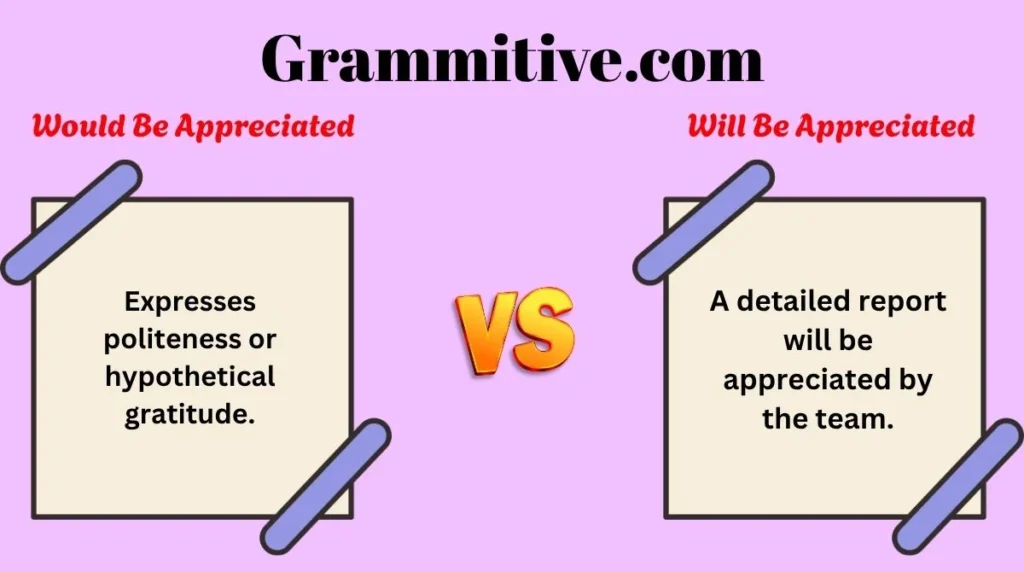
- Expresses politeness or hypothetical gratitude.
- Often used when making requests or suggestions.
- Signals that the action is optional, not mandatory.
When to Use It
- Writing polite emails.
- Requesting something formally.
- Talking about situations where you hope someone will help.
Grammar Rule
- Structure: [Subject] + would be appreciated + [object/verb-ing]
- Often follows phrases like: It would be appreciated if…
Example Sentences
- Your help would be appreciated if you could check the report.
- It would be appreciated if everyone arrived on time.
- Any feedback on my work would be appreciated.
- Your advice would be appreciated in this difficult situation.
- It would be appreciated if you could send the documents today.
- Your assistance would be appreciated during the meeting.
- A prompt reply would be appreciated.
- It would be appreciated if you could keep this confidential.
Common Learner Confusion
- Learners often confuse it with will be appreciated, thinking both are future tense.
- Mistake: Using would in situations where certainty is required.
- Tip: Use would for polite, conditional, or less direct requests.
What Does “Will Be Appreciated” Mean?
“Will be appreciated” is more direct and confident. It expresses certainty that something will be valued or acknowledged in the future.
Simple Definition
- Expresses future gratitude or assurance.
- Shows that an action is expected and will definitely be appreciated.
When to Use It
- Giving clear instructions or expectations.
- Speaking in a confident or formal tone.
- Mentioning guaranteed appreciation.
Grammar Rule
- Structure: [Subject] + will be appreciated + [object/verb-ing]
- Can follow phrases like: Your help will be appreciated when…
Example Sentences
- Your help will be appreciated during the event tomorrow.
- A detailed report will be appreciated by the team.
- Your support will be appreciated in completing this task.
- Feedback on this project will be appreciated.
- A quick response will be appreciated.
- Your cooperation will be appreciated by the management.
- Any assistance will be appreciated in handling the issue.
- Your understanding will be appreciated during this transition.
Common Learner Confusion
- Using will be appreciated when you want to sound polite but not pushy.
- Mistake: Saying “Your help will be appreciated if possible” – sounds slightly rude or demanding.
- Tip: Use will when you are confident that help is expected or guaranteed.
Difference Between Would Be Appreciated and Will Be Appreciated
Understanding the difference is easier when you compare them side by side.
| Feature | Would Be Appreciated | Will Be Appreciated |
|---|---|---|
| Politeness | More polite, softer | Less polite, more direct |
| Certainty | Conditional, not guaranteed | Certain, definite |
| Tone | Polite request, hypothetical | Confident expectation |
| Usage | Formal emails, suggestions, requests | Instructions, announcements, definite requests |
| Structure | It would be appreciated if + [verb] | It will be appreciated when/if + [verb] |
| Example | It would be appreciated if you could help me. | Your help will be appreciated during the event. |
Usage Difference
- Would is ideal when you want to sound polite or make a soft request.
- Will is ideal when you want to express certainty or expectation.
Grammar Logic
- Would = conditional, polite, optional.
- Will = future, definite, expected.
Sentence Structure Difference
- Would: “It would be appreciated if you could send the files.”
- Will: “Your help will be appreciated by the team tomorrow.”
Meaning Comparison
- Would be appreciated → “I hope you can help, it would mean a lot.”
- Will be appreciated → “Your help is expected and valued.”
Grammar Rules You Must Remember
Rule #1: Conditional vs Future
- Would = conditional.
- Will = future.
- Example:
- Correct: It would be appreciated if you joined the meeting.
- Correct: Your presence will be appreciated at the seminar.
Rule #2: Formality
- Would be appreciated is more formal and polite.
- Example: It would be appreciated if you could review the report.
Rule #3: Optional vs Expected Action
- Would = optional action.
- Will = expected or certain action.
- Example:
- Would: Any help would be appreciated.
- Will: Your help will be appreciated when you arrive.
Rule #4: Sentence Structure
- Would → “It would be appreciated if…”
- Will → “Your help will be appreciated when…”
Common Mistakes Students Make
Mistake 1: Using would when will is needed
- Wrong: Your attendance would be appreciated tomorrow.
- Correct: Your attendance will be appreciated tomorrow.
Mistake 2: Using will in polite requests
- Wrong: It will be appreciated if you could help.
- Correct: It would be appreciated if you could help.
Mistake 3: Confusing tone
- Using would in casual speech may sound too formal.
- Tip: Use would in emails, will in spoken instructions.
Easy Correction Tips
- Ask: Is this request polite or definite?
- Polite → would
- Definite → will
Easy Trick to Remember the Difference
Think about certainty.
- Would = wishful, polite, conditional
- “I would be grateful if you help.” → soft and polite.
- Will = certain, definite, future
- “Your help will be valued tomorrow.” → sure and expected.
Memory Trick:
- “Would” → wish
- “Will” → will happen for sure
Daily Life Examples
- It would be appreciated if you could bring some snacks to the party.
- Your advice would be appreciated before I submit my assignment.
- It would be appreciated if everyone could arrive on time for the meeting.
- Your help will be appreciated during the charity event next week.
- A detailed report will be appreciated by the manager.
- Your cooperation will be appreciated in completing this task.
- Any assistance would be appreciated while I handle this project.
- Your quick reply would be appreciated.
- Support from volunteers will be appreciated during the festival.
- It would be appreciated if the documents are sent today.
Practice Section
Choose the correct option in each sentence:
- Your feedback ___ very helpful. (would be appreciated / will be appreciated)
- It ___ if you could review the report. (would be appreciated / will be appreciated)
- Support from you ___ during the event tomorrow. (would be appreciated / will be appreciated)
- It ___ if you arrive on time. (would be appreciated / will be appreciated)
- A prompt reply ___ by the team. (would be appreciated / will be appreciated)
Answers:
- would be appreciated
- would be appreciated
- will be appreciated
- would be appreciated
- will be appreciated
FAQs
Q1: What is the difference between would be appreciated and will be appreciated?
A1: Would be appreciated is polite and conditional. Will be appreciated is definite and expresses certainty about future gratitude.
Q2: Can we use would be appreciated in questions?
A2: Yes, especially in polite requests: “Would it be appreciated if you joined us?”
Q3: Is will be appreciated formal or informal?
A3: It is formal, but more direct than “would be appreciated.” Suitable for instructions and emails.
Q4: Can both be used in emails?
A4: Yes. Use would be appreciated for polite requests, will be appreciated for expected actions.
Q5: Which is better for spoken English?
A5: Will be appreciated is easier in spoken instructions. Would be appreciated is more common in written polite requests.
Q6: Can I replace “would be appreciated” with “please”?
A6: Sometimes, but “would be appreciated” sounds more formal and professional than just “please.”
Final Conclusion
Mastering the difference between would be appreciated and will be appreciated can make your English sound more natural, polite, and professional. Remember:
would is soft, conditional, and polite, while will is certain, direct, and future-focused.
By practicing with real-life examples, using these phrases in emails, conversations, and requests, you will gain confidence and clarity.
Small differences in words can make a big impact, and now you know exactly when and how to use each one.
Keep practicing, and soon it will feel effortless to choose the right phrase in every situation. Politeness and clarity together will make your English stand out.

I am Lucas Bennett, a digital content creator passionate about social media trends and online growth strategies.
I share practical insights and guides to help users better understand and navigate the digital world.