
Many English learners feel confused when they talk about their job.
You probably asked yourself this question before:
Should I say “I work in a company” or “I work at a company”?
Both sound correct. Both are used by native speakers. But they don’t mean exactly the same thing.
This small difference causes big problems. Students mix them up in speaking. They feel nervous during interviews.
They write the wrong one in emails or exams. Even intermediate learners sometimes guess.
The reason is simple. English prepositions like in, at, and on are tiny words, but they carry special meanings. These meanings are not always logical. You cannot translate directly from your language.
Still, there is good news. Once you understand the idea behind in and at, the difference becomes clear and easy. It’s not about memorizing. It’s about understanding space, place, and focus.
After reading this guide, you will clearly know:
- when to say work in a company
- when to say work at a company
- the grammar rules
- common mistakes
- real-life examples
- easy tricks to remember forever
By the end, you won’t hesitate anymore. You’ll just know what sounds right.
What Does “In” Mean?
Simple definition
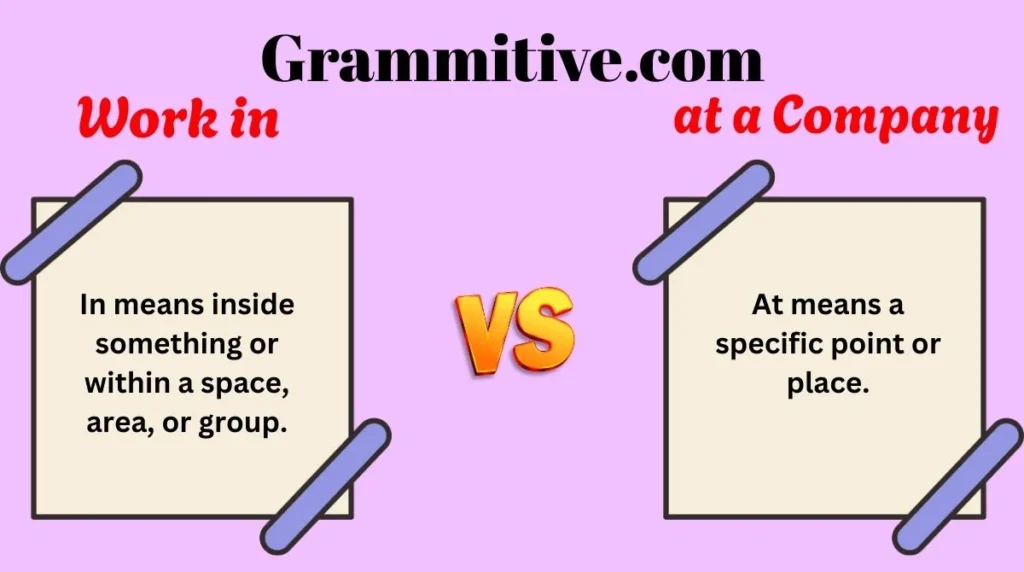
In means inside something or within a space, area, or group.
Think about being surrounded by something.
You are in a room.
You are in a car.
You are in a city.
So when we use in with work, we usually talk about:
- being inside an organization
- being part of a department
- being inside an industry or field
It focuses more on belonging to a system or group, not just the physical building.
When to use “in”
Use in when talking about:
- departments
- teams
- industries
- fields
- large organizations
- internal roles
It shows membership or involvement.
Grammar rule
work + in + department/industry/organization
Structure:
Subject + work(s) + in + noun
Example sentences
- I work in the marketing department.
- She works in finance.
- They work in a big tech company.
- He works in customer service.
- We work in education.
- My sister works in the healthcare industry.
- I worked in a startup for two years.
- Tom works in human resources.
Common learner confusion
Students often think:
“If I’m inside the building, I must say ‘in.’”
But that’s not always correct.
English is not only about physical space. It’s also about focus.
With in, we focus on:
👉 the system
👉 the organization
👉 the group
Not the building itself.
That’s why “I work in Google” can sound strange. We usually say “at Google” because Google is seen as a workplace location, not just an internal system.
What Does “At” Mean?
Simple definition
At means a specific point or place.
It shows location.
Think of it like a pin on a map.
Examples:
- at school
- at home
- at the station
- at the office
So when we say work at, we focus on where the job happens, not the internal system.
When to use “at”
Use at when talking about:
- companies
- offices
- workplaces
- stores
- buildings
- specific locations
It answers the question:
👉 Where do you work?
Grammar rule
work + at + company/place name
Structure:
Subject + work(s) + at + place
Example sentences
- I work at Google.
- She works at a bank.
- They work at the hospital.
- He works at a law firm.
- We work at a small startup.
- My father works at the airport.
- I work at Microsoft.
- She works at the head office.
Common learner confusion
Students sometimes think:
“At means outside.”
No. That’s not true.
It means location, not outside.
Even if you are inside the building, we still say:
✔ I work at the hospital
✔ I work at the office
Because we talk about the place, not being physically inside.
Difference Between In and At (Detailed)
Understanding the difference becomes easier when you compare them side by side.
Quick comparison table
| Feature | In | At |
|---|---|---|
| Meaning focus | inside a system/group | specific place/location |
| Used for | departments, fields, industries | companies, buildings, workplaces |
| Feeling | membership | location |
| Question answered | What area? | Where? |
| Example | in marketing | at Google |
Usage difference
Say:
✔ I work in marketing.
✔ I work at Google.
First sentence → your department
Second sentence → your company/location
Grammar logic
In = container or group
At = point or place
Think like this:
- marketing = group → in
- Google office = place → at
Sentence structure difference
In structure:
Subject + work + in + field/department
At structure:
Subject + work + at + workplace/company
Meaning comparison
Compare:
👉 I work in a bank.
👉 I work at a bank.
Both are correct but slightly different.
In a bank → focus on the banking environment or inside the organization
At a bank → focus on the workplace location
In daily speech, at is more common for companies and workplaces.
Grammar Rules You Must Remember
These four rules will save you from most mistakes.
Rule #1 — Use “at” for company names
✔ I work at Apple.
❌ I work in Apple.
Company names are treated like locations.
Rule #2 — Use “in” for departments or teams
✔ She works in sales.
❌ She works at sales.
Departments are groups, not places.
Rule #3 — Use “in” for industries and fields
✔ He works in IT.
✔ They work in education.
Fields = systems or areas.
Rule #4 — “At” sounds more natural in everyday speech
Native speakers often say:
✔ I work at a hospital
✔ I work at a school
Even though “in” is possible sometimes, “at” is more common and natural.
When unsure, at is usually safer for workplaces.
Common Mistakes Students Make
Why mistakes happen
- direct translation from native language
- not understanding abstract meanings
- memorizing without context
- mixing location and department ideas
Wrong vs correct examples
❌ I work in Google.
✔ I work at Google.
❌ She works at marketing.
✔ She works in marketing.
❌ He works in the office downtown.
✔ He works at the office downtown.
❌ They work at finance.
✔ They work in finance.
Easy correction tips
- Company/building → at
- Department/team → in
- Ask: “Where?” → at
- Ask: “Which area?” → in
Easy Trick to Remember the Difference
Here’s a simple memory trick many students love.
Picture this:
Imagine a map.
📍 A small dot = at
📦 A big box/container = in
So:
- Company = dot on the map → at
- Department = box/group → in
Or think:
At = address
In = inside
If you remember just that, you’ll choose correctly most of the time.
Daily Life Examples (Very Important)
These are real sentences you will hear in daily English.
- I work at a supermarket near my house.
- She works in accounting.
- My brother works at Amazon.
- They work in customer support.
- I work at the main office.
- He works in research and development.
- Do you work at a bank or at a private company?
- She works in the legal team.
- I used to work at a restaurant.
- We work in the same department.
Notice how natural they sound. Native speakers use these forms without thinking.
Practice Section
Choose the correct option: in or at
- I work ___ Microsoft.
- She works ___ HR.
- They work ___ a hospital.
- He works ___ marketing.
- We work ___ a software company.
Answers
- at
- in
- at
- in
- at
FAQs
1. What is the difference between work in and work at?
Work in talks about departments, industries, or fields. Work at talks about a workplace or company location. One shows membership, the other shows place.
2. Can we use “work in a company”?
Yes, but it usually means you are part of the organization or inside the system. In normal speech, many people prefer “work at a company.”
3. Is “work at” more common?
Yes. Native speakers often use work at for companies, offices, schools, and stores. It sounds more natural in daily conversation.
4. Can we use these in questions?
Yes.
Where do you work? → I work at a bank.
Which department? → I work in sales.
Both forms are very common in questions.
5. Is one form more formal?
No. Both are neutral and correct. The choice depends on meaning, not formality.
6. Can both be correct sometimes?
Yes. “I work in a hospital” and “I work at a hospital” are both possible. The first focuses on being inside the system. The second focuses on the workplace location.
Final Conclusion
Small words like in and at can feel scary at first. They don’t follow strict logic, and every learner gets confused. But once you understand the idea behind them, everything becomes simpler.
Remember the core difference:
In = inside a group or system
At = a specific place or workplace
Think about what you want to focus on. The department or the location? That one question helps you choose quickly.
Practice with real sentences. Listen to how native speakers talk about their jobs. Repeat examples out loud. After some time, the correct form will feel natural.
Don’t worry about being perfect. Even advanced learners make small preposition mistakes. What matters is clear communication.
Keep practicing, and soon you’ll say these sentences without thinking at all.

I am Lucas Bennett, a digital content creator passionate about social media trends and online growth strategies.
I share practical insights and guides to help users better understand and navigate the digital world.