
Many English learners feel confused when they talk about jobs and careers. You finish school, apply for a job, and someone asks, “Do you have work experience?”
But then you hear another person say “working experience.” Now you stop and think… which one is correct?
Both phrases sound similar. Both talk about jobs. Both use the word experience. So it’s easy to believe they mean the same thing.
But here’s the problem: one phrase is natural and correct in most situations, and the other sounds strange or unnatural in everyday English.
This small difference can change how professional you sound. It matters in job interviews, resumes, emails, and even casual conversations. Using the wrong phrase can make your English sound translated or non-native.
The good news? The rule is not difficult. Once you understand the grammar and logic behind these words, everything becomes clear.
By the end of this guide, you will clearly understand:
- Which phrase native speakers really use
- When to use each one
- Why one is common and the other is rare
- Simple grammar rules
- Easy memory tricks
- Real-life examples you can copy
Think of this like a friendly classroom talk, not a boring grammar lesson. Step by step, everything will make sense.
What Does “Work Experience” Mean?
Simple definition
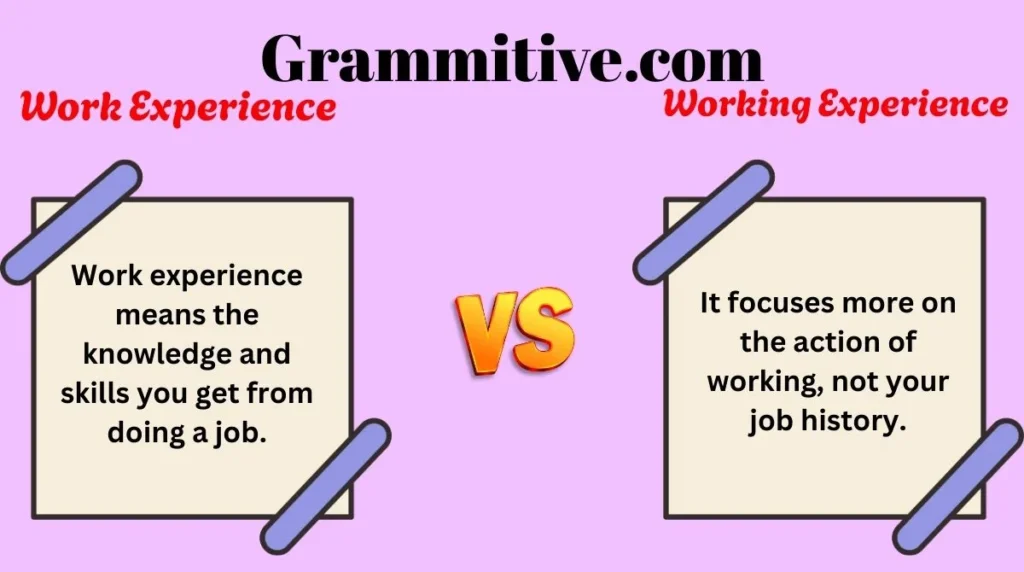
Work experience means the knowledge and skills you get from doing a job.
It talks about your past jobs, internships, or professional activities.
It is the standard and natural phrase in English.
Native speakers use this expression all the time.
When to use it
Use work experience when you talk about:
- jobs you had before
- professional skills
- internships
- your resume
- job applications
- interviews
It is common in both formal and informal English.
Grammar rule
Here’s the key idea:
Work (noun) + experience (noun) = compound noun
“Work” acts like an adjective describing the type of experience.
It means:
👉 experience related to work
This pattern is very common in English:
- life experience
- teaching experience
- travel experience
- job experience
So “work experience” follows a normal English structure.
Example sentences
- I have three years of work experience in sales.
- Do you have any work experience?
- She gained work experience during college.
- This internship gives students work experience.
- My work experience helped me get this job.
- He listed his work experience on his CV.
- They want someone with international work experience.
- I don’t have much work experience yet.
Notice how natural these sentences sound.
Common learner confusion
Many students think:
“Work” is a verb, so maybe it’s wrong here.
But in this phrase, work is a noun, not a verb.
It simply means “job” or “employment.”
So don’t overthink it. It’s completely correct.
What Does “Working Experience” Mean?
Simple definition
Working experience means the experience you have while you are working or the process of working.
It focuses more on the action of working, not your job history.
When to use it
Honestly, in daily English, native speakers rarely use this phrase.
It sometimes appears in:
- academic writing
- technical reports
- engineering or machine descriptions
- formal research papers
But in normal conversation or job talk, it sounds unnatural.
Grammar rule
“Working” is a present participle (-ing form).
So:
working (verb form) + experience
This structure usually describes an activity happening, not a record of past jobs.
That’s why it feels strange when talking about resumes.
Compare:
- work experience (type of experience)
- working experience (experience while working)
The second one is less clear.
Example sentences
Here are some cases where it can work:
- The working experience in this factory is challenging.
- Her working experience during night shifts was difficult.
- The working experience of nurses during COVID was stressful.
- We studied the working experience of remote employees.
- Their working experience improved after new rules.
- The survey focused on workers’ daily working experience.
- He described his working experience at the site.
- The report analyzed the working experience of staff.
Notice something?
These sound more like research or reports, not normal speech.
Common learner confusion
Students often say:
❌ I have two years of working experience.
It sounds logical but unnatural.
Native speakers almost always say:
✅ I have two years of work experience.
So even though “working experience” is not 100% wrong, it’s not the normal choice.
Difference Between Work Experience and Working Experience (Detailed)
Here’s a clear comparison:
| Feature | Work Experience | Working Experience |
|---|---|---|
| Common in daily English | Yes | Rare |
| Used on resumes | Yes | No |
| Natural for interviews | Yes | No |
| Grammar type | Noun + noun | Verb (-ing) + noun |
| Focus | Job history | Experience while working |
| Sounds native | Yes | Often no |
| Formal research use | Sometimes | More common |
Usage difference
Work experience = your career history
Working experience = what it feels like to work
Big difference in meaning.
Grammar logic
English often uses noun + noun to describe types:
- school bus
- coffee cup
- work experience
But -ing forms usually describe actions:
- running water
- working hours
- sleeping baby
So “working experience” feels like something happening now.
Sentence structure difference
Correct:
- I have five years of work experience.
Strange:
- I have five years of working experience.
Better version:
- I have five years of experience working in marketing.
That sentence works because “working” becomes part of a verb phrase.
Meaning comparison
- Work experience → your past jobs
- Working experience → how the work feels
One talks about history. The other talks about feelings or conditions.
Grammar Rules You Must Remember
Rule #1: Use “work experience” for jobs and resumes
Example:
I added my work experience to my CV.
Rule #2: Avoid “working experience” in interviews
Wrong: I have good working experience.
Correct: I have good work experience.
Rule #3: Use “experience + working” if needed
Correct structure:
I have experience working with children.
Not: working experience with children.
Rule #4: Noun + noun compounds are very common in English
Examples:
life experience
job experience
work experience
Follow this pattern for natural English.
Common Mistakes Students Make
Why mistakes happen
Many languages translate directly into English.
So learners think:
working = related to work → must be correct
But English doesn’t always follow logic like that.
Wrong vs correct examples
❌ I have working experience in a bank.
✅ I have work experience in a bank.
❌ She has three years of working experience.
✅ She has three years of work experience.
❌ My working experience helped me grow.
✅ My work experience helped me grow.
Easy correction tips
Whenever you talk about:
- job history
- career
- resume
Just use work experience automatically.
Don’t think too much.
Easy Trick to Remember the Difference
Here’s a simple memory trick my students love.
Think:
👉 Work experience = CV / Resume
If you can imagine writing it on your resume, use “work experience.”
Now try:
Would you write “Working Experience” as a section title on your CV?
No. It sounds strange.
But:
Work Experience ✔
Very natural.
So remember:
Resume → work experience
Daily Life Examples (Very Important)
These are how real people speak:
- Do you have any work experience?
- I got some work experience during summer break.
- This job needs at least two years of work experience.
- My work experience helped me become confident.
- She doesn’t have much work experience yet.
- The company values international work experience.
- I’m looking for a job to gain work experience.
- Your work experience looks impressive.
- How much work experience do they require?
- He changed careers after ten years of work experience.
Notice: no native speaker says “working experience” here.
Practice Section
Choose the correct option.
1
I have two years of ______.
a) working experience
b) work experience
2
This internship gives students ______.
a) work experience
b) working experience
3
She has experience ______ with children.
a) work
b) working
4
Add your ______ to the resume.
a) working experience
b) work experience
5
The report studied nurses’ daily ______.
a) working experience
b) work experience
Answers
1 → b
2 → a
3 → b
4 → b
5 → a (research context)
FAQs
What is the difference between work experience and working experience?
Work experience means your job history and skills from past jobs. Working experience focuses on the act or feeling of working. The first is common. The second is rare in daily speech.
Which phrase is correct for a resume?
Always use work experience. It’s the standard and professional term used worldwide.
Can we use working experience in questions?
You can, but it sounds unnatural. Native speakers usually say work experience instead.
Is working experience wrong?
Not completely wrong. It’s just uncommon. It appears mostly in research or formal writing, not everyday English.
How do native speakers say it in interviews?
They say things like:
“I have five years of work experience in IT.”
Can I say “experience working” instead?
Yes, and it’s very natural.
Example: I have experience working with children.
Final Conclusion
Small grammar differences can create big confusion, especially when two phrases look almost the same. That’s exactly what happens with work experience and working experience.
The good news is simple: when talking about jobs, careers, resumes, or interviews, choose work experience every time. It sounds natural, professional, and native-like.
Save “working experience” for special cases like research or reports, but you probably won’t need it often.
Language becomes easier when you notice patterns. English loves noun + noun combinations, and this phrase follows that rule perfectly.
Try using it in your daily sentences. Talk about your own work experience. Write sample interview answers. Practice out loud.
The more you use it, the more natural it feels.
Clear, simple English always wins.

I am Lucas Bennett, a digital content creator passionate about social media trends and online growth strategies.
I share practical insights and guides to help users better understand and navigate the digital world.