
English verbs can be tricky. Some follow easy rules like play → played or work → worked. But others change in strange ways. These are called irregular verbs, and they often confuse learners.
The verb wake is one of them.
Many students ask:
- Should I say I woke up?
- Or I waked up?
- Or I have woken up?
- Why do people say different forms?
If you’ve ever paused while speaking because you weren’t sure which one sounds right, you’re not alone. Even intermediate learners mix these up.
Sometimes you hear one form in movies, another in books, and something different in grammar lessons. That makes it even more confusing.
But the good news is simple: once you understand how past tense and past participle work, everything becomes clear.
By the end of this guide, you will:
- know which form is correct in daily English
- understand when to use each one
- stop making common mistakes
- feel more confident when speaking
Think of this like a friendly classroom lesson. Step by step, everything will make sense.
What Does “Woke Up” Mean?
Simple definition
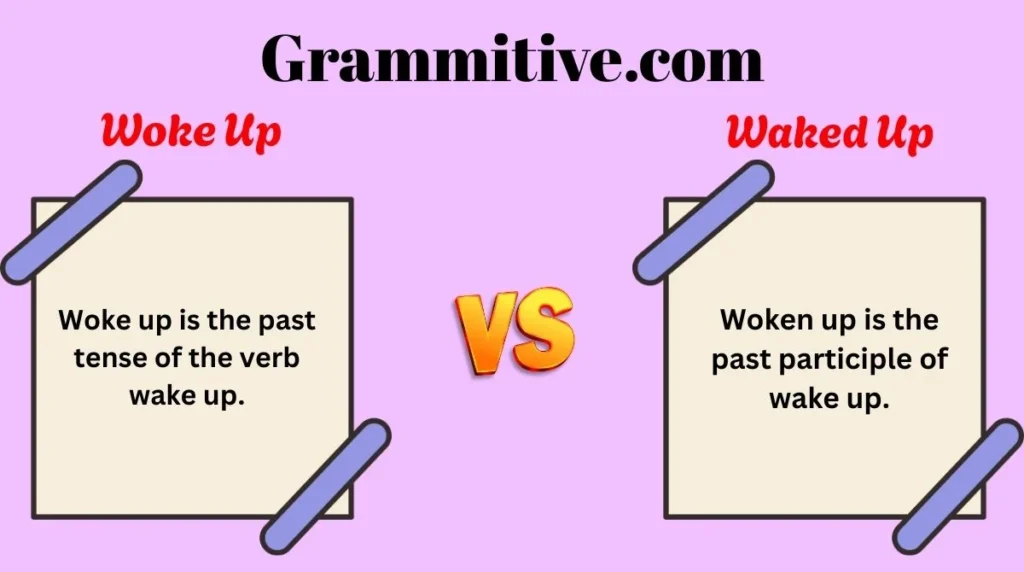
Woke up is the past tense of the verb wake up.
It means:
👉 you stopped sleeping in the past.
When to use it
Use woke up when you talk about:
- yesterday
- last night
- this morning
- any finished time in the past
Grammar rule
wake → woke → woken
So:
- Present: wake up
- Past: woke up
- Past participle: woken up
“Woke” is the simple past form.
Examples
- I woke up at 6 a.m.
- She woke up late today.
- We woke up when the alarm rang.
- He woke up feeling sick.
- They woke up early for the trip.
- My baby woke up twice at night.
- I suddenly woke up from a bad dream.
- She woke up and checked her phone.
Common learner confusion
Many students say:
❌ I waked up at 7.
❌ I have woke up.
Both are wrong.
Remember: woke = past only. Nothing else.
If the sentence is about yesterday or a finished time, “woke up” is perfect.
What Does “Woken Up” Mean?
Simple definition
Woken up is the past participle of wake up.
It means the same action (stop sleeping), but it is used with helping verbs.
When to use it
Use woken up with:
- have / has / had
- be verbs in passive voice
Grammar rule
Past participles usually work with auxiliary verbs.
Examples:
- have woken up
- has woken up
- had woken up
- was woken up
Examples
- I have woken up early every day this week.
- She has woken up already.
- They had woken up before sunrise.
- He has woken up feeling better.
- I have just woken up.
- The baby was woken up by the noise.
- We had woken up when the phone rang.
- She has never woken up this late before.
Common learner confusion
Students often say:
❌ I have woke up
❌ I am woken up at 7 every day
These are incorrect.
Remember:
- “have” needs woken, not woke
- participles need helping verbs
What Does “Waked Up” Mean?
This one causes the most confusion.
Simple truth
Waked up is grammatically possible but very rare.
Modern English almost never uses it.
Why?
Long ago, “wake” had two patterns:
- irregular → wake, woke, woken
- regular → wake, waked, waked
Over time, native speakers stopped using waked in daily speech. Now we mostly use woke and woken.
Today, waked appears only in:
- poetry
- old books
- very formal or technical writing
Examples (rare/old style)
- The noise waked him up.
- She was waked by the storm.
These sound old-fashioned.
In modern English, we say:
✔ The noise woke him up.
✔ She was woken by the storm.
Common learner confusion
If you use waked, people will understand you, but it sounds strange or unnatural.
So it’s better to avoid it.
Difference Between Woke Up and Woken Up (Detailed)
This is where many learners get stuck. The meanings are similar, but the grammar is different.
Quick comparison table
| Form | Type | Used With | Example |
|---|---|---|---|
| woke up | past tense | no helper | I woke up late |
| woken up | past participle | have/has/had/be | I have woken up |
| waked up | old/rare | rarely used | old English only |
Usage difference
Woke up
→ simple past
→ finished action
Woken up
→ perfect tenses or passive
→ focus on result or connection to now
Grammar logic
If there is NO helping verb, use woke.
If there IS a helping verb, use woken.
Sentence structure difference
Simple past:
👉 Subject + woke + up
- I woke up early.
Perfect tense:
👉 Subject + have/has/had + woken + up
- I have woken up early.
Passive:
👉 be + woken
- He was woken up.
Meaning comparison
Compare:
- I woke up at 6.
(finished action yesterday) - I have woken up at 6 every day this week.
(experience connected to now)
Small difference, but grammar changes.
Grammar Rules You Must Remember
Rule #1 — Simple past uses “woke”
I woke up late yesterday.
Rule #2 — Perfect tenses use “woken”
I have woken up three times tonight.
Rule #3 — Passive voice uses “woken”
She was woken up by the dog.
Rule #4 — Avoid “waked” in modern English
Use woke/woken instead.
Common Mistakes Students Make
Why mistakes happen
Because:
- irregular verbs don’t follow patterns
- learners translate from their language
- “waked” looks logical (like played/worked)
English doesn’t always follow logic. You must memorize some verbs.
Wrong vs Correct
❌ I waked up early
✔ I woke up early
❌ I have woke up
✔ I have woken up
❌ She has woke up already
✔ She has woken up already
❌ He was woke up
✔ He was woken up
Easy correction tips
When unsure, ask:
👉 “Do I see have/has/had/be?”
Yes → woken
No → woke
Easy Trick to Remember the Difference
Here’s a simple memory trick students love.
Think:
Woke walks alone.
Woken needs a friend.
“Friend” means helping verb.
Examples:
- woke (alone)
- have woken (with friend “have”)
If you see a helper, add -en.
Just like:
- break → broken
- choose → chosen
- wake → woken
Same pattern!
Daily Life Examples (Very Important)
These are natural, spoken English sentences you will hear every day.
- I woke up late and missed the bus.
- Did you wake up early today?
- I just woke up. Give me five minutes.
- She has woken up already.
- He woke up hungry.
- We had woken up before the alarm.
- The noise woke me up.
- The baby was woken up by thunder.
- I woke up at 3 a.m. and couldn’t sleep.
- Have you woken up your brother yet?
These are exactly how native speakers talk.
Practice Section
Choose the correct form.
- I _____ up at 7 yesterday.
- She has _____ up already.
- They were _____ up by the bell.
- We _____ up late last Sunday.
- He had _____ up before sunrise.
Answers
- woke
- woken
- woken
- woke
- woken
FAQs
1. What is the difference between woke up and woken up?
“Woke up” is simple past. “Woken up” is past participle used with helping verbs like have/has/had. The action is similar, but grammar changes.
2. Can we use waked up in modern English?
It’s technically correct but very old-fashioned. Native speakers almost never use it. Stick to woke and woken.
3. Can I say “I have woke up”?
No. After “have,” you must use the past participle. Say “I have woken up.”
4. Is woke up formal or informal?
It’s neutral. You can use it in daily speech, writing, and even formal English.
5. How do I know when to use woken?
Check for helping verbs. If you see have/has/had/be, choose woken.
6. Is wake up regular or irregular?
It’s irregular because the forms change: wake → woke → woken. It doesn’t follow the -ed rule.
Final Conclusion
The verb wake up doesn’t need to feel scary anymore. It simply follows the irregular pattern: wake, woke, woken. That’s the key.
Use woke up for finished actions in the past.
Use woken up with helping verbs.
Avoid waked up in normal conversation.
Once you practice a few times, it becomes natural. Listen to movies, read stories, and try making your own sentences every day. Small practice makes a big difference.
Soon, you won’t stop to think. You’ll just say it correctly without effort.
That’s when you know real learning has happened.

I am Lucas Bennett, a digital content creator passionate about social media trends and online growth strategies.
I share practical insights and guides to help users better understand and navigate the digital world.