

English learners often feel confused when they hear native speakers say sentences like, “I know where they are,” and others say, “I know where they are at.”
Both sound similar. Both are common in daily conversation. But many teachers say one is correct and the other is wrong. That can feel frustrating.
You might think:
Why add at if we already said are? Isn’t it extra? Or maybe both are fine?
This small difference causes big problems for learners. Students worry about sounding uneducated. They hesitate while speaking. Some avoid the phrase completely.
The truth is simpler than it looks. One form is grammatically standard. The other is informal and used mostly in spoken English.
Understanding this difference helps you speak naturally and write correctly.
After reading, you will clearly know:
- which form is grammatically correct
- which one is informal slang
- when to use each
- when to avoid each
- how native speakers actually talk
- and how to sound confident in both speech and writing
By the end, you won’t guess anymore. You’ll choose the right form automatically.
What Does “Where They Are” Mean?
Simple definition
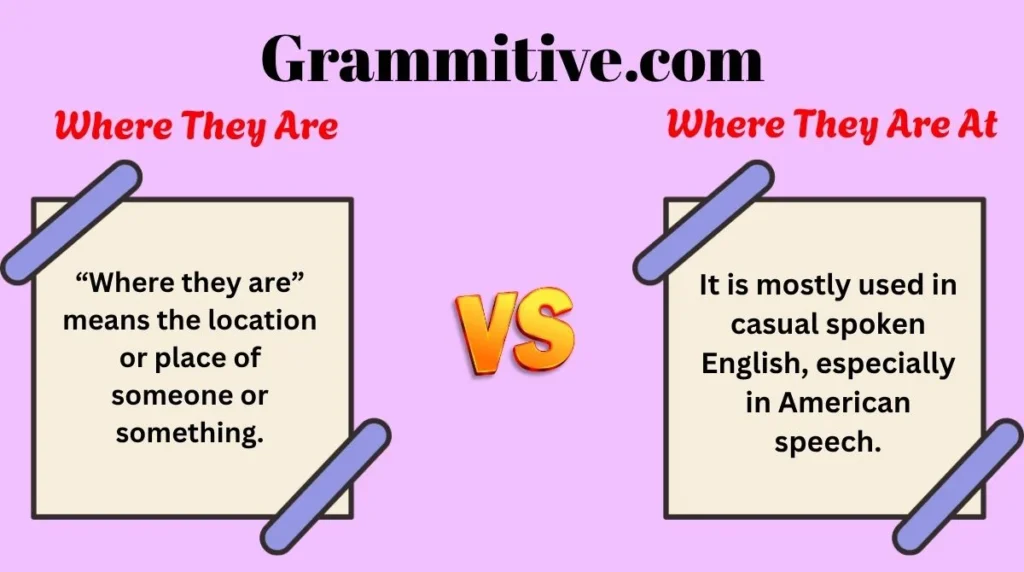
“Where they are” means the location or place of someone or something.
It asks or tells position.
Very simple idea:
👉 their place
When to use it
Use where they are when:
- asking about location
- describing position
- writing formally
- speaking clearly and correctly
- taking exams
- writing emails, reports, or essays
This is the standard grammar form.
Grammar rule
Structure:
where + subject + be verb
Example pattern:
- where + they + are
It already shows location.
No extra preposition is needed.
Adding at is not required in standard English.
Example sentences (6–8)
- I know where they are.
- Can you tell me where they are now?
- We checked where they are staying.
- Nobody knows where they are hiding.
- Please find out where they are.
- The teacher asked where they are sitting.
- She remembered where they are parked.
- Do you see where they are standing?
Notice something?
Every sentence sounds clean and complete. Nothing feels missing.
Common learner confusion
Many students think:
“If we say at school or at home, maybe we must add at here too.”
But this is different.
Because:
- “at school” = preposition + noun
- “where they are” = full clause already showing place
So no preposition needed.
The sentence is already complete.
What Does “Where They Are At” Mean?
Simple definition
“Where they are at” also means their location.
But it is informal and not grammatically standard.
It is mostly used in casual spoken English, especially in American speech.
When to use it
You may hear this in:
- friendly conversations
- street talk
- movies
- songs
- texting
- social media
But avoid it in:
- exams
- formal writing
- school essays
- business emails
- professional speech
Grammar rule
Structure:
where + they + are + at
The problem:
“At” repeats the same idea of location.
It becomes redundant (extra and unnecessary).
In traditional grammar, this is considered incorrect or nonstandard.
Example sentences (6–8)
Here are sentences you may hear:
- Do you know where they are at?
- I can’t see where they are at.
- Tell me where they are at right now.
- We found where they are at.
- Where are they at?
- Nobody knows where they are at these days.
- Check where they’re at.
- I’m not sure where they are at exactly.
These are common in speech, but not ideal for formal English.
Why do native speakers use it?
Good question.
There are three main reasons:
- Habit
- Emphasis
- Rhythm in speech
Sometimes people add at for extra stress:
“Where are they at??”
It feels stronger emotionally.
But grammatically, it’s still unnecessary.
Common learner confusion
Students think:
“If natives use it, it must be correct.”
Not always.
Native speakers often break grammar rules in casual talk.
Spoken English is more relaxed than written English.
So:
Common ≠ correct in formal grammar.
Difference Between “Where They Are” and “Where They Are At” (Detailed)
Quick comparison table
| Feature | Where they are | Where they are at |
|---|---|---|
| Grammar correctness | Standard | Nonstandard |
| Formal writing | Yes | No |
| Exams | Yes | No |
| Casual speech | Yes | Yes |
| Sounds professional | Yes | No |
| Extra word | No | Yes (at) |
| Recommended? | Always | Only informal |
Usage difference
Where they are
- neutral
- correct everywhere
- safe choice
Where they are at
- casual
- slang-like
- can sound careless in writing
Grammar logic
“Where” already shows location.
So:
- where = place
- are = be verb
Adding at repeats location again.
It’s like saying:
❌ Where they are at place
That repetition is unnecessary.
Sentence structure difference
Standard:
- I know where they are.
Informal:
- I know where they are at.
The second simply adds extra word without new meaning.
Meaning comparison
Meaning is basically the same.
But tone changes:
- without “at” → clear, educated, professional
- with “at” → relaxed, casual, street-style
Grammar Rules You Must Remember
Rule #1 – “Where” already shows location
Correct:
✔ Tell me where they are.
Wrong:
❌ Tell me where they are at.
Rule #2 – Avoid extra prepositions
Don’t double location words.
Wrong:
❌ Where is he at?
Correct:
✔ Where is he?
Rule #3 – Formal writing needs standard grammar
In essays or work emails:
✔ Please confirm where they are.
Never use slang forms.
Rule #4 – Spoken English is flexible, but choose wisely
Talking with friends:
✔ Where are they at?
Acceptable.
But still better:
✔ Where are they?
Cleaner and smarter.
Common Mistakes Students Make
Why mistakes happen
- copying movies
- listening to friends
- thinking “more words = better grammar”
- translating from other languages
Wrong vs correct examples
❌ Do you know where they are at now?
✔ Do you know where they are now?
❌ I found where my keys are at.
✔ I found where my keys are.
❌ Tell me where he is at.
✔ Tell me where he is.
Easy correction tip
After “where + be verb,” stop.
Don’t add anything else.
Simple rule:
👉 Where + are/is = finish
Easy Trick to Remember the Difference
Think like this:
“Where” already means place.
“At” also means place.
So saying both is like saying:
“Where place they are at place”
Too many places!
Your brain only needs one.
Memory trick:
👉 One place word is enough
If you say where, don’t say at.
Easy.

Daily Life Examples (Very Important)
These sound natural in everyday conversation.
- Do you know where they are?
- I wonder where they are right now.
- Let’s check where they are sitting.
- Nobody told me where they are going.
- Ask them where they are.
- I can’t remember where they are parked.
- Can you show me where they are standing?
- We finally found where they are hiding.
- Tell me where they are meeting.
- I forgot where they are staying tonight.
Now casual speech versions you may hear:
- Where are they at?
- I don’t know where they’re at.
These are okay with friends, not in class or work.
Practice Section
Choose the correct option.
- Do you know where they are / where they are at?
- Please tell me where the kids are / are at.
- I can’t see where they are / are at in the photo.
- Where are they / are they at now?
- The teacher asked where they are / are at sitting.
Answers
- where they are
- are
- are
- Where are they
- are
FAQs
What is the difference between where they are and where they are at?
The first is standard grammar and correct everywhere. The second is informal and mainly used in casual speech. Meaning is similar, but tone changes.
Can we use “where they are at” in questions?
Yes, but only in relaxed conversation. For school or professional English, avoid it and use “where they are” or “where are they.”
Is “where they are at” grammatically wrong?
In formal grammar, yes. It is considered nonstandard or redundant because “at” is unnecessary.
Why do Americans often say “where are you at”?
It’s part of everyday speech and habit. Many native speakers use extra prepositions for rhythm or emphasis. It’s normal in conversation but not formal English.
Which form should students use in exams?
Always use “where they are.” Teachers and examiners expect standard grammar.
Does adding “at” change the meaning?
Not really. It only changes the tone. The meaning stays about location, but it sounds more casual.
Final Conclusion
Small grammar differences sometimes create big confusion. This is one of those cases. Both phrases talk about location, but only one follows standard grammar rules.
“Where they are” is clean, correct, and safe everywhere. It works in school, exams, emails, and professional life. You never have to worry when you use it.
“Where they are at” belongs to casual speech. You’ll hear it in movies and daily talk, but it isn’t the best choice for careful English.
The simplest habit is easy: use the shorter version. If you remember that “where” already shows place, you won’t add extra words.
Practice a few sentences each day. Say them out loud. Soon it will feel natural, and you’ll speak with confidence without stopping to think.
Clear grammar makes communication smooth. Keep it simple, and English becomes much easier.

I am Lucas Bennett, a digital content creator passionate about social media trends and online growth strategies.
I share practical insights and guides to help users better understand and navigate the digital world.